[Some computers might ask you to allow the music to play on this page]
Frank Griffith |
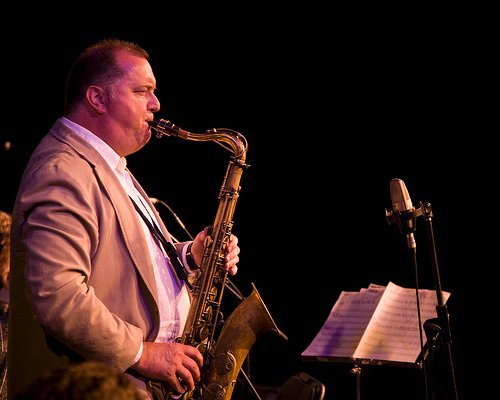
Saxophonist, clarinettist, composer and arranger Frank Griffith was born in Eugene, Oregon in 1959, that year when so many things happened in jazz. Years before, his great grandfather had been a farmer in Wales, and like many others, had emigrated to farm in the New World, heading for the hills of Montana. In time, he moved to Oregon where the Griffith family established themselves, his son leaving farming to become a Psychology Professor at Reed College in Portland, Oregon in days when Psychology was a new profession. His son, Frank’s father, married an American girl who was a music major, a gifted pianist and vocalist and it was she who really brought music to the family.
Frank and his sisters inevitably learned piano. ‘I was about five when I started,’ Frank remembers, ‘but I wanted to be different to my sisters, and when I found an old clarinet at home, I started to play that. I couldn’t get much out of it at the beginning, but we had music teachers and I steadily improved. We didn’t do ‘Grades’ in America at that time, and I was mainly having tuition in classical music, but by the time I left school, a few things had happened. I had listened to jazz in my parents’ record collection, Ellington, Armstrong, and I had friends at High School who were into jazz, as well as having very good music teachers in Eugene.’
In 1980, at twenty one, Frank left home and headed for New York City and started at the Manhattan School of Music. By the time he graduated in 1984, he had been exposed to some significant experiences in jazz playing with Ron Carter, Jon Hendricks and Jack McDuff. With a BFA (Bachelor of Fine Arts) to his name from City College he was asked to join The Glenn Miller Orchestra on alto sax for a nationwide tour in 1984. ‘It was an amazing experience and I met some great people,’ says Frank, ‘But a long time travelling is not so good.’
Back in New York, Frank spent the next ten years teaching on a peripatetic basis and getting his compositions and arrangements played by bands such as the Lionel Hampton Orchestra, the Jon Hendricks Explosion and the Brooklyn Philarmonic Orchestra. He played with the orchestras of Toshiko Akiyoshi, Buddy Rich, Mel Lewis and Mel Tormé. ‘One of Mel’s saxophonists, Andy Fusco, fell ill,’ Frank recalls, ‘and I received this call asking if I would dep. The thing about Mel Tormé was 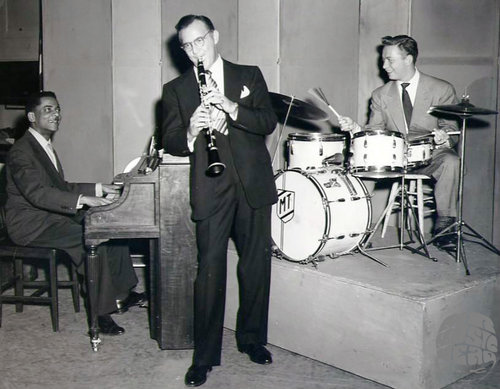 that he was not just a vocalist but a talented arranger and composer and a good drummer and vibes player. This made him aware of the whole thing and enabled him to sing with, be part of, the band, rather than just a singer.... that on top of his great voice.’ We did a gig at Harrow Arts Centre not long ago recalling the partnership of Mel Tormé and Marty Paich.
Mel Tormé on drums with Benny Goodman and Teddy Wilson
During the 1990s, Frank had the good fortune of working with Dick Haymes Jr and David Allyn in New York. City and New Jersey. Looking back, Frank says: ‘There was also a recording featuring a crack band of NYC stalwarts comprising John DiMartino, piano, Bill Moring, bass, Andy Watson, drums and myself, well,..three out of four aint bad. The songs included were Stella By Starlight, You Stepped out of a Dream, Young and Foolish and, of course, The More I See You. I also penned a big band arrangement of The More I See You for Dick to sing as part of the a ‘Tribute to Glenn Miller’ nationwide tour that he did in 1994 or so that also featured Paula Kelly Jr. and Beryl Davis.
‘I also had the great opportunity to arrange for and play with the legendary 1940s crooner, David Allyn.' (Click here to listen to David Allyn singing Sonny with tribute photographs).
'David stayed friends with Johnny Mandel throughout the years as Johnny would come by our regular big band gigs at NYC’s Red Blazer on West 46 Street when he was in town, which was often. During the few times that I met him, Johnny was a most 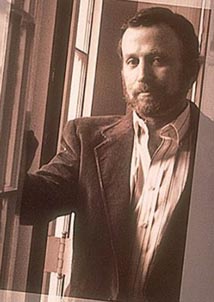 congenial and approachable chap especially when I would grill him with questions about arranging and composition. I once had the cheek of asking David if the band could play my arrangement of Johnny’s classic A Time For Love in the presence of the composer which he generously agreed to. Johnny came up to me afterwards and was very complimentary about the chart - a moment I will treasure forever. I strongly feel that my time with Dick Jr, David and Johnny has played a significant part in developing my confidence to flourish in the music business. Long may that triumvirate of artists thrive.’
Johnny Mandel
By 1996, Frank had married an English girl and they had a son. Frank was looking for a new challenge and he and his wife thought that their son would be better growing up in England where they would also have the support of his wife’s family, so they moved to London.
It was not long before Frank began to find his place in the UK music scene. He met up with Peter Cater whose Big Band included Frank in their recordings Playing with Fire (1997) and Upswing (2000) – ‘Peter was really helpful in getting me started here,’ says Frank, - and Frank’s jazz arrangements were being used by people like Mark Nightingale, Tony Coe, Norma Winstone and Joe Temperley.
Frank’s liaison with baritone saxophonist Joe Temperley resulted in Frank’s clarinet and string arrangements being featured on Joe’s 2001 album Easy To Remember (Hepjazz). Click here to sample.
Frank recorded his debut album The Suspect on the Hepjazz label in 1999. The album featured Tom Harrell. It was also the beginning of a longstanding relationship between Frank and retired art teacher Alastair Robertson of Hepjazz recordings. Click here to sample.
Frank first put together his Nonet in 1999. Their appearance at the Ealing Jazz Festival in 2000 was recorded and released by Hepjazz, under the predictable title The Frank Griffith Nonet ‘Live’ at Ealing Jazz Festival 2000 (click here to sample) and the band has played at the Festival every year since then.
There have been some changes in the Nonet personnel over the years, but many of the musicians remain in place: Henry Lowther, Robbie Robson (trumpet), Adrian Fry (trombone), Frank and Mick Foster (reeds), Tim Lapthorn (piano), Mark Hodgson (bass), Paul Clarvis (drums), saxophonist Bob Sydor (a veteran Brit jazzer who played with Maynard Ferguson, among others) and drummer Matt Home.
The Nonet’s Live Ealing album was followed up in 2004 by The Coventry Suite album, released this time on the 33 Records label. Click here to sample (ignore the misspelling as ‘Country Suite’ on the Amazon site).
2009 saw the Nonet playing at the Pizza Express Jazz Club in London’s Dean Street, this time featuring singer Georgia Mancio. Trudy Kerr had sung with the band, but Georgia took over the vocalist role when Trudy moved on.
Here is a video of them playing at the Pizza Express Jazz Club in London in 2009 with Georgia.
Since then, both Georgia and Tina May have sung regularly with the band, Tina being featured on Frank’s 2011 Big Band album ‘Holland Park Non-Stop’ which also featured top-flight musicians  including trumpeters Steve Fishwick and Freddie Gavita, trombonist Adrian Fry, saxophonist Karen Sharp and pianist John Turville.
In July 2009, the Nonet also played at the Stables, the Dankworth’s venue in Wavendon, Buckinghamshire with John Dankworth as guest artist, and Frank the American was presented with an award by John and Cleo Laine – a BAJA – ‘British Adoptee Jazz Alumni’! ‘I was first introduced to John Dankworth by pianist Eddie Harvey who sadly died in 2010,’ Frank recalls. ‘I would go along to gigs by his band and we would chat and then I started to play with the band. John was a gentleman. A quiet man, focussed and controlled. His partnership with Cleo was great – he wrote many if not most of her arrangements for her. In fact, when he died he probably passed away with a manuscript in his hand. Although in the end he found difficulty playing, he was determined to go on writing.’
‘I interviewed John in 2005 about his 1960s film scores that included Saturday Night, Sunday Morning; The Servant, The Criminal and Darling. The interview was published in the Journal of  British Film and Television in December 2006.’ (You can read the interview by clicking here).
Frank plays on the 2009 John Dankworth Big Band album Jazz Matters (QNote) featuring Cleo Laine, and he played with John, Cleo and the London Symphony Orchestra at the Barbican and Royal Festival Hall. ‘I was also involved in the last recording John made before he died’, says Frank. ‘The recording has never been released, and it would be good if someone could put it out.’
In 2010, Frank and pianist / composer Alex Webb co-curated a project for the London Jazz Festival, Songs Of Strayhorn, which was staged at the Queen Elizabeth Hall and featured singers Alexander Stewart and China Moses with the Nonet. This was followed in November 2012 by Alex Webb’s Jazz At Café Society which played at the Purcell Room as part of the London Jazz Festival. The show which celebrated a historic New York City jazz club featured singers China Moses, Gwyneth Herbert and Alexander Stewart and musicians including Frank, Nathaniel Facey, Sue Richardson and Gary Crosby. Frank wrote several of the arrangements including the arrangement of Where Or When featured in this video with Gwyneth Herbert singing the number:
Frank was a busy man. In addition to his teaching commitments at various summer schools, he composes for the Associated Boards Jazz Works ensemble series, serves on the Music Education Panel at Jazz Services UK, fronts the Nonet and regularly plays with other bands – click here for a video of him with singer Sarah Ellen Hughes band playing Someone in September, 2012 and the Hot Waffle Big Band earlier that year playing What Is Hip?:
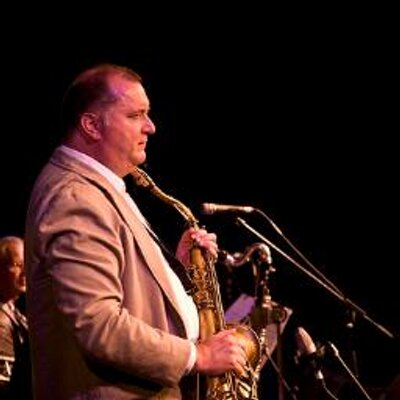
In liaison with Alastair Robertson at Hepjazz records, Frank is working on an album that will feature singer Tina May performing some of Alastair’s favourite Standards and Frank’s arrangements. ‘The project is a pleasure,’ says Frank. ‘Alastair has these songs that he loves, songs like Why Don’t You Do Right?, but he is an enlightened man, comfortable with new ideas and open to change.’
Frank is writing music for a string quartet that will back various soloists for a project at the Pizza Express Jazz Club early in 2014, and for a saxophone quartet, that will feature music based on the themes of that famous year in jazz, 1959 – for Frank, the year he first appeared without a saxophone!
You can also check out Frank’s forthcoming gigs on Frank’s website (click here) where you can listen a showcase of his groups and recordings. Frank’s albums are available on the Hepjazz label (click here).
Frank's upcoming gigs in 2020:
Date: 2 March 2020
Location: Boulevard West. 7 Lord Street, Southport, PR8 1RP
Time: 9PM.
Featuring: Frank Griffith Trio
Admission: £15, includes supper
More information: 01704 537263
Date: 13 March 2020
Location: Kazimier Garden. 32 Seel St, Liverpool, L1 4BE
Time: 6-8PM.
Featuring: Frank Griffith Trio
Admission: Free
More information: 0151 792 3506 www.the kazimiere.co.uk
Date: 20 March 2020
Location: Hopscotch. Constance St, Liverpool, L3 8HB
Time:8.30PM.
Featuring: Frank Griffith Trio
Admission: Free
More information: www.hopscotchliverpool.com. 07985 039189
Date: 4 April 2020
Location: Ma Boyles, 7 Tower Gardens, Liverpool, L3 1LG
Time: 9PM.
Featuring: Frank Griffith Trio
Admission: Free
More information: 0151 236 0070 www.maboyles.com
Date: 22 March 2020
Location: Seven Arts Jazz, 31 Harrogate Road, Leeds, LS7 3PD
Time: 1.30PM
Featuring: Frank Griffith, Louise Gibbs and Richard Wetherall.
More information: Music of Ellington and Strayhorn www.sevenleeds.co.uk
Admission: £10
Date: 10 April 2020
Location: Blackburne House, Hope St, Liverpool, L8 7PE
Time: 8PM
Featuring: Frank Griffith Trio w/Eddie Binstead
More information: 0151 709 4356
Date: 12 April 2020
Location: Nantwich Jazz Festival, Crown Hotel, High St, Nantwich, CW5 5AS
Time: 2-4PM
Featuring: Frank Griffith Trio
More information: 01270 625283 www.nantwichjazz.com.
Date: 15 April 2020
Location: Heskith Social Club, Southport, PR9 9XH
Featuring: Frank Griffith Quartet
Admission: Free
More information: 01704 227968
Date: 17 April 2020
Location: Sefton Park Cricket Club, L17 1AA
Time: 8PM
Featuring: “Tenors Anyone” with Frank Griffith, Phil Shotton and the Jonny Dale Trio.
More information: 07481 155077
Admission: £5
Date: 26 May 2020
Location: LIPA, Mount st, Liverpool, L1 9HF
Time: 8PM
Featuring: Frank Griffith guest artist with LIPA Big Band
More information: 0151 330 3000. www.lipa.ac.uk
Admission: Free
Date: 31 May 2020
Location: The Railway Pub, 74 Wellington Road, Stockport, SK4 1HF
Time: 9PM
Featuring: Frank Griffith Quartet
More information: 0161 477 3680
Free
Date: 16 June 2020
Location: Wilmslow Conservative Club.15 Grove Avenue, Wilmslow, SK9 5EG
Time: 8.30PM
Featuring: The Frank Griffith Quartet
More information: 01625 528336
Admission: £8
Date: 18 July June 2020
Location: Bridport Arts Centre, South Street, Bridport, DT6 3NR
Time: 8.00PM
Featuring: The Frank Griffith Quartet with Guy Gardner, Stu Barker and Matt Skelton, with guest vocalist, Rachel More. Performing the music of Burt Bacharach
More information: 01308 427183 www.bridport-arts.com
Admission £13
Date/Time: September 8, 2020. 8.30PM
Location: Wilmslow Conservative Club. 15 Grove, Wilmslow, SK9 5EG.
Featuring: Frank Griffith Nonet 01625 528336
Admission: £8
Date: 2 October 2020
Location: Sefton Park Cricket Club, L17 1AA
Time: 8PM.
Featuring: The Frank Griffith Nonet
Frank's Blogs shared with Sandy Brown Jazz:
"Many of us are familiar with the saying "If you're not a part of the solution you're part of the problem". After 40 years of trying to get a "leg up" in the Jazz Business I can't agree more with this tenet. Below are some of observations and advice in helping the cause of the music as well as getting oneself "on the map".
In these cyberworld days that we live in, musicians have more and more opportunities to promote their wares and make contacts with others of influence than before. These include other musicians, bandleaders, gig fixers and contractors, etc. When I began my "journey" in the early 1980s there were few means of contacting people outside of the telephone, post or meeting them in person. If one wasn't "discovered" or sought out by a record company there were few other ways to get a decent recording off the ground. Forming one's own record company was not the done thing in those days. This was largely due to the costs and limited access to the technology to do so. One of the advantages of the internet is that one can "set out his/her stall" to practically anyone via email, Facebook or other social media before trying to meet up with them.
Most musicians know the difficulty and awkwardness of approaching someone at a club or public place and giving them your speil on what you have to offer in that setting. They most likely, will have other matters on their mind (the gig, other people waiting to chat to them, etc) and its possible that they won't be best pleased with that approach. I've had punters come up to me ten minutes before the gig starts and expect to meet with me about some proposal about a gig or project that they have in mind. Note to opportunists - if you insist on chatting to a performer (especially someone that you don't know) you'll get much a better reaction if you wait until after the gig and even then it should just be a matter of exchanging contact information and save the heroic speech until a later date, if that should emerge.
There are a number of agencies for gigs listings these days, both hard copy and online publications. Gone are the days though, of Time Out in London and The Village Voice in New York City - both of which included extensive listings often accompanied with brief blurbs of the performer, band, etc. While many of them will publish your listing free or charge, there are often difficulties in making contact with them and having your information published regularly. The same applies to press releases as many of the jazz magazines in the UK (Jazzwise, particularly) are very discerning and agenda driven about which press releases that they will run. The BBC and other leading UK jazz publications seem to champion the same jazz names over and over again to the detriment of the many others who deserve more exposure.
Another area that musicians can thrive with today is publicity via the internet. I clearly remember the 1980s/90s days when the only option of letting people know of your gigs was the costly and time taking task of posting flyers. This practice has pretty much been rendered extinct with email, websites, Facebook and other social media. I suppose though, that when one recieves a letter in their postbox they are much more likely to actually open and read it as opposed to seeing a gig announcement in their inbox which can often lead to them letting it sink down into the netherworld zone or just deleting it before reading it. Fair enough!"
2019.7
"UK Jazz fans will be familiar with Sir John Dankworth (1927-2010) the great British saxophonist/clarinettist, bandleader and arranger/composer for his collaborations with his wife of 52 years, Dame Cleo Laine, and his prolific output for the John Dankworth Seven and his big band. John’s arrangements over the years were a hearty testimonial to his love of Duke Ellington and Billy Strayhorn. There are too many to mention, but two stand out as completely devoted to Ellington's music - Cleo Laine's Solitude with the Duke Ellington Orchestra (1994) and In A Mellow Tone recorded in 2005 by the John Dankworth Quintet. These albums do not attempt to recreateDuke's opuses note by note as so many repertory ensembles do (and very well too), but instead are sifted through an alchemy of Sir John's unique sound and vision.
Cleo's Solitude CD was recorded in 1994 with the Ellington Orchestra led by Mercer Ellington and arranged by John alongside fellow British arrangers, Stan Tracey and Eddie Harvey. Harvey in particular, was a long-time member of the Dankworth stable, having been a charter member of the Johnny Dankworth Seven from 1949, as well as John's various big bands over the years.
Cleo's interpretations of classic Ellingtonia featured popular gems like Don't Get Around Much Anymore, Take The A Train, and Sophisticated Lady, as well as lesser known titles like All Too Soon and Reflections. Also included was Duke's ‘Don't You Know I Care’ with lyrics by Hal's older brother Mack David, and an eloquent and heartfelt delivery by Cleo. I also had the pleasure of recording this song with fellow DESUKIAN, pianist, Brian Priestley, on his 2004 album "Who knows - The Uncovered Ellington" on the 33 Jazz Label.
Writer of ‘In A Mellow Tone', Alyn Shipton, had the following to say on this album:
"Such open-mindedness is readily apparent in this selection of Ellingtonia by the John Dankworth Quintet. Most, but not all the repertoire is familiar, but the way it is tackled is not. With John's typically astute ear for what makes a jazz arrangement work and his ability to get to the heart of a piece of music, numbers that are normally the preserve of a sixteen piece orchestra hold no terrors for the five musicians in his band. All of the twelve selections have something fresh and original about them, although throughout the disc there's also a clear familiarity with Duke's own interpretations". Indeed.
The quintet included Mark Nightingale (trombone), John Horler (piano), Alec Dankworth (bass) and the late Allan Ganley (drums). All play distinctive roles in echoing Ellington's timbre and spirit while executing the music of The Maestro. It should also be added that Allan Ganley was a mean arranger/composer himself and certainly brought that insight and experience to his interpretations from behind the drums.
Dankworth's final big band CD was "Jazz Matters" (2007) on the Qnote label. Having played on this album myself, an Ellington-like influence was clear, and I detected a kinship with the Duke in how it was put together. John wrote and arranged fourteen pieces, half of which with lyrics by saxophonist/songwriter Duncan Lamont, and all sung by Cleo. With titles like Colour Your Dreams, Madame Jazz and How Goes The World, et al, the listening experiences that great warmth of collaboration and sharing that Duke Ellington and Billy Strayhorn had.
2019.8
Other Profiles / Articles that might be of interest
Click HERE to join our mailing list
© Sandy Brown Jazz 2017