Archive of Correspondence and Thoughts from Sandy Brown Jazz Readers
(Scroll down for the list of topics)
Recent Correspondence:
Gugnuncs
Howard Lawes has come across a reference to 'The Wilfredian League of Gugnuncs' that was a childrens' club from the 1920s and 30s that arose from the popularity of a strip cartoon called Pip, Squeak and Wilfred printed in the Daily Mirror. Howard says: "I have just discovered my father's membership book numbered 190560 so it must have been a very popular club. In the book it reads "Gugnuncs might form themselves into little separate clubs ..... Gugnunc choirs, jazz bands and amateur theatricals might also be easily arranged". Howard wonders whether any readers remember Gugnuncs and whether any jazz bands emerged from the club? Pip was a dog, Squeak was a penguin and Wilfred a long-eared rabbit who could only say 'Gug' and 'Nunc'. The cartoon series was discontinued in 1955
MA Walker writes the story of the cartoon series in the Cartoon Museum Blog and says: "Pip, Squeak & Wilfred were so popular, so beloved, that a club was founded in 1927 called the Wilfredian League of Gugnuncs. They even made badges in blue enamelled metal with Wilfred’s long ears as the main motif. In a short period of time the Gugnuncs, which of course was formed by the two baby words uttered by Wilfred, counted over 100,000 members. The W.L.O.G. organized events, competitions, parties and rallies for its members, specially in the British South Coast Seaside resorts. On more than one occassion they filled the Royal Albert Hall in London to raise money for several children’s hospitals and charities. Among the rules of the club was to be a good person, to make the world a better place, to be kind to dumb animals, and to never eat rabbit." 2022.11
Geraldo's Navy
Mike Whitaker leads the U3A Jazz Appreciation Group in Taunton, Somerset, and has been looking into references to what Mike refers to as 'a fascinating story of an odd corner of British Jazz'.
"All those guys who signed up to play in the Cunard liner dance bands just to get a free ride to New York to drink in the new music on 52nd Street. The image of all our wannabe boppers - Ronnie Scott, John Dankworth, Stan Tracey, Peter Ind, Harry Klein, Allen Ganley etc dressed in dinner jackets playing Victor Sylvester to pearl-bedecked dowagers in the Queen Mary's First Class lounge - is...well...entertaining! Apparently the Queen Mary had 20 musicians, including an organist, for recitals and church services and a String Quartet solely for First Class delectation. Only the organist and the String Quartet ever went for breakfast. Some of the musicians, having got to the States, stayed there, Ralph Sharon and Peter Ind for example. Some took lessons from the Greats - Bruce Turner (our original Dirty Bopper) had lessons with Lee Konitz, Tony Kinsey with Cozy Cole, Peter Ind with Lennie Tristano. The interesting thing from the jazz-lover's point of view is whether those guys - and apart from Ann O'Dell (organ and vocals) they were all guys - contributed significantly to speeding up the development of modern jazz in the UK ?."
Does anyone else have information about Geraldo's Navy - Ed. ? 2022.11
Band Wagon - The Cy Laurie Band
Last month we shared a video of the Cy Laurie band in footage from the Ford National Motor Museum (click here). We were able to identify clarinettist Cy and bass player Stan Leader but asked if readers recognised other band members. Colin Graham writes: 'I enjoyed the Band Wagon footage in this month’s What’s New magazine featuring the Cy Laurie band. The trumpet player looks like Colin Smith who was with Cy Laurie in 1958 before joining Acker Bilk. Hope this helps.' 2022.10
Dick Charlesworth's 'Brothers'
Leon Breckman has written asking: 'Have you heard of The Brothers, which was a pseudo Masonic fraternity run by Dick Charlsworth of 'City Gents' fame of which there were some 500 members of semi-pro musicians from the London area. It would be very interesting to know who are still surviving?"
Clarinettist Alvin Roy, who was amember of The Brothers for a while, remembers the group meeting up at the 100 Club in London once a quarter: "It was a get-together, no instruments, so no playing. When there was a new member, Dick Charlesworth would sprinkle the four corners of the room from his whisky glass which encompassed the new initiates and also the onlooking members."
Trumpeter Digby Fairweather writes about The Brothers in his book Ace Of Clubs : A Celebration Of The 100 Club (more on that next month). 'One of the great institutions of the 100 Club was 'The Brothers' a community of musicians and singers who met at the club on Monday nights once a quarter .... I wasn't very keen to begin with ... There was a real 'initiation' ceremony and the existing brothers used to quite like winding up new members about what they'd have to go through .... there was dear James Asman ... I said "What's the matter Jimmy?" He said "I think I've got to bare me bum!" .... I think It's safe now to reveal that you didn't have to do that; just stand on one leg and turn round in a 360 degree circle and then sing The Brothers' anthem which was 'Benignity - which was pronounced ben-igg-nity - is not beneath your dignity' and so on, to the tune of The Red Flag .... But to be honest I didn't go to The Brothers more than once I don't think ... on my night (trombonist Jim Shepherd) came down in a furious temper: "Some bloody traffic warden's just given me a ticket" and so on. And we had to remind Jim; "Don't forget - ben-igg-nity! Ben-igg-nity! Come on!".
If anyone else has memories of The Brothers please get in touch.
[In his book, Digby also mentions another 'organisation' - The Universal Life Church of Modesto California - more on that next month too - Ed] 2022.10
Leon send this picture taken of a gathering of The Brothers - can anyone tell us more?
Ray McVay and his Band Of The Day
David Parry writes: 'For some reason I thought about Ray McVay and his Band of the Day. Remembering having met his brother who also played an instrument in that band. Trombone I think? I forget his first name. He and his wife rented a flat in what we now call a house of multiple occupancy home in Ilford. I rented the flat next to his with my first wife. It was in 1963. It was a haunted house!! As the other couple would confirm. But that is a story for another day. Much later on I was working at Smithfield Meat Market where there was a Glenn Miller tribute band. Speaking to the singer she remembered Ray and his brother! That was in 2005 or thereabouts!!. She told me he no longer played due to losing his front teeth. Not sure now if she meant Ray or his brother!'
[There is an article about Ray McVay in The Scotsman - here. Born in Glasgow in the late 1930s, Ray was a saxophonist but became musical director for many well known pop singers of the 1950s and 1960s as well as fronting his Ray McVay Orchestra. In 1960 he was supposed to be travelling in the car in which Eddie Cochrane died, but instead travelled back with the other band members in a dormobile. Ray's orchestra was regularly featured in the TV series Come Dancing and he went on to lead the Glenn Miller Orchestra UK - click here for a video of Ray leading the Glenn Miller Orchestra with In The Mood]. 2022.10
Ottilie Patterson's Debut
Bob Lamb picked up on last month's news item that a docuemtary about vocalist Ottilie Patterson is being prepared: 'Regarding Ottilie Patterson's debut at the Royal Festival Hall in 1955 I can add a little extra. The Merseysippi Jazz Band were also on the bill. Chris Barber approached Dick Goodwin, bass player, founder and leader of the Mersey's. Beryl Bryden was due to play with Barber that night but he told Dick that he had a new singer (Ottilie Patterson) and could the MJB take on Beryl Bryden as a favour. She knew the MJB and had recorded with them. Dick agreed and, on scraps of paper, hastily wrote the chord changes for Beryl. As the band were about to start, the lights dimmed so that they couldn't see the written chords and played for Beryl from memory. I was compiling material for an MJB history so noted what Dick Goodwin said. He was very clear about that night at the Royal Festival Hall. Dick, a very good friend, died in 1996.' 2022.7
La Strada Del Jazz, Bologna, September 2022
Howard Lawes recently came across the Strada Del Jazz in Bologna, Northern Italy, and thought that anyone visiting might be interested in this location where: 'In the Bologna city centre, hidden in the heart of the Quadrilatero, there is a street known as “La strada del Jazz” (Jazz Street), named after the gold stars dedicated to the greatest Jazz players of all time. Via Capraie 3 used to be the location of the disco club owned by Alberto Alberti, point of reference and manager of great artists such as Miles Davis and Chet Baker.
The club has made Jazz memorable in Italy since the 1950s from Festival del Jazz di Bologna to Umbria Jazz. It is precisely here between via Capraie and via degli Orefici, where international jazz artists used to meet, that we find the marble stars dedicated to the main musicians who contributed to the growth of what was crowned UNESCO Creative City of Music in 2006.'
'There is also a star dedicated to Lucio Dalla, beloved local artist who started off playing Jazz music. Every September, these locations are filled with the street sound of “La strada del Jazz” Festival which animates corners, alleyways and squares in the heart of Bologna with live music.'
From information online, it looks as though this year the Festival takes place on Friday, Saturday and Sunday, 9th - 11th September and is dedicated to Lucio Dalla (click here for a video of himplaying Tu Non Mi Basti Mai - You Are Never Enough For Me). Details are on their Facebook page and here. There is a background to La Strada here. 2022.7
Sounds From Down Under
Of course, if you are reading this in Australia or New Zealand (I know there are some of you who do), this won't be news to you, but John Westwood says: 'I've just recovered from 3 weeks of Covid, and didn't enjoy it!. Anyway, while locked up in my room here, I had plenty of time to enjoy a lot of the old stuff, as well as "What's New" - for which many thanks. Along the way, found https://jazzday.com/ which doesn't seem to be getting much exposure here, unlike in Oz where they're making a real effort to support our music. In particular, this week's https://www.3cr.org.au/jazz contains some gems - including a Sandy Brown recording I'd not heard before. It should be up for a few weeks on their AoD shortly; always a good 90 minutes!' 2022.5
The Fox And Goose
Last month also Bryan Wright remembered going to the Fox And Goose venue that we mention in various places on the website, but about which we have little information. Bryan says: 'Went to Fox and Goose every Friday, I can't remember if it was 1940s or 50s. John R T Davis guested one night played trombone. Brilliant! There was a glass arcade across the footpath and the
Jazz club was a hall on the right with a small bar. We used to stand on the dance floor. I was called up National Service in1949, a month or two before they moved to Sudbury.'
We asked if anyone else remembered going to the Fox and Goose:
Roger Trobridge says: 'You have material on Steve Lane who ran the jazz club at the Fox and Goose. It has a video of his funeral which I had to conduct as Steve had no close family to do it. You embedded the Facebook video I made of Steve's New Orleans arrival at the crematorium. The Fox and Goose was where Cyril Davies and the late Colin Kingwell got their start with Steve. I visited the pub with Colin and we used it for the wake after Steve's funeral. I wrote a piece in my blog about the Fox and Goose about the visit (click here).
There is more on my Cyril Davies web site (click here). '
John Westwood adds: 'I too recall the Ealing scene, especially seeing Steve Lane's early band there, and the Colyers turned up there once when I went. Happy days. Bryan and I obviously did our National Service at much the same time - I wonder if he had the same Jazz 'opportunities' that I enjoyed while in the RAF?'
and Alan Bond writes: 'Regarding the Fox & Goose at Alperton, I remember seeing Steve Lane's band there in the 1970s but I knew the pub prior to that as the local Alvis Owners Club had their monthly meetings there for years. Just prior to those sessions, Steve had a regular gig at the Park Royal Hotel on the other side of the A41. Both venues were quite close to Perivale Underground station. That was the last occasion on which I spoke to Steve's dear old mum, who often used to turn up at his gigs in those days. It wasn't all that long after that that she passed away. Steve's earlier gigs at the Fox and Goose were outside my sphere of activity but I knew of them. Heady days indeed.' 2022.3
How Japan Created Its Own Jazz
Thanks to Tim Rolfe who spotted this article in The Guardian during January setting the scene (with examples) for Japanese jazz which perhaps we don't get to hear often enough. The article begins: 'The story of Japanese jazz is about music and a movement, but also a nation’s state of mind – a daring vision of a better future after the second world war, sounded out on piano, drums and brass. Jazz is a distinctly American art form – the US’s greatest cultural achievement, in fact, along with hip-hop – and a healthy scene had formed in the 1920s and 30s as American players toured the clubs of Tokyo, Kobe and Osaka. But Japan had historically been an insular nation – its policy of sakoku, which for more than two centuries severely limited contact with the outside world, had only ended in the 1850s – and an increasingly nationalist government, feeling jazz diluted Japanese culture, began to crack down.'
Koichi Matsukaze photo by Shigeru Uchiyama
'By the second world war, “the music of the enemy” was outlawed. After the country’s surrender, occupying forces oversaw sweeping reforms. American troops brought jazz records with them; Japanese musicians picked up work entertaining the troops. There was a proliferation of jazz kissa (cafes), a distinctly Japanese phenomenon where locals could sit and listen to records for as long as they wanted. For some, jazz was the sound of modernity.........'
Dennis Hyde writes: 'Really interested in your article - we visited the Thames hotel many times in the early '70s (click here) .
Would you have any photos of the club?'
[I had not included a picture of the Thames Hotel in Hampton Court / East Molesey on the Kingston Jazz page, but I have found a page online here that includes a picture of the Thames Hotel (?Tagg's). Is this the venue others remember? Ed] 2021.12
Mike Pointon
Sadly, trombonist Mike Pointon passed through the Departure Lounge on 2nd November 2021 (see below). People have written remembering him fondly:
Nick Hubert: 'I have known Mike Pointon since 1965 (he was at school with my brother). I was with Mike a few hours before he died last Tuesday (2nd November 2021) and had visited him on several earlier occasions in the hospital and nursing home. A few weeks ago, I pointed out to him that on your April 2018 Tea Break, it says that the banjo player at the Bent Persson concert was unknown….. and without a moments hesitation Mike said it was Tom Stuip.' [We have now added Tom to the personnel list for the picture on his Tea Break page - Ed].
Ron Drakeford: 'Sad news, just watched the You Tube interview with John Petters and Mike (click here), what a wonderful life he had, and I feel privileged to have known, played and been good friends with him since the mid 50's. I shall miss him dearly. Bit gutted really. Some wonderful memories though, like the time we were both new to our instruments, but sat in together with Bill Brunskill at the Fighting Cocks, adventurous schoolboys Mike called us. Thank you, Bill, for starting that lifelong friendship for us. RIP Mike.' (Click here for Ron Drakeford's page about jazz in Kingston Upon Thames)
Photograph courtesy of Marcus Holt.
Marcus Holt sends this picture of Mike Pointon and says: Dear Ian, I suppose you have already heard the sad news that Mike Pointon passed away from Pancreatic Cancer. The correct date should be Tuesday 2nd November.
(Mike Pointon produced the double CD Zutty Singleton - Icon Of New Orleans Drumming re-released in 2021.
Do you have memories of Mike that we could include in his Tea Break page on this website? If you do, please let me know and I'll include them. 2021.12
Remembering Colin Bowden
Laurel Lindström has let me know of the sad passing of her father, the UK drummer Colin Bowden. Colin passed away peacefully and unexpectedly on 1st August. Colin began drumming around the age of ten. He went on to play with Steve Lane, Cy Laurie, Sonny Morris, Ken Colyer, Alan Elsdon, Ken Sims, Mike Daniels Delta Jazzmen, the New Crane River Jazz band, Chris Barber and many others. He has been a substantial part of the UK jazz story and will be missed and remembered by many. For more about Colin click here: Colin Bowden. Obituaries: Syncopated Times ;
Ron Drakeford writes: 'Like Barry Elson (last month), many of will mourn the passing of Colin Bowden. From my perspective, he was not only an exciting drummer to watch and listen to, but playing alongside him was even more exciting. I cherish the days spent playing with the Preacher Hood's Jazz Missionaries, and in particular the period between drummers when Gerry Card left the band until Barry Martyn, back from New Orleans, joined us. During that period, we were fortunate enough to enlist the services of Colin, and boy did he give the band a lift on each and every gig. It was my responsibility to collect Colin and his drums from his home in the Carshalton area at the time. I would park up my beaten-up Ford 5cwt van, make my way to the front door and on each and every occasion music would emanate from the open windows. It was never pure New Orleans music, but Ellington, McKinney's Cotton Pickers, Fletcher Henderson, Bix, you name it. He had a wide appreciation of all jazz, and could accompany any tune you would care to name, plus The Preacher Hood band played some obscure numbers at the time, not normally heard by most of the traditional bands then. (check out "Since my best girl turned me down") Some of my favourite memories of Colin, and they will endure for the rest of the time I have left on the planet. Sad loss but great memories. Thanks for those memories Colin, you were an inspiration to us all. 2021.11
Steve Day says: 'I watched Colin Bowden’s incredible drum solo video with the Delta Jazz Band. When I was a kid I saw Colin Bowden live two or three times – my Dad was into Kenny Ball and Colin was with him for many years. My father always said he was the best – when I was fourteen years old I believed it too. These days I find Colin a little one dimensional but there’s no denying his technique. And now, of course, his place in the Departure Lounge.' 2021.11
Money's Too Tight To Mention
This is part of an email received from a musician about other things, but I thought this paragraph might be of interest to readers: '.......Spotify. I’ve amassed £0.09p so far in royalties on the label I publish with. I did a spot on the TV a few years ago and played one of my own compositions. I got £1,300 in royalties! One spot on the TV much better than years on Spotify! Unfortunately the streaming service model has killed the recording industry from an earning point of view. I got £36 from streaming service royalties from another service I use, for a period of about 6 years. Why can’t they charge £50 per month for unlimited streaming, which is the same as buying 4 CDs per month? Unfortunately the value has gone from recorded music. The plus side with download and streaming is I don’t have the money to produce CDs at the moment, so at least they give me a platform to display my creativities.......' 2021.10
Jazz Clubs World Wide
Peter Maguire has written from Brussels during the Coronavirus pandemic to say " ... the combination of not playing on a regular basis, and in general not seeing too many people, is at times something of an issue. I'm putting off a revision of Jazz Clubs Worldwide Database until such time as things loosen up somewhat. This morning I see The Village Vanguard is at this juncture closed. In the meanwhile I have started a new project on YouTube of non-sequential recollections of my jazz life, both as a musician, and creator of the website database." (click here for Peter's recollections). 2021.9
Dave Holland and James Tormé Interviews
Dave Self has written offering to share two intevriews he has done, one with bassist Dave Holland and another with Mel Tormé's son, vocalist James Tormé.
The interview with Dave Holland took place at the Cork Jazz Festival in 2005 - click here. For the interview with James Tormé click here 2021.11
What's New
One of our readers, Christina, writes about the August issue of What's New; "Always a good read.Thanks! You have encouraged me to branch out in Jazz. I have even bought a Miles Davis CD Kind Of Blue." 2021.9
Protest Marches And Jazz Bands
In April 2021, Chris Macdonald sent us this picture from the Aldrmarston March of 1960. Chris says: 'The photo of Eric Lister and Tony and Douggie Gray is, I’m almost positive, from the Aldermaston March 1960, as my late wife took the attached photo, which has the Grays in the same outfits, and the same kilted drummer!
From left to right we have Douglas Gray on pocket cornet, Martin Fry (Temps) on helicon, Tony Gray on slide trumpet, Jeff Nuttall (artist and author) on trumpet, and Dave Aspinwall on trombone.'
Eric Jackson saw the picture and writes: 'These protest marches nearly always had a parade band to lift the spirits. CND and Anti Apatheid were two of them and the musicians were usually based on a core from the Colyer band plus others from that persuasion. Clarinettist Neil Millett and trombonist Dave Cutting were usually in the mix.
I enclose some snaps ..... Ken Colyer is at Tafalgar Square after a CND rally and Pete Dyer is on trombone leading the other band ...There are probably some anecdotes to be had from bands at funerals .. but not from me. 2021.5
Humph And The Klipschorns
Russell Medcraft writes: 'I followed Humphrey Lyttelton’s band from 1954 to 1966, visiting the 100 Club in Oxford Street regularly most weeks, and also at the Conway Hall sessions. At the interval time I used to go to the local pub with the band where we would chat about jazz music, bands, etc.
When I was 21 years of age on 16th December 1957, I had invited the band to our house where I was living with my parents. Due to a terrible fog Humph and some of the other members of the band were unable to travel out. Johnny Parker and Jim Bray both came on Johnny’s motorbike as they could navigate using a motorbike in that thick fog.
They were all coming over to listen to their record of Humph At The Conway be played using a special corner horn loudspeaker made by a company called VITAVOX, the speaker model being the remarkable VITAVOX KLIPSCHORN. This cost £145:00 at the time when my father Harry purchased it in 1952 (quite a considerable price then!). Johnny and Jim were taken by surprise when they heard the sound from the Klipschorn. We played various other bands’ records, and then Johnny played on our baby grand piano some of his favourite pieces including Bad Penny Blues.
Afterwards they walked across the road to the Goodwill public house for a beer, I had to stay behind just in case any other members turned up. They brought back with them a few bottles and we carried on with Johnny playing the piano and chatting until about 11:30pm.
The speaker units were made in the UK by Lowther Voight and the cabinets were made in Cricklewood under company name of VITAVOX. When using this loudspeaker it gave the same volume and sound as if the band was in the room with you, an astonishing reproduction of that sound. It was constructed using the folder horn technique for the 15 inch diameter bass unit, making this speaker cabinet 55% efficient, whereas normal speaker cabinets were 10% if you were lucky. The middle and treble frequencies were reproduced using VITAVOX own exponential flared horn driven by the pressure unit and enclosed behind a metal grille mounted inside the top of the cabinet.
They still manufacture an updated version of these speakers called the Klipsch Klipschorn AK6 and priced at £17,500:00.
[Click here to listen to Elephant Stomp from the Humph At The Conway album and featuring Bruce Turner - it would probably sound much better with Klipschorn Speakers. Ed.] 2021.4
Bill Reid - Bass
Stephen Reid asks whether any of his late father's band colleagues have memories they can share: 'I have been on your website and find it all very interesting. I am trying to find out more and more about my father’s jazz days and what happened to his old band members (most of the Alex Welsh band died a while ago, of course). I did meet Terry Lightfoot a few times and my parents stayed friendly with the families of Dick (and Ray, his brother ) Smith and Johnnie Richardson. Dick’s widow (Kay) came to my father’s funeral (La Vie en Rose by his hero Louis , Minder theme and Jeep’s Blues finished off by Woolly Bully were the tunes !). Anyway, perhaps someone knows of any relatives and especially Archie Semple’s (if he had any)? Here is a link to my father’s obituary: click here.
Future Gigs In Europe
Howard Lawes, who writes regularly for What's New says: 'Any musician I have interviewed recently is very concerned about the problems likely to be experienced due to the need for visas, work permits, customs declarations etc. for playing in Europe when travel is possible again. There was a debate in the House of Commons in December 2020 with the UK Government blaming the EU whereas the EU was blaming the UK Government. There is now pressure on the two sides to negotiate an exemption to the new restrictions for musicians, with performers and crews saying livelihoods could be at risk.'
Howard pointed to a report on the BBC website in January 2021 that said: '... Since Brexit, British musicians and crews are no longer guaranteed visa-free travel and may need extra work permits to play in certain European countries. Under the terms of the deal, British bands can tour Europe for up to 90 days in a 180-day period. But tours in Germany and Spain, for instance, will now require extra visas for paid work, while those in France and The Netherlands will not. ... A petition signed by more than 250,000 people ... is calling on the the government to "negotiate a free cultural work permit" that would allow "bands, musicians, artists, TV and sports celebrities that tour the EU to perform shows and events and ATA carnet exception for touring equipment". The government later responded to the petition, saying the EU "turned down proposals", while noting that "there is scope to return to this in the future" .....' (Click here for more details). Two days earlier, the BBC website carried a story on the same issue with further opinions - Click here.
We shall try to keep an eye on this debate as it unfolds. 2021.2
Annie Ross - Straight On Till Morning
Saxophonist Frank Griffith writes: 'Fans of the late Annie Ross might be interested to know that she was in a 1972 British horror flim entitiled Straight On Till Morning. Pretty much a B movie by all accounts. She plays a slightly older (she was 42 at the time) boozy girlfriend of this evil young lad protagonist who ends up killing his dog and another girlfriend (not Annie, happily). The largely jazz infused score was written by Roland Shaw and included a theme song co-written (lyrics) by Annie which she also sings throughout the film. Other British jazz greats, Ronnie Scott and Kenny Wheeler are heard soloing as well. For these reasons alone, make the film worth a look. I saw it recently on a UK channel called Talking Pictures (talkingpictures.co.uk) which shows many films like this. Not sure how accessible this film would be outside of the UK but defo worth googling. It is also available on Blu-ray.'
The film is available on DVD (click here where there are also a synopsis and reviews). Click here for a trailer for the movie. 2020.12
Have They Started Yet?
One reader wrote last month saying "Just a note of thanks for running this site and newsletter in these strange times, it really is a joy to read, although my wife thinks it is detrimental to our bank balance, as I tend to buy more CDs following your reviews! Long may you continue. Sadly my wife doesn't have a favourite band or artist, she tolerates (mostly) what I play in the house! When we could go to concerts (pre Covid) she would usually always come along. One of the first concerts I took her to was Miles Davis at the Royal Festival Hall in the late 1980s I guess. Once after Miles had walked on stage and the applause had died down, he started an improvisation and she whispered to me, " Have they started yet?"
[As you might expect, the reader's wife doesn't look at this website each month, but I thought it might be nice to dedicate this lovely version of Miles Davis playing Blue Room to her - click here - it does has a clear beginning and an end. Thinking about personal dedications, would any reader like to dedicate a tune to a friend or a family member? - Ed] 2020.11
Sold - Louis Armstrong's Trumpet
Last month we reported on the sale of one of Louis Armstrong's trumpets at a Christie's auction. Syd Wardman writes: 'According to legend this was the second golden trumpet given to Louis.The first was given by King George the 5th in the 1930s, and later Louis gave it to Lyman Vunk a trumpet player with Charlie Barnet's band - he was a friend of Louis. I was told that brass will not gold plate it has to be silver plated first.' 2020.12
David Gent writes: 'I was amused by the letter about Miles Davis "Have they started yet?" The American avant-garde composer John Cage once wrote a short piece called 4'33 which was completely silent. His mother attended the first performance of this composition. She asked the composer how she should approach it, and he told her to look on it like a prayer. It was followed by a very loud electronic piece, and Mum sat through all of this, then said "What a long and intense prayer." (click here for a performance of 4'33). 2021.6
Pic and Mix Up
Per-Ola Anderstedt in Sweden questioned a picture we originally had in Jeff Duck's article on Jack Payne in our 'Jazz Remembered' series (click here). We acknowledged that Per-Ola is of course correct, this is not Jack Payne, and Ihave now changed it, but I asked whether readers knew who it actually is?
Alan Bond writes: 'I saw the picture of Jack Hylton as a youngish man. My Mum's favourite bandleader, followed closely by Harry Roy. Here's one of my favourites by Harry Roy's Tigeragamuffins. It would be banned today (click here to listen).'
[Alan gives fair warning! One commentator on the YouTube channel writes: 'As so many query whether the Lyrics were understood in the 1920's I got a friend to check BBC archive and the record was never broadcast on the radio, indicting deep problems, and a note still exists that it was banned for sexual innuendo. So the double entendre was fully noticed as soon as the disk came out. It however sold well!! There was a market for such disks, many dance bands did them, notably Bill Cotton. Harry Roy was noted as having a wicked sense of fun, he loved playing prank versions of songs. You have to appreciate that the English audiences loved such lyrics and jokes, Max Miller made a whole career on such comic material.' - Ed.] 2020.12
Treasure
Martin Goldsmith says: 'Can you believe it - two treasures I found dumped outside a local house in a box.
The house owner had no idea who owned these albums.
When I suggested it was someone’s father, they said their parents hated jazz and really hated the Scots .
I was so happy, I am sure the mystery of the owner would never be found. Unless it was me who threw these masterpieces away during a sleep walk or nightmare . 2020.12
Oscar Rabin
Philip Lyons has seen our page on Oscar Rabin (click here) and writes: 'I remember Oscar Rabin and his family, his wife Leah and his daughters Marlene and Helena, plus the boys David, Bernard and Ivor. Oscar and Leah where great friends of my parent Jack and Yetta Lyons and helped them very much over the years of friendship We used to go to their home in Maida Vale - lovely lovely people.' 2020.12
An Evenin' At The Gin Mill with Ken Colyer
John Westwood picked up on the Ken Colyer album that we included in Recent Releases last month and writes: 'Nice read this month ends with the review of the Cadillac KC reissue, which prompted me to dig around my odds 'n' sundries. Probably the rarest of Ken's recordings is Doug Dobell's 77LP24 of which I believe only 100 copies were pressed to avoid the dreaded 100% Purchase Tax of the day. Because he was under tight contract to Decca at the time Ken plays under the pseudonym 'Kenneth Coleman' (a bit transparent that, eh?)
In case you haven't heard it, here's a download - click here. John Clarke (piano) solos on the starred tracks and John Mason plays bass and Colin Bowden drums. 2020.9
The tracks are:
Put Me In The Alley
R-G Bar-G Boogie *
Frankie And Johnnie
Twinklin' Rag *
Freight Train Blues
J.C. Stomp *
Careless Love
Head Hunters Boogie*
Trouble In Mind
Brum Trad Jazz
David Braidley writes: 'Your readers may be interested to have a look at the website Birmingham Traditional Jazz Musicians. There are hundreds of interesting and historic photographs of Midlands musicians from 1950s onward, plus other memorabilia. 2020.9
Charlie Parker Centennial
August saw the centennial of the birth of saxophonist Charlie Parker who was born on 29th August 1920 in Kansas City.
Phil Kent sends us this link to a 37 minute programme on Milwaukee's 'Fresh Air' radio programme where they look back over Bird's story with Terry Gross speaking to Max Roach, Red Rodney and Jackie McLean.
You can either read the text of listen to the programme here. 2020.9
Russell Procope and Jelly Roll Morton's Blues
Alan Bond writes: 'Sitting here in 'self isolation', I was listening to some Jelly Roll. It put me in mind of a time when I played trombone in the John Purves Swingtette in the 1960s. Out of the blue he received a request from the editor of a London based magazine called 'Jazz News' now, sadly, long defunct. Apparently he had heard via the grapevine of our band and was particularly interested because we were not a 'trad' band (how I hate the term 'trad') but we played in the 'mainstream' style with two brass and three reeds in the front line. Their reporter came along to one of our weekly rehearsals at Edgware, actually in a church hall which is still there to this day. He turned up towards the end of our session but was suitably impressed and said he would return on another Saturday for a longer appraisal.
It was a few weeks later when he turned up again and he had in tow, two gentlemen who turned out to be members of the Duke Ellington band, which was in town for a number of concerts. One of them was the reed player Russell Procope and the other was one of the trombone players who I thought at the time might have been Britt Woodman but I later found out that he was not with Ellington at the time. Our leader and trumpet player was convinced that it was Lawrence Brown as he was still working with Ellington then. Needless to say, our rehearsal was soon brought to an end while we chatted with these two gentleman. Russell was deep in conversation with our three reed men for a while and I eventually managed to buttonhole him to ask about his career and his work with John Kirby and he said that the Onyx Club job was the best paid he had other than with Ellington.
Click here to listen to John Kirby and his Onyx Club Boys playing From A Flat to C.
I then asked him about his work with Jelly Roll Morton and he seemed rather surprised that I was interested in all that 'old stuff' as he put it. I said, not at all and mentioned his incredibly moving clarinet solo on Deep Creek Blues, but he couldn't remember it as 'it was so long ago'. I suppose, for a working musician with many recordings to his credit it would be hard to remember too much detail, but that clarinet solo, to me reflects the pain of the struggle of the black man in America as it is so poignant. Right at the end is a quirky little effect by Jelly Roll where he leaves a pause and then plays just one final note - ever the dramatist! This is, without doubt, one of the most moving blues performances I have ever heard.'
The 100 Club in London's Oxford Street has been granted special protected status by Westminster Council. It has been recognised as a Community Interedt Company being a not-for-profit social enterprise for the public good. John Westwood writes: 'Your piece about the 100 Club brought back many happy memories - and a few regrets. As you know, Joe Feldman took out the lease from the guy that ran Mack's, and put on some good music (often visiting American servicemen) but his main purpose was to promote his offspring. Anyway, I played there a few times with John Haim's Jellyroll Kings in the late 40s, but never ate the rather suspect grub then on offer! At that time there were two bandstands - one at the front (Oxford Street) end and the other at the back by the kitchen. It was at the latter that we always played - Humph or visiting VIPs had the prime 'front' one. One such notable occasion was when we did the opener and closer for when Jimmy and Marian (McPartland) guested with Humph - highly illegal of course because the Bechet case was still very much in mind, but a great experience to witness. They were very happy days. During the '90s, Friday lunchtimes were 'free admission' and made a memorable rendezvous for us Mouldy Fygges. The corner by the bar was always occupied by Harry Gold, Bill Colyer, Ray Foxley and visiting Tradsters who quaffed copious quantities of the real ale which Roger got in - back at a time when it was mainly Red Barrel/Double Diamond in vogue. Now, although I believe Roger still owns the business, he sits back while his son Jeff runs it and who I hold responsible for the almost total absence now of Jazz as we know it. There's more proper jazz to be heard at Ronnie Scott's than at the 100 these days. Dig (Digby Fairweather) played a blinder there a few weeks ago!' 2020.4
Who Is With Lil Hardin?
Stu Morrison sends this picture of pianist Lil Hardin and wonders if anyone can remember anything about the photograph?
Stu says: 'The lady, of course, is Lil Hardin and the guy shaking hands with her is the Aussie banjoist Ashley Keating who lived in the UK for a bit. The guy in the dark jacket is K. Minter and the taller guy Roy Maskell. Keith Smith extremely right. The guy in the sheepskin taking a photo is, to date, a mystery. I can’t for the life of me remember where I got the picture from or who sent it, or where the record shop is?' 2020.4
Lister and Gray
Eric Jackson sends this picture saying: 'This photo is from way back. The clarinet player is Eric Lister and the other two gentlemen were Tony and Dougie Gray who I believe at one time were members of the Steve Lane band.
Collectively they were later known as The Alberts and appeared regularly with Spike Milligan on TV. Their ouevre was in The Temperence Seven / Bonzo Dog Doo Dah Bands so may not be strictly jazz as your followers might know it. Click here for a taste of The Alberts music.
Prior to their later career they might have been nightowls hurtling off from Fleet Street to deliver early edition newspapers to newsagents around London.
As Eric says, 'not strictly jazz', but an illustration of what must now seem an outdated type of 'silly' humour that went from Spike Milligan and The Goons through to Monty Python. 2020.4
Fats Waller
Reading our article about Fats Waller's Short'nin' Bread last month (click here) brought back a memory for Alan Bond: 'There is very little of 'Fats' work that I don't enjoy. He was a geat entertainer, songwriter, musician, choreographer and raconteur. Hugh, an old friend of mine from way back worked for HMV back before WWII and was involved in the recording of the 1938 London session involving 'Fats'. At one of the rehearsals involving George Chisholm, whom Hugh knew very well, they arrived at the studios in the morning to be greeted effusively by 'Fats' who suggested that they go behind the piano "To meet 'my manager' " whereupon each member of the band was presented with a bottle of scotch to sustain them through the session ....!'
Riverboat Shuffles
Peter Clist has seen our page on Riverboat Shuffles (click here) and writes: 'My cousins, friends and I went on the Jazz boat in 1961 and 1962 on the Royal Daffodil and the Royal Sovereign from Tower Pier to Margate, and we have photos of our trips. We need another Jazz revolution in this country and another Jazz boat would really set up the Jazz again. My friends and I have played jazz and have so many contacts in jazz circles including American Jazz artists, so let us get going!'
Trevor Benwell, Charlie Green and Annette Hanshaw
Searching online for information about Trevor Benwell led Alan Bond to remember Fletcher Henderson's trombonist, Charlie Gree, and singer Annette Hanshaw: 'I was browsing for information on Trevor Benwell, one of the founders of VJM records and the VJM magazine when I came across this article about Charlie Green, trombonist with Fletcher Henderson's band. It's a lengthy article but it busts a few myths about Charlie -
there are some rare photographs in among the article too (click here). A friend and I spent many happy hours at Trevor's place at Dollis Hill listening to records from his collection and on the odd occasion my late father would come along as well. At each visit Trevor would record everything he played on to a cassette tape which we would save and I have quite a few of these now transferred to CD - all good stuff. Trevor was a delightful man and he was also a regular Cranwell trained RAF fighter pilot who fought in the battle of Britain. He showed me his log books once and I was staggered to find that he had about 17,000 hours on Spitfires by the time he retired after the war. Among his collection of memorabilia was a photo of Annette Hanshaw signed by the lady herself which I would have given my eye teeth to have owned. Unusually for a singer she made very few public appearances and almost all of her work was done on records or the radio as she suffered from stage fright.
Click here for a rare video of Annette Hanshaw singing We Just Couldn't Say Goodbye.
Annette Hanshaw
[The text with the video talks about an animated film Sita Sings The Blues based on the Hindu epic The Ramayana. The whole film is available on YouTube but click here for a clip with Annette Hanshaw singing Am I Blue. Alan Bond has written to us before about Annette and there is a Jazz Remembered page about her on the website - click here]. 2020.2
Jazz In Redbourn
Dan Lucken writes about the Redbourn Jazzmen in Hertfordshire: 'Sixty years ago, most towns in Hertfordshire had their weekly jazz club, but as times and tastes in music moved on, most, along with the jazzers and jivers that visited them, have disappeared. But look around, there are, still in Herts, a few jazz clubs where you may go, listen to live jazz, maybe risk a JIVE! Even on a wet Wednesday afternoon. A group of friends are recreating the Jazz Club atmosphere of the 1950s/60s, holding live trad jazz sessions every Wednesday afternoon at the Holly Bush pub, Redbourn, Herts, AL3 7DU. These sessions are hosted by the Redbourn Jazzband. Formed in 2001 by a group of seniors to meet weekly in retirement and play, live, the music they enjoy. First class musicians, years of experience, some have played alongside 'Jazz Legends' of the past era.'
Alan Bond writes: 'I caught the note about Vic Lewis last month and I remember a couple of occasions when we caught up with him at Trevor Benwell's at Dollis Hill in the 1970s & 1980s. Trevor would invite friends round and give a recital with some of his vast collection of 78s. Among others who were his guests were Irene Gibbons (better known of course as Eva Taylor) formerly Mrs Clarence Williams and Yank Lawson, formerly trumpet player with the Ben Pollack & Bob Crosby bands and letterly with The World's Greatest Jazz Band (always referred to by Ralph Sutton as 'the world's LOUDEST jazz band'. Vic was quite outspoken about music and referred to the world of 'pop' as 'the three chord wonders of the world'. He was the Beatles' agent for a long time and he was very complimentary about Brian Epstein as their manager and classed him as a genius. When asked why, he would reply that only a genius could turn four mediocre musicians into a multi million pound international business.
Vic wasn't the greatest guitar player in the world, as he himself admitted, and he always maintained that he was a rhythm section man. His organisational skills were best at arranging and as an agent and The Vic Lewis Big Band is a treat to listen to IF you can get hold of any of their recordings. I only have a couple of sides in my collection, both off the original Parlophone 78s. There needs to be a re-issue of some of their stuff. There are, of course, the sides by the Vic Lewis/Jack Parnell Jazzmen but, sadly very few of those seem to have been re-issued. Vic knew where the real talent lay and he got it on to disc with the help of Jack. Both were giants of the music business and Vic was a mine of information.
I only met Jack Parnell once and that was when he turned up at the Woodside Musicians Association Sunday jam session at the Green Dragon in Borehamwood. The sessions were run by, among others, Jimmy Skidmore and Allan Ganley and were primarily for younger musicians to hone their talents by playing with and learning from the professionals. Didn't do me a lot of good I'm afraid as my trombone playing never really rose above the ordinary, enjoyable though the experience was.' 2019.9
Richard Grandorge and Brian Rust's 'Jazz Records'
Last month, we shared correspondence from Alan Bond about Richard Grandorge and Brian Rust. Alan wrote: 'Back in the mid 1960s when we used to be regulars at Steve Lane's 'Southern Stompers' gigs at North Wembley, there was a chap that used to sell 78 rpm records each week and I bought several off him at very sensible prices. His name was Richard Grandorge and he was a mate of Brian Rust's and it was Richard who compiled the index for Brian’s 'Jazz Records'. Now this was in the days before computers and such and a couple of us went to Dick's place at Hayes End to collect a few records he had put by for us. When we got there, there were sheafs of paper dotted all over house and we wondered what they were all about and Dick said that he was compiling the index for 'Jazz Records.' I know it took him months and I also know that it caused a lot of arguments between him and his wife! Sadly, Dick was killed in a car crash in 1968, another nice chap who is sorely missed.
Mike Rose from the National Jazz Archive writes: 'I was inspired to add to the item on Richard Grandorge and Brian Rust's 'Jazz Records'.
What few people know is that the Sounds Department of the British Library contains over 500 interviews with British jazz musicians: the ‘Oral History of Jazz in Britain’. Currently these interviews are only available to listen to by visiting the Library or listening on-line if, you are an accredited member of a Higher and Further Education institutions. This is due to the total lack of copyright clearance which wasn’t obtained at the time of the interviews.
In 2017, the National Jazz Archive were awarded funding by the Heritage Lottery to mount the “Intergenerational Jazz Reminiscence Project” – an oral history project. It was decided that if we could include a number of relevant clips of the British Library interviews they would make a feature of the subsequent exhibition. On contacting the British Library we were informed they would allow 6 clips of 3 minutes each from selected interviews to be used. However, this involved two Archive Trustees visiting the Library, listening to the whole 6 interviews previously chosen and select the 3 minute clips. BUT the clips could only be used on the proviso we gained permission from the interviewee to do so. Of course, as the majority of those involved had passed to the Big Jazz Club in the Sky, this meant tracking down living relatives.
Amongst the interviews I listened to was one with Brian Rust, doyen of jazz discographers. In the selected 3 minute interview, Brian described how his parents had visited the London Palladium in 1919 with the express purpose of seeing a French dance company. To their utter disgust, they also had to ‘endure’ a performance of the Original Dixieland Jazz Band which they described as “a group of grown men jumping around the stage producing a total cacophony”.
Brian Rust
Photograph courtesy of the National Jazz Archive
After some intensive research, I ‘found’ Vic Rust, Brian’s only son. On contacting Vic to obtain his permission to use the clip, his response was “On behalf of my sisters and me, I am happy for you to use the audio interview and hope that anyone listening and attending will be inspired by it and the wider exhibition”. Vic also confirmed that his parents' visit to the Palladium included the story his Dad regularly recounted of the ODJB. As a result, the clip was made available to visitors to the exhibition. A further benefit was that the Archive contains a copy of the event programme which was displayed in the exhibition.
The positive news on the ‘British Library Oral History of Jazz in Britain’ interviews is that Andy Linehan, head of Popular Music at the British Library, is now an Archive Trustee and we’re hoping that clearance can be obtained to allow the Archive to make the interviews available to all jazz fans. 2019.8
The Lord Napier
Keith Wicks writes: 'The Lord Napier pub in Beulah Road, Thornton Heath, was once a well-established jazz venue, but it was sold to Parkheath Estates Ltd in 2016, and the licensee closed the pub suddenly in July 2017. Plans are to build seven new flats, with a smaller pub below. Progress has been slow, but demolition eventually started in April 2018.
Bill Brunskill's band were regulars at the pub for about 30 years, and Thames Television made a jazz documentary there in 1984. "Whatever Happened to Bill Brunskill" was presented by George Melly (click here). Many of the best bands played at the Lord Napier in the 1960s and 70s. In more recent times, The Delta Big Band featured regularly, but audiences were very small'.
The Lord Napier pub
This article in the Thornton Heath Chronicle (click here) says '...However, the plan still includes providing a similar sized traditional local pub with seven flats above for small households suitable for the location above a pub ..... The architects and designers go on to say in the application: “The proposed development will replace a tired looking agglomeration of buildings that, due to the lack of viability of the existing pub, is only likely to deteriorate further with a striking new, contemporary building that will be a positive addition to the street scene and reflect the aspirations of the area moving forwards'. That was 2 years ago. If anyone has any further information about the Lord Napier, please let us know. 2019.8
WBGO Radio
If you have internet radio or are able to stream music from the internet, John Slater writes: 'I don't know if this is likely to be of interest to you - there is a jazz radio station in New Jersey called WBGO which we listen to on the internet radio in our house nearly all the time. It is unique among US radio stations in that they run no adverts whatsoever and very little chitchat etc and so it's nearly all music. They are funded almost entirely by their listeners and have quite frequent fundraising days which can be tedious, but we like it anyway. The point about telling you all this is that this year is their 40th anniversary and there are a number of events they are promoting with some quite interesting background publicity'.
Click here to listen and for details on the station's website.
Jazz History
Amy Carr writes: 'I just wanted to shoot you a quick email to say thanks. I'm a youth mentor, and one of my mentees (Mark) is an extremely talented tuba player. We meet biweekly and go over everything from current homework and projects to his life goals, dreams, aspirations, struggles, etc. He had a project due this week on Jazz History and the Sandy Brown Jazz page was a great help to him (click here) so we wanted to let you know how much he appreciated it.
Mark is only in the 9th grade but he's started exploring his options in terms of where his musical passion and talent can take him for college. Together we found this really helpful guide on "Scholarships and Financial Resources for Future Musicians" (click here). Mark actually suggested that I pass it along to you as a way of saying thank you. He thought it would be a great addition to your resources and that perhaps it could help to encourage another young aspiring musician that there are real options out there for them.
[For those who enjoy the tuba in jazz, Tuba Skinny is a great contemporary band - click here for them playing Jubilee Stomp. Ed] 2019.6
Ken Scott corrects information on our page about guitarist Louis Stewart (click here): 'I was looking at your Louis Stewart page - and thanks for adding that as the world needs to be reminded of his contributions. However, at the risk of being a pedant there is a mistake on the lineup mentioned for "Louis The First" - the others were Martin Walshe and John Wadham not Billy Higgins / Peter Ind etc; they all appeared on later recordings. 2019.6
Nit Picking
Thanks to pianist Rick Simpson who has agreed that I can share some thoughts he posted on Facebook during May. It was interesting how many messages of agreement and support he received from other musicians:
'I have been thinking about this for a while and I apologise in advance for this rather serious post. It’s a really wonderful jazz community we have here and in a weird way it’s often like one massive office where we’re shoved together, with the exception that most people hardly ever get to see each other that regularly. That makes things weird enough but one of the things that bugged me on and off over the years is how people often hold onto nit picky things about other musicians and often tell those things to everyone when that person comes up in conversation. I’m sure I’ve done plenty of this in the past but these days I’m really trying to make my own mind up about people, be forgiving and not give my little nugget of negativity about the one time said musician was late, or a bit ‘vibey’, or played a bit iffy. It’s inevitable that if someone is having a bad day and they see another musician that they don’t know very well they could come across badly but it would be great if we could all try and be a bit more forgiving and let go of little things that happen over the years. Lord knows I often give a bad impression without meaning to and it’s usually always because I’m having a rough time with something or I’m just shy/awk or whatever and I’m sure everyone is the same! I really think that well meaning but quite bumbling social awkwardness around people you don’t get to see that often and sometimes only really know the musical side of accounts for so much perceived character flaws. So let’s be positive and celebrate each other. Love to all!' 2019.6
The Greatest Jazz Festival That Never Was!
Colin Clark writes: 'Would you have taken a week’s trip to the Isle of Man had you been promised Duke Ellington, Woody Herman, Thad Jones / Mel Lewis, Joe Williams and the Maynard Ferguson Orchestras, the Lawson-Haggart World’s Greatest Jazzband, the Preservation Hall Jazz Band and Wild Bill Davidson’s Chicago Jazzmen? Not to mention the UK contingent of the Humphrey Lyttelton Band, George Webb’s Dixielanders, Acker Bilk and the Paramount Jazz Band, Alex Welsh and his Band, the Original Crane River Jazz Band, George Melly and Beryl Bryden?
The flyer promised all of this in Douglas during the period 9th to 15th September 1973, for those with a maximum of £70 to spend on their travel from UK, hotel and festival tickets.
Are you kicking yourself for missing this bargain break?
Don’t feel so bad! It never happened. A case of too good to be true, I am afraid.
I only learned of this non-event a few days ago. A neighbour, Alan Grubb was de-cluttering following a house move, and came across the flyer. He had started bringing UK jazz stars to the island a couple of years previously, starting with Nat Gonella, and went on to be one of the founders of the Manx Jazz Club. But meanwhile had been approached for local knowledge input from the UK-based organisers of this event, who included George Webb and Acker Bilk’s brother David.
But this super-ambitious project never got off the ground; Alan believes that George Webb had to mortgage his house in order to pay bills incurred in the organisation of this greatest jazz festival that never was! 2019.6
The Price Of A Gig
In May, the excellent vocalist Verona Chard who is behind a number of initiatives in music posted a question on Facebook to guage peoples' opinion on the price of gigs that she stages in Wimbledon. The post raised a continual question about how to charge for events and a number of people responded. Our thanks to Verona for letting us share it here. We have included a number of the responses anonymously.
"Hello Folks, we are thinking of increasing the price for 'Jazz In A Broad Way' at the Studio Theatre Wimbledon from September to £20.00. I feel it might be a bit steep? Would this put you off attendiing? Thanks for your feedback, Verona xxxxx"
"I would have no problem with this particularly having had the chance to listen to such tip top musicians."
"Seems really fair and well deserved."
"It would put me off x."
"£20 is not really expensive. A good show with good artistes and musicians deserves reasonable reward. Some will find £20 unaffordable, but I suppose sadly, that is always going to be the case."
"Well worth £20 and I would think affordable in a good area like Wimbledon.....if it doesn't over complicate things you might want to consider an early Bird type booking where you get in for £18 if you book online up to a week or two before. That way you may encourage advance booking, get the money in and lessen the chance of last minute changes of mind."
"I would guess the seniors' cohort would be worth polling- the event is so accessible and comfy I would think its a priority for them MU/ jam participant discount might be handy?"
"For what it's worth, a venue such as the Bulls Head Jazz Club in Barnes, where you can see talent of at least the same calibre, usually charges around £14."
Verona Chard
Jazz In A Broad Way takes place in the studio at the New Wimbledon Theatre, The Broadway, Wimbledon, London SW19 1QG. 'Live music and Vamp Jazz JAM with the VC Band and Special Guests. International award winning acro-vocalist Verona Chard heads up this evening of sultry swing, funky beats, foot tapping originals and dance divining global tunes. Relax in our Studio Theatre / Bar where the mood is 'smoky' and the tunes will mesmerise and delight your soul. Bring your horns, vocal chops, drum sticks etc. and 'Play It Again Sam...'
Click here for more about Jazz In A Broad Way. The dates for the next season of gigs are: Sundays - September 8th, October 6th, November 3rd, December 1st then in 2020 February 2nd, March 1st and April 5th. Verona also runs the Musical Balloon Band - ' interactive, fun and totally inclusive for the whole family. Meet Cecil 'the balloon' Donkey and his jazzy friends'.Click here for her website. 2019.6
The Weimar Jazz Database
Saxophonist and writer Howard Lawes draws our attention to this database created in Weimar, Germany:
Musicologists Klaus Frieler, Frank Höger and Martin Pfleiderer from the Institute for Musicology, University of Music “Franz Liszt”, Weimar, Germany and Simon Dixon from the Centre for Digital Music, Queen Mary University of London, UK recently presented a paper at the 19th International Society for Music Information Retrieval Conference, Paris, France, 2018 entitled Two Web Applications For Exploring Melodic Patterns in Jazz Solos.
'Musicology' is described as 'the academic analysis of music from various points of view with computational analysis being one. With each note having a defined pitch and each tune in the simplest of terms being a series of notes with defined intervals between notes, it is possible to record and define any piece of music mathematically and use computers to process the information'.
In the introduction to the paper the authors state - "This paper presents two novel user interfaces for investigating the pattern content in monophonic jazz solos and exemplifies how these interfaces could be used for research on jazz improvisation. In jazz improvisation, patterns are of particular interest for the analysis of improvisation styles, the oral transmission of musical language, the practice of improvisation, and the psychology of creative processes.
"The ongoing project “DigThatLick” is devoted to addressing these questions with the help of a large database of jazz solo transcriptions generated by automated melody extraction algorithms. To expose these transcriptions to jazz researchers, two prototypes of user interfaces were designed that work currently with the 456 manually transcribed jazz solos of the Weimar Jazz Database".
For those of us who are not musicologists there is still a wealth of interest in the Weimar Jazz Database. Use this link (click here) which takes you to the Jazzomat Research Project web page which is jam-packed with goodies for everybody from computer specialists to jazz fans. The second line in the list of contents is a link to Weimar Jazz Database (WJazzD), by clicking on this you get three links one of which is Database Content, which in turn provides a list of 456 examples of the greatest ever jazz and with each you get a transcription in C, Bflat or Eflat so you can play it yourself on your chosen instrument. Alternatively if you click on JazzTube you get any available links to YouTube videos of your chosen artist.
The element of the project called 'Dig That Lick' is accessed here. This facility allows you to search the whole database for short musical phrases or motifs which you can either describe numerically or play on a virtual keyboard.
As Frieler et al say, these applications are aimed on the one hand at an expert audience of jazz researchers to facilitate generating and testing hypotheses about patterns in jazz improvisation, but on the other hand at a wider audience of jazz teachers, students, and fans. They also have a Facebook page here. 2019.4
Traditional Jazz in the San Francisco Bay Area
John Westwood sends us details of the Charles N. Huggins Project that explores the history of Traditional Jazz in the San Francisco Bay Area from the Barbary Coast to the 1980s through historic images, recorded sound, articles, scores and film. Charles N. Huggins, a key player and founding member of the San Francisco Traditional Jazz Foundation (SFTJF), led the effort to expand the Collection to its present size. He supported numerous concert performances, educational outreach programs, and radio broadcast series to bring classical forms of jazz to large audiences nationwide. In light of his outstanding service, the SFTJF Board of Directors moved to recognize Mr. Huggins by naming this online exhibit, The Charles N. Huggins Project.
On the website you can 'jump right into the materials and films using a 'Browse' tab; Click on 'The Collection' tab to read illustrated feature articles; Explore Turk Murphy's scrapbooks, or use the main chapter links by clicking on the thumbnail images.
Click here for the San Francisco Traditional Jazz Collection at Stanford Libraries. 2019.4
Bruce Turner - Trombone
John Mason writes: An old friend, Derek Paramour (related to Norrie) a sax player, ran the jazz club at Queen Mary College, London in the mid 1950s. Derek has lived in Germany for many years and when he visited 4 years ago, he gave me some jazz books including Bruce Turner's autobiography. Just this week I found in the book some letters from Bruce confirming that he wanted to play trombone. He rehearsed each week with the college band - had to be early as he played with Humph in the evenings. Derek recalled that Bruce would turn up with his trombone, which had no case, in the leg of a corduroy trouser leg with a knot tied in the bottom! Only Bruce or Spike Milligan could do that! I wonder if anyone else can recall Bruce the trombone player? 2019.2
Paul Barbarin
David Braidley writes about one of the videos featured in last moth’s Video Juke Box (click the picture):
'You have a short clip of Paul Barbarin playing for which you seem to have little information. This came from a TV programme 'Art Ford's Jazz Party' broadcast on Christmas Eve 1958.
The play list was:- Basin St., The Saints, Buddy Bolden's Blues, Careless Love, Bucket's Got a Hole in it, and High Society.
The line-up: Punch Miller, Peter Bocage (trumpets); Louis Nelson (trombone); George Lewis (clarinet); Alphonse Picou (violin, and clarinet on High Society); Emma Barrett (piano); George Guesnon (banjo and vocals) Alcide Pavegeau (string bass) and Paul Barbarin (drums). I found it on 20sjazz, in their New Orleans section as Buddy Bolden Tribute, Parts 1 & 2'.
'Incidentally, I cannot recommend 20sjazz too highly.
Likewise, I recommend Sandy Brown Jazz to other jazz lovers. We try to out do each other in the Quiz (click here) as gentle exercise'. 2019.2
Uncle Bonny's Chinese Jazz Club
Elliot Jackson in Canada writes: 'I was just googling Uncle Bonny’s Chinese R ‘n B Club in Bristol and came across the poster on your website. It was way down the page under the heading of “Chinese” Jazz Clubs (click here). The poster was from 1965. I was born in Bristol and was a regular attender seeing such great bands. Hope this helps to fill in a gap and I look forward to seeing the updates in future'. 2019.1
Jazz Novels
Eric Jackson adds another recommendation to the list of Jazz novels we have featured over the past two months (click here) - 'The Bear Comes Home' by Rafi Zabor (Vintage) that won the PEN Faulkner award.The bear performs in the street for his owner.
'The story of a sentient, talking jazz-playing bear and his adventures in the human world. What, in other hands, might have become a recipe for mawkishness and banality has been made by Rafi Zabor into an enchanting and quirky novel that is at times moving, hilarious, and informative. Follow that bear as he escapes from the bondage of literally playing dumb animal and attempts to succeed in the world of ordinary humans (and jazz musicians) and works out his relationship with his fomer 'owner'. (Amazon reviewer *****). Another review by Andy Summere: 'Great book probably the best I have ever rear about what it feels like to be a musician, poignant, humorous and right on. The spiritual odyssey of Paul Zabor's deeply human sax-playing bear provides an exhilarating read'. 2019.1
Women In Jazz Exhibition
Mike Whitfield visited the National Jazz Archive's Women In Jazz exhibition at The Barbican in December and the information there raised a number of interesting questions for him: 'One of the most interesting exhibits was another series of video clips, entitled The Girls In The Band. The one about the 1940s 'Girl Bands' was interesting but not exactly new - the girls were marketed on appearance not musical ability - and when the guys came back from the Services, that was it - back to the kitchen, girls! In fact Dr Samuel Johnson's remark on women preachers sums up the general view of women in jazz - " a woman's preaching is like a dog's walking on his hind legs. It is not done well; but you are surprised to find it done at all." I would like to have had insight into WHY this was so. Why did jazz have a macho atmosphere? Was it to do with its origins in brothels, etc? Was it to do with the almost gladiatorial attitude of some musicians - 'cutting' contests' and that sort of extreme competitiveness? Another unanswered question (to me) is 'do female players approach the music differently? My ears suggest that they don't - Kathy Stobart could hold her own with the guys in Lyttelton's band. Maybe it's different in the 'all-women' bands like Sherrie Maricle's Diva Orchestra but I doubt it.' (click the picture for a video). 2019.1
Steve Lane
Derek Lane-Smith writes: 'I found some 2003 photos I took of Steve Lane. You may care to add them to your database. They are sad in that he had stopped performing, I think, even back then, but he seemed content and we got on well. That was the year I discovered his dad’s Wheatstone concertina, that is now my prized possession'.
My thanks to Derek, I have added two of the pictures into our page on Steve Lane (click here). 2019.1
Music Education
In recent times we have heard from various sources of the problems surrounding reduced funding for music in schools. On the 10th October, The Independent newspaper carried a report with the sub-heading 'We are in danger of music becoming the preserve of families who can afford private tuition' (click here). They added that 'councils would be forced to reduce the services of centrally employed teachers (CETs), such as music tutors, if they were asked to meet the cost of an additional pay rise of one to 2.5 per cent (for classroom teachers). The Local Goverment Association .... said stretched councils cannot take on the cost. Currently there are nearly 5,000 CETs who either provide direct teaching to children, or who play key roles in supporting education professionals. At least half of them teaching music'.
Yvonne Mallett reminds us of how far we have come since some of us went to school and how valuable musical education can be:
'Some people have all the luck! And I must be one of them. I live in a time and place where I can go and hear some of the best live jazz on the planet. Free. I'm talking about performances by jazz students at some of the top music colleges, including the Guildhall School of Music and Drama and the Royal Academy of Music, both in London. It's tough for students aiming to join these institutions so they are already brilliant and dedicated. While they continue with their studies, under some of the very best-known jazz musicians as tutors, they are happy to present their considerable talent to eager audiences.
'Having recently spent three consecutive afternoons listening to student combos, from trios to big bands, at the Guildhall School, I fell to thinking about how music lessons were long ago when I was at school and how unlikely those lessons were to have inspired anyone to musical appreciation, let alone a career. Of course the school was, for those times, an average all-girls school and the music lessons were enough to put anyone off the subject for life. Needless to say, the word 'jazz' was never spoken. Every week the teacher wrote a music score on the blackboard. Then we were instructed to transpose it into another key using academic information previously drilled into us. We never actually heard the music represented so the exercise was essentially a maths lesson.
'In an effort to inculcate some musical appreciation she would play us, once a term, a scratchy old 78rpm record of the Erlking, a horror poem by Goethe, put to heavy-handed, over-dramatised music by Schubert and sung, with some bravura, by the master German opera singer of his day, Dietrich Fischer-Dieskau. We would groan inwardly. Our teacher's main claim to fame seemed to be that her husband, a musician, had once won a competition run by a national newspaper to write an additional verse to that great classic, 'Who Killed Cock Robin'. To be fair, the teacher did make some attempt at live music by offering recorder lessons. The recorder was not a popular instrument and neither, it seems, were the lessons. Once in the class the only way to get out of it was to take drastic measures and accidentally break your instrument. (Amazing how clumsy some of those girls turned out to be!).
A music teacher leading a music ensemble in an elementary school in 1943
'Now I sometimes wonder how many youngsters in schools like mine might have become meaningfully involved with music, whether as musicians themselves or as fans, had they enjoyed a better start. What were music lessons like in your school?' 2018.12
Can You Brand A Jazz Musician?
I met a Business Management Consultant at an event in October and we talked about his work in helping individuals and organisations promote and develop their businesses. Initially, his approach is something you might expect - where do you want to see yourself or or business in 3 or 5 years time? What steps and stages should you / can you take to get there? What are the challenges and opportunities? How could he, as a consultant with contacts and experience help someone achieve those steps?
We then moved on to talk about how businesses should develop the image they want to present; the image people would recognise and remember; the brand. I asked how this could be applied to jazz musicians trying to establish themselves professionally as the process seems somewhat different. I can see how a band might develop a style, an image and how steps could be planned towards a recording, a tour, or an approach to publicity. There are of course challenges here too as bands are not always put together with any expectation of longevity.
Louis Armstrong
But what about an individual musician? The consultant argued that a professional musician should also take an approach to promote themselves as a 'brand'. How that works, I am not quite sure. I can see the rationale for asking where do you want to be in 5 years? What steps will you plan to get there? How can you develop and work with contacts that will help you get there? How do you publicise yourself? ..... but can a musician be a 'brand'?
Considering some famous jazz musicians, perhaps they did have an individual persona - say a name; get a picture; think of their music. Examples might be the image of Bill Evans hunched over a piano, cigarette hanging; Louis Armstrong with a handkerchief; Gene Krupa wild at a drum kit .... the images might not have been intentional initially, but have taken root over time.
Some bands do go for an image Get The Blessing in suits with bags on their heads for example, and by a musician regularly using an image, perhaps people get to associate the image and the musician with their music - for example this image regularly used by trumpeter Henry Spencer and that I always associate with his music. Other obvious examples are Gregory Porter's hat, Carla Bley's hair style, Billie Holiday's gardenia ...
Henry Spencer
Publicity and promotion is a factor that all musicians and bands have to take into account, for gigs, album releases and their own professional development. The concept of a 'brand' can seem at odds with the integrity of making music, but is it? 2018.11
Jazz Harp
Doug Potter writes about Robin Kidson's article on Jazz harp (click here): 'I remember a guy called David Snell who could really swing the harp, not heard of him for a long time though'.
There is an interview with David Snell on YouTube, but click here to listen to him playing My Favourite Things. 201810
Pete Allen in Somerset
John Westwood writes: Reeds player Pete Allen has been attempting to preserve the good sounds (what more can you expect from an Hon. Citizen of New Orleans?) but after his failure to get a regular following for sessions at the Master Thatcher in Taunton, he's now trying hard to get the scene firmed up in Minehead, at the Regal Theatre bar on Sunday afternoons (the next being 14 Oct and 12 Nov). That effort started well, but numbers are already starting to decline, and I fear that it, too, may fall by the wayside, unless it gets better attendances. I know he's tried hard to get support from the media so could I ask that you add the two gigs abovementioned in your next issue's listings? Plus the very promising concert at the Brewhouse Theatre, Taunton on 17 Oct, which promises to be a belter, with his 'Hot 7' supporting Ben Holder - one of the very few currently playing real Jazz on the violin. 201810
Chris Bateson
In August, Dave Arthur wrote: 'I remember a cornet player named Chris Bateson, who at 17 was playing trumpet-mouthpiece blue-blowing with Russell Quaye’s City Ramblers Skiffle/spasm Group. One of the bass players of which was Pete Maynard, who later played bass with Dave Keir’s Elizabethans. Chris Bateson left the Ramblers around 1957/8 and seems to have vanished. I know that he had some drug problems as a young guy but apparently came out of the other side and was rumoured to have been seen/heard playing piano as well as cornet (his main instrument in the mid-50s).
In the late 50s early 60s I was running a basement coffee bar in Monmouth Street, London, called The Farm; it was a place where guitar payers would drop in after gigs. One customer was Chris Bateson who would come down the stairs and take up a position in a little alcove, his head hunched into his turned up collar. I think this was his drug time. I never saw him again when I left The Farm.
Since then I can find nothing about him. He was a lovely looking young guy, and a great musician, and I’d love to be able to filll in some more info on his later life. Hopefully he’s still around? Could you please help me through the website, or your contacts that might know something of Chris.
Since Dave's request, others have remembered Chris Bateson but what happened to him remains a mystery.
David Stevens writes: 'Like Dave Arthur, I would very much like to know what became of Chris Bateson. I knew him well in the late fifties and early sixties when I was living in Ladbroke Square, Notting Hill (I moved to Australia in 1964).
I remember Chris as a good trumpet player (or it could have been cornet) but lacking in self-confidence. I remember one story about him that’s worth telling.
It was at the time that Ella Fitzgerald came to London with a group that included Les Spann, Tommy Flanagan and Roy Eldridge. I got to know Roy quite well, and he often visited our flat.
On one such visit, we were chatting with Roy when the doorbell rang. It was Chris.
I introduced him to Roy, and perhaps thoughtlessly told him “Chris is a trumpet player”. Roy beamed at him, and held out his horn which he had beside him. “You’re a trumpet player, man” he said “Play me some things!”
Chris froze for a moment, looked wildly round, and fled out of the door. I didn’t see him again for some weeks'.
Peter Maguire recalls Chris and sends this photograph: 'I often jammed with Chris Bateson in the early sixties. The House of
Sam Widges, The Nucleus, The Farm, The Gyre and Gymble, et al. The
musician he was closest to was Dave Tomlin, a very talented tenor
saxophonist. I remember them performing Parker's compositions.
Chris was on a Prince Lasha album:
Prince Lasha Jeff Clyne, Rick Laird, Joe Oliver (drums), David Snell
(harp), Mike Carr, Stan Tracey, John Mumford (trombone) and Chris
Bateson (trumpet).
Also was a sideman with Bluesology, Elton John's group around 1966. Bluesology supported Little Richard at The Saville Theatre on
Sunday, December 11, 1966. Also on the bill were The Alan Price Set
and The Quotations who performed with Little Richard. The Bluesology
line up consisted of Stewart A. Brown (vocals), Freddie Creasey (bass
guitar), Reggie Dwight (organ): David Murphy (saxophone): Chris Bateson (trumpet), Paul Gale (drums)'.
'The last time I saw Chris was in a flat in Charles Square, Notting
Hill Gate, where I lived for a while with a whole bunch of musicians,
artists, etc. that included Davey Graham.
Chris Bateson was a paid up member of a school of jazz musicians
that I think has almost ceased to exist, a romantic devotee of the
jazz life. A rather quiet, polite, and reserved individual who
carried his trumpet around in a soft leather bag. He had I am sure
some psychological issues, was into milder drugs; if he graduated to
Class A substances, of that I do not know. From time to time I am in touch with trombonist John Mumford, who
has lived in Switzerland for many years. On the last occasion we
talked on the telephone, Chris was mentioned. John told me that
Chris really went downhill, was not playing, and basically sleeping
in the hallway of a house that belonged to some sympathetic musicians.
Within the last couple of years I was in touch with Dave Tomlin. I
asked him about Chris. He didn't know what had happened to him'.
Let us know if you can help Dave or have any memories of Chris Bateson or The Farm. 2018.9
Musical Playgrounds For Kids : The History Of Jazz Music
Sarah Neale, who plays trumpet, went to music camp in the summer where she had research worksheets that she took home and showed to her father, Steven. When Sarah was researching Jazz History, she came across the web page Musical Playgrounds For Kids : The History Of Jazz Music (click here). It is strange that it appears on an American website for a company selling children’s play equipment, but it might prove a useful reference point for readers. Apart from a history of Jazz, the page contains links and references to other interesting jazz-related material. 2018.9
What Is 'Hard' About Bop?
Mike Whitfield writes: 'I was talking to my Taunton U3A group about 'what is bop' and we got on to 'hard bop'.
Well, most of us know what hard bop is, but one of my group asked why is it called that? What's 'hard' about it? Cue stunned silence.
I have ploughed through the internet and my collection of jazz books but all tell us what it is but not why it's called that. Just one line in one webpage suggested that the 'hard' might relate to the hard (or heavy ) beat. Hard bop did contain elements of R 'n' B - so maybe that's why?
Any ideas ? 82018
Before The 606 Club
In May 2018, we congratulated the 606 Club in Cheslea on its 30th birthday, but apparently the club is older than it looks. Last month, trombonist Mel Henry wrote: 'Although Steve Rubie took over the club in the mid '70s, it was formerly run by a sometime actor, Steve Cartright before he disappeared to the South of France. I first knew the club even before then, when it was called Davina's - the first time I sat in was with the Morgan James duo!!' (Mel Henry plays regularly with 'Jazz Times Three' in the Bath area).
We asked if anyone else remembered the club in its former life and Ian Simms writes:
'Mel Henry reminisces about the 606 club when it was Davina's. I too remember it, from the same era as the GiGi coffee bar I wrote about in your "information requests". Davina was a french chanteuse - her Autumn Leaves was electrifying - and I knew Colin James well (Morgan James duo). I believe he previously partnered Keith Cooper, who we researched earlier. Lots of actors,and well known faces dropped by in the early hours and once I found myself sitting opposite one of Sinatra's ex-wives (Ava Gardner). Those were the days!!'
In 2015, Ian had asked hrough our Information Requests whether: '... anyone remembers the GIGI Coffee Bar and Keith Cooper: 'I was nostalgically web-browsing names from my music past - George Baron, Tony Pitt, Alan Leat, Neville Skrimshire, Diz Disley - sadly nearly all gone now - and I was delighted to see photo of the Tattie Bogle (on our Banjo Jazz page - click here) where I sat in with the guys and the lovely Lois Lane, who's still going strong! I can never find any mention of the GIGI coffee bar on Finchley Road where they all came to sit in with resident guitarist Tony Lafrate who had the best right hand in the business and where I was lucky enough to sit in and get tutored. We were all Django fans and I'd been lucky enough to meet his brother Joseph in Paris in 1963. I wonder who else might remember the GiGi and those great Paris bistro-style nights? I still have Diz's old Colleti G40 guitar from the '60s - what a mellow tone it's developed over the years.'
'Is Keith Cooper still around? It'd be good to hear. Keith gigged for many years with the great Denny Wright - Stef's favourite rhythm player after Django died. The GiGi became a focal point simply because Tony Lafrate played there, he knew them all, was a superb rhythm player, very much a musician's man and 'Banjo' George was there 2 or 3 times a week, as was Les Muscutt - very sad to hear he too has passed away. I first went there in 1963 at 17 yrs and for the next 6 years learned "on the job" sitting in and gigging in Beaucham Place, where the Borscht and Tears was another venue with great guys dropping in. I gigged with the late Gerry Shepherd, whose son Pete is a well-known swing guitarist. I never took it up full time and nowadays I only play for myself after 3 operations on my hands. How ironic to end up damaged like my idol! Other names I recall: Lucien, a French guitarist who Gerry toured France with, a fantastic swing guitarist, and Alyosha, leader of the London Balalaika Ensemble. he was so good George said: "I throw my banjo at your feet". Sweet memories!!!'
Keith's son, Dominic, who lives in America contacted us to say that towards the end of 2015 he visited Keith who is now in a care home in Battersea.
Dom sent us some photographs of Keith playing solo and one of him with Diz Disley. 'I passed on Ian Simms's your good wishes and he smiled. He is up and down these days, so that was a good sign.'
Dom also gave us links to a track on Soundcloud with Keith playing Together Again For The First Time with Keith Cooper - Vocals & Rhythm Guitar;
Diz Disley - Lead & Rhythm Guitar;
Clive the Jive - Double Bass;
Roger Limb - Backing Music (click here). The track list is on the page. 7.2018
Click here for Steve Rubie's Tea Break at the 606 Club.
Daniel John Martin - Jazz Violin
Daniel writes: 'I was just reading your article on jazz violin (click here) a few minutes ago and enjoyed doing so very much.
My name is Daniel John Martin. I was born in Congleton near Manchester and I tour the UK twice or three times a year.
The rest of the time I am based in Paris in the artist's quarter of Montmartre from where I tour Europe and France.
My latest opus will be out next autumn. I co-lead an acoustic quartet alongside world-renowned guitarist "Romane".
We have recorded a repertoire of my compositions written specially for Romane. [Click on the picture for Daniel and Romane playing After You've Gone]. We came to play together at the Liverpool Philharmonic and the London-Soho Pizza express last February. I have just got back from Preston where I was invited to play alongside American guitar player M J Harris ...... [click here for a video of Daniel playing Django Reinhardt's "Daphne" live at the "Petits Joueurs" in Paris with Tchavolo Schmit and Tony Landauer]. 7.2018
Momma Don't Allow - The Girl From The Train
Michael Herbet writes: I showed “Momma Don’t Alllow” on my history course today when we looked at women in 1950s, and the start of youth culture. We all enjoyed it, even though it’s not our era (we are mostly 1960s teenagers). We wondered who the young woman was (railway carriage cleaner) who danced like a wild thing, and what happened to her. Does anyone know?
Watch Momma Don't Allow - it is in 2 parts: Part 1 and Part Two.
Click here for our page on the Wood Green Jazz Club where it was filmed. 2018.5
Cleo Laine and John Dankworth Video
In one of our 'On A Night Like This' features we shared passages from Cleo Laine's bookYou Can Sing If You Want To. We ended the piece with a link to some early footage of Cleo with John Dankworth from the TV show The 6.5 Special (click here) saying: 'The date is not clear, but this looks like a rehearsal'.
Geoff Leonard writes: 'The clip of Cleo Laine and Johnny Dankworth you linked to is actually from the film 'Spin-off', and would have been recorded in late '57 or early '58. The film was released on DVD/blu-ray 3 years ago, and although it's a bit, well, contrived, it does contain performances from some well-known names at that time -- albeit the Dankworths are the only jazzers. It's available direct from Network DVD (click here) at a very cheap price!' 2018.5
Mike Pointon
Bass player Ron Drakeford writes after reading our Tea Break with trombonist Mike Pointon (click here):
'The 'Lounge Lizards'. This, initially anyway, was an ad hoc group of musicians put together for certain gigs. My involvement was for a New Year wedding up in Beighton near Sheffield, for Tom Stagg's wedding. His brother Bill got us together for the gig in the early sixties and it snowed all the way up from London to Derbyshire. We stopped off en route in West Bridgford, Nottingham for a break at my brother's house. Personnel on the gig were, Mike Pointon (trombone), John Defferary (clarinet), Jim Holmes (trumpet), Bill Stagg (banjo) and yours truly (string bass). Drums were provided courtesy of Tom Stagg's father-in-law, Len. Several gigs were played over the few days up there including local pubs and clubs apart from the wedding reception itself. All went down a bomb! The Lounge Lizards name was coined by John Defferary according to Mike.
As an aside, on New Year's Eve whilst awaiting for things to get underway, another local group got stuck in the snow with their bandwagon and we all helped give them a push to get them going. Group leader was Dave Berry. As far as I can recall it was Dave Berry and the Dingles, with Mike being quick off the mark saying the leader must be Dingleberry! Mike and I have kept in touch since the mid fifties when we used to frequent the Fighting Cocks and stand in with Bill Brunskill's band and learn the trade - so to speak. He also made an interesting choice of Jelly Roll Morton and Duke Ellington from my perspective as I would have chosen them too! Great minds eh?' 2018.5
Jazz And Gender - Some Thoughts
The excellent saxophonist, Josephine Davies, whose album we featured in a 'Tea Break' item, has shared some thoughts on this topic and has agreed that I can share them with you too. I think her persepective is put so well and deserves to be shared more widely ...
I was recently asked by an audience member why the rest of my band were men and if that made me ‘not-a-feminist’. It seemed such a bizarre question that I merely stared stupidly at her until she walked away, but I have since spent a considerable amount of time rehearsing what I would have said if I’d thought about it as much as I now have. So I’m going to have to say, otherwise I will burst. And also because I have a feeling that the aforementioned audient may not be a lone odd fish, but part of a larger misguided judgement of the female/male ratio in jazz.
Firstly, I would like to mention that I don’t define myself as a female jazz musician, as I would not expect my partner to define himself as a male jazz musician, and I look forward to the day when such binary and unnecessary terminology becomes obsolete – the medical profession is way ahead of the game in this respect.
Secondly, I believe that as artists we should not have to justify our artistic choices. I book musicians on the basis of their sound and creative outlook, neither of which is gender specific. I do not think about their demographics, nor do I think it is my duty as an artist to be considering these unchosen and unchangeable aspects of their existence. Of course, if we are booking only people who share our chromosomal make-up or skin colour because we are uncomfortable with difference then that should certainly be challenged by others, but if we are booking musicians on the basis of sound, and they all happen to be men then that’s that – there is no criticism to be made.
Satori (Paul Clarvis, Josephine Davies and Dave Whitford).
The fact is that there are far fewer female jazz musicians than male and that limits the palette of sound available, particularly when considering that in both sexes there are widely differing levels of ability. This is merely factual; it does not imply inherent belief systems. Gender imbalance in jazz stems directly from an historical social inequality between men and women that is rapidly changing; I do not believe that it reflects a current misogynistic ideology. To use a topical analogy; working class kids are less likely than privately educated ones to get into the top universities. This doesn’t suggest a current class prejudice (I hope), it is more a continuation of cultural imbalances that go back centuries. This trend, as with gender balance in jazz, will not change overnight and it may be a generation before we approach equal numbers; our societal impatience to see gender balance in all spheres and a 50/50 ratio in jazz programming is simply not supported by the statistical availability.
I argue that artistic quality should not be sacrificed in the name of gender equality, and I would like this statement not to be misinterpreted; it is not my view that male jazz musicians are of a higher calibre than female, but that to find the right band sound is difficult, and we need a wider array of options than might be currently derivable from the female contingent, wonderful though that may be.
In an era where mainstream culture celebrates mediocrity, and even in the arts we see ‘diversity’ becoming almost synonymous with worth, I believe that as artists our responsibilities lie firmly within the sphere of creative excellence, not as proponents of visible change for the sake of it. As citizens, educators, and parents, we are individually and collectively responsible for instilling an innate sense of equality in ourselves and others, but we must also maintain our integrity through a commitment to authenticity in our musicianship. Music, after all, is primarily a sensory delight for the ears, not the eyes. 2018.4
Cold Brew Coffee
Last month in his 'Tea Break' (click here), saxophonist Scott Murphy in Malaysia opted for Cold Brew Coffee rather than tea. I had never come across Cold Brew Coffee before (but of course I obliged).
Kathy Gallo, who writes about all things coffee, has seen the article and sent details from her website DailyCupo on how to make Cold Brew Coffee (click here).
Kathy says: 'We all love coffee and let’s face it, it’s difficult to get through the day without our caffeine fix. Does that mean we’re just a little bit addicted? Maybe, but we don’t mind admitting that. The problem is, in the heat of the summer, sometimes it can be too warm for a hot coffee, and all you want is a cold beverage. The perfect answer is an iced coffee, right? Except have you ever tried to make one?'
'You brew a strong, hot coffee, pour it over the ice – and then the ice melts and the drink you end up with is watery and tasteless. We’ve all been there. But what you really need is cold-brewed coffee. Cold-brew is a completely different drink. It’s rich, it’s smooth – and since it’s brewed cold, it doesn’t melt the ice when you serve it. One of the best things about cold brew is, it’s so easy to make. Here’s our recipe for how to make cold brew coffee (click here). 2018.4
Do Nothing 'Til You Hear From Me
In a recent Quiz, I asked the question 'Duke Ellington wrote the tune 'Concerto for Cootie' named after Cootie Williams. What was the title of the tune after lyrics were added'? I gave the answer: 'Do Nothing 'Til You Hear From Me'
David Stevens points out that it was a little more complicated than that:
'You’re by no means the only person to say that Concerto For Cootie (C for C) had lyrics added to produce Do Nothing 'Til You Hear From Me (DNT).
What evidently happened was that Duke took the eight-note principal motif from C for C and built a popular song round it. Bob Russell wrote the lyrics.
C for C is quite a complex piece of music. It begins by Cootie stating the eight note theme on his own, followed by an elaborate intro by the band (sounds as though written by Strayhorn). There follows four sets of eight or ten bars, all different, the first two and the last played by Cootie using a straight mute and the third a growl with plunger. You could look at it as a loose AABA sequence, as the first, second and third each consist of the eight-note theme repeated three times, followed by a variation and a contribution by the band. But the third, the growl one, has a different theme altogether, probably contributed by Cootie himself. All of that’s in F.
After that, the band plays four bars which sound as though it’s going into a bridge, but simply introduces Cootie’s magnificent open solo, sixteen bars of a new theme, in D flat. The band has two bars to get back to F, after which Cootie returns with a mute, restating the eight-note theme, and developing it into a beautiful extended coda, Cootie, with plunger, in dialogue with the band.
Sorry to bang on about the construction of C for C, but it’s such a beautiful piece of work, and although it might be possible to write lyrics to it (Jon Hendrix might have had a go) you wouldn’t get many singers who were game to sing it.
DNT is a simple AABA song, its only real similarity to C for C being the eight note main theme. The harmonies are different from those in the first half of C for C, although the sequence in DNT, F - F7 - Bb - Bbm, does appear in C for C’s final statement, after Cootie’s open solo. The bridge of DNT is entirely different from anything in C for C; in F, it's in Db for four bars, then F for four bars'. 2018.3
West Country Venues
Alan Bond writes: 'We are experiencing a little bit of a jazz revival in the West Country, with a club in South Molton which came to my attention in the middle of last year. Even better news is that they have opened an offshoot in Tiverton. Both venues are once a month and provide a variety of jazz. There is another run by Ivor Topp once a month at the Cotleigh Brewery in Wiveliscombe. I went over a few weeks ago to hear 'The Sopranos', a band run by Andy Leggett, once of the Phil Mason band. I had seen Andy on a few occasions when he sat in with the Darktown Strutters and this was too good a chance to miss. It was an excellent evening's entertainment. The Pebbles Tavern in Watchet also occasionally plays host to Andrew Barratt's rather nice little band'. 2018.2
Rod Marshall and the Anchor Inn, Brighouse
Peter Maguire from Jazz Clubs Worldwide writes:
Rod was the slim build, flute playing, landlord of The Anchor Inn, and totally passionate about jazz; I played there for several years in the seventies. Rod featured resident bands and presented at regular intervals the crème de la crème of the British jazz scene.
It is astonishing now to recall on one particular dark and rainy Tuesday evening I was able to take in not one but three venues within a range of less than a couple of miles. First pub - Red Price. Pub two - a local band. Then the Anchor Inn - Barbara Thompson.
The late Joe Harriott was a regular face during the last few months of his life. I was never quite sure why he suddenly appeared on the local scene. Rod Marshall provided him with some of the support he badly needed and Rod's wife Phyllis was her usual beneficent self.
It was an amazing venue and certainly enriched my jazz life and that of many other jazz fans and jazz musicians. The photograph below is of the Joe Markey Band featuring the late Ronnie Ross and his lady of that time, Toni Cooke, on French Horn. Happy days. 2017.12
Maxwell Knight – MI5’s Greatest Spymaster and Jazz Man
Yvonne Neblett writes about the intriguing Maxwell Knight:
A man who keeps a bear as a pet and takes it for walks on a leash, a man whose fashionable flat in Chelsea was also home to a baboon called Bimbo, several grass snakes, an Indian mongoose and so much more from the natural world, is remarkable by anyone’s standards.
And there’s more. The man in question was Maxwell Knight (1900 – 1968), widely believed to have been MI5’s greatest spymaster.
He had even more claims to uniqueness. He wrote detective stories. His first novel, written under his own name was ‘Crime Cargo’ (1934). He had a penchant for villains’ names like ‘Fingers Reilly’ and ‘Lobo the Killer’. Yet this seeming hard-headed individual could shed tears over the death of a monkey that he had failed to bring through pneumonia. He believed that being a naturalist – indeed he presented wildlife programmes for BBC Television and was spoken of in the same breath as David Attenborough - taught him the patience to wait and watch, clearly an essential skill when picking future spies.
But 'M', as he was inevitably known in the Service, and who became an inspiration for John Le Carre’s Jack Brotherhood in A Perfect Spy (and ever heard of a certain character in the James Bond stable?) had yet another intriguing side to his many talents. He was a keen follower and even an exponent of jazz.
He took clarinet lessons from Sidney Bechet and created his own jazz band during the jazz surge of the Thirties. He called it London’s first small, hot combination. And it probably was – he would have accepted nothing less.
More recently it has come to light that he and a consultant surgeon friend also enriched the then Brompton Sanitorium by playing along to their favourite jazz recordings on their clarinets. Adept as ever at choosing the right person for the job, 'M' could rely on his secretary, who knew about the workings of a gramophone, to adjust its pitch to match that of his clarinet.
To prove how important the jazz scene was to Britain’s greatest Spymaster one can simply refer to his choice of records when he appeared on Desert Island Discs on the then Home Service during the '60s. They included:
Jelly Roll Morton – King Porter Stomp
Bing Crosby and Mary Carter –The Waiter, the Porter and the Upstairs Maid
Original Dixieland Jazz Band – I’ve Lost My Heart to Dixieland
Sidney Bechet and His New Orleans Footwarmers – Preachin’ Blues
Mildred Bailey and Her Alleycats – Downhearted Blues
Jack Teagarden – Junk Man.
[Click here to listen to the Jack Teagarden Orchestra playing Mildred Bailey's Junk Man in 1934 with Jack Teagarden (trombone); Charlie Teagarden (trumpet); Benny Goodman (clarinet); Frank Trumbauer (c melody sax); Casper Reardon (harp!); Terry Shand (piano); Art Miller (bass) and Herb Quigley (drums)]
His book choice was The Cambridge Natural History and his luxury, a microscope.
For the full, fascinating biography of Maxwell Knight, go to the excellent book by Henry Hemming, Maxwell Knight, MI5’s Greatest Spymaster published by Preface Publishing in May of this year. 2017.12
Decline In Venues
Clarinettist Alvin Roy writes: 'I have news that sadly reflects the continued decline in good venues that feature jazz music. The Rose Revived in Oxfordshire has ceased the regular Monday nights that featured my band “Reeds Unlimited”. The venue never publicised or promoted the band and is another prime example of a pub/restaurant, which is part of a large chain and whose managers appear to have no interest in the music and feel no need to promote something that presumably, to them, is a necessary evil imposed on them by head office. In turn, the “suits” running the HQ seem to be oblivious to the fact that any events taking place on their premises have to be advertised to the public and appear to not bother to ensure that the venue does just that.......inform the public.
Surely only a modicum of common sense tells you that if nobody knows that the venue has a regular jazz night, then nobody will come. The people that did come on a regular basis, did so through “word of mouth” and as a product of the efforts of myself and the musicians to spread the word. This is not the first time that a jazz venue has ceased to function because of total apathy by the management and sadly it won’t be the last'. 2017.11
Acker Bilk - Utter Bilge
Eric Jackson writes: 'About Acker Bilk; In the old Flook comic strip there was often a coach parked in the background with signage 'Utter Bilge' and his band'.
Flook was a British comic strip which ran from 1949 to 1984 in the Daily Mail newspaper. It was drawn by Humphrey Lyttelton's clarinettist Wally Fawkes (of the jazz group Wally Fawkes and the Troglodytes), who signed the strips as "Trog". There are a number of Flook cartoons online but unfortunately I have not been able to find one with the coach in it (Ed). 2017.7/8
Sandy Brown Top Tunes
Dr John Latham produces the Sandy Brown Society newsheet posted out to members each month. He has recently been asking members which of Sandy Brown's recordings they consider to be 'the best' and in the June newsheet John shares the results. There are 12 that have been nominated, and as John says: 'What is striking is that of these, 8 are composed by Sandy himself!' Details of the recordings are included in the newsheet, but the 12 tunes are:
Everybody Loves Saturday Night; African Queen; Go Ghana; The Card; Wild Life; The Last Western; Harlem Fats; Portrait Of Willie Best; Two Blue; Get Happy; In The Evening and Eight.
I have linked to the 2 tunes that you can currently hear online. Everybody Loves Saturday Night is available on Spotify together with other tunes not included in the twelve listed above.
To subscribe to the Sandy Brown Society and receive the newsheet from Dr John Latham, write to him at 2, Church Meadow, Reynoldston, Swansea, SA3 1AF or ring him at Tel: 01792 390055. Annual subscriptions are:
UK
£9.00; Europe, U.S.A. and World £13 (US $20). 2017.6
Ken Sims
Jon Critchley takes issue with the obituary for Ken Sims published in The Times and to which we linked last month in our Departure Lounge section. Jon says: 'What a ludicrous title: Mellifluous he was not, and to say he was renowned for tickling trout and fluffing a note is churlish. I used to play 2nd cornet alongside Ken in the Northwest in the late 60s / early 70s and his version of why he had to leave Bilk’s Band bears no resemblance to the article. And, (call me nitpicky if you want to), but I’m pretty sure that Ian Wheeler was not Acker’s clarinettist. Acker did that quite well himself! Dear oh dear. Ken was a stickler for accuracy and he would have hated this piece of nonsense. I think no one knew best about Ken than Ken himself, and I would refer you to his own version! In “Just Jazz” magazine, October 2004 to July 2005, and July – August 2005, he documented his life in music. That’s got to be the best source. Also, Fred Burnett's website has a tribute page with recollections' (click here). 2017.6
Lost London Jazz Venues
Oliver Weindling, British jazz promoter and founder of the Babel jazz record label, has been collating a map of venues in London that have been lost, either because they are no longer physically there or because the music side has vanished. Oliver says: 'I started it in 2010 because of venues like the Vortex, Jazz Cafe, Ronnie Scott's, 606 had moved but still exist today. I add further venues on an ad hoc basis.
Venues are constantly are risk. Rising rents, regulation etc. A report from the Mayor of London highlighted that 40% of live music venues have closed since 2008'.
Alan Bond has picked up a Lake Records CD of Teddy Wilson with Dave Shepherd dating from 1968 (click here) and writes: 'The vibes player is Ronnie Greaves, a name from the past if ever I heard one. It also has Peter Chapman on bass, another name from long ago. Further names from long ago are trombonists Charlie Galbraith and Eric Allandale, both of whom had rather nice bands in the 1960s. I remember Eric as a very nice chap who was always ready to chat. News of either of these gentlemen would be welcome as would any of George Dawson, erstwhile of Steve Lane's band in the 1960s. I did see some fairly recent video of George on YouTube but I can't locate it now. As far as I know he is still playing'.
Please let us know if you have any information I can pass on to Alan. 2017.5
Fake Book Memories - Music Maestro Please
Seppo Lemponen in Finland remembers 'Fake Books':
In the 1940's a Finnish music publishing company started selling small-size books with blank lines for music and chord changes. After the war, at least in the countryside, dance band musicians had difficulty in buying records and sheet music to build a necessary and up-to-date repertory. Gramophones were rare, not to speak of tape-recorders, so to keep up with popular music trends one had to listen to broadcasts from abroad.
When a ban on dancing was lifted in Finland after the war, any kind of light music, including jazz, was accepted with enthusiasm. Pop music was, however, a rare treat, because the national Finnish Broadcasting Company had the policy of playing mainly "serious" music. Therefore musicians listened eagerly to foreign stations like the Swedish Radio, the BBC, AFN and the Voice of America. Some memorized the tunes on one hearing and were also deft at transcribing them for fake books. They were copied, sometimes even with mistakes, later corrected and commented on.
One of my late friends had filled in a few of fake books that are now in my possession. He started picking up tunes as a schoolboy and wrote them down nicely with a fountain pen, later a ballpoint, and ended the last line with the information of the place of writing and date. This gives an interesting picture of the pop music of the day played on the radio and my friend's whereabouts from 1949 to 1960. Some of the first transcriptions include Sophisticated Lady, The Sheik of Araby and Samba Brazil.
During my military service in 1954-1955 I got to know a young talented pianist and accordion player, Mr Aulis Sallinen. He served in the same signal company and wrote a few tunes for my fake book with a pencil. It did not take long and he didn’t need any instrument. Some of the melodies I wanted were I May Be Wrong, The Continental and Music, Maestro, Please.
As a return service I was able to free him from some regular cleaning duties at the barracks and let him focus on playing with his trio for his senior officers. At present Aulis Sallinen (born 1935) is one of the best-known Finnish classical music composers and - at least to me, a real Maestro.
Aulis Sallinen Trio in 1955
Seppo Lemponen writes for the Finnish web jazz magazine Jazzrytmit.
Photographs courtesy of Seppo.
In an article on Universitas Helsingiensis, Maarit Niiniluoto, writes: 'In the 1920s and 1930s, summertime open-air dance pavilions run by local youth and labour organisations epitomized the entertainment culture, which spread with the aid of modern ballroom dancing, the favourite melodies of the era, the radio and the record industry. The venues were situated by lakes and on islands, and were widely popular until the eve of the Winter War against Russia. During the Second World War, however, a ban - unique in its kind in wartime - was put on dancing. In a small country like Finland, dancing during wartime was considered "dancing on graves". It was not until the Allied Control Commission left Finland in 1948, that the then Minister of the Interior, Aarre Simonen, lifted the ban.'
Trombonist leader of Spicy Jazz, Bob Jackson travelled to Trondheim last month to receive an Honorary Doctorate from the
Norwegian University of Science and Technology (NTNU). The Doctorate was not in music, but in science, nevertheless, Bob says: ‘I knew that the University did a good deal more than science, but I didn't know that their music department specialises in jazz. The emeritus professor is Bjorn Alterhaug, a wonderful bass player and composer and arranger. In his mid-20s he was on the Ben Webster In Norway album, and has done some excellent CDs since (e.g. Constellations and Songlines). I was invited to play with him and also with Vigleik Soraas (piano) and Håkon Mjåseth Johansen (drums). We did an hour's lunchtime gig at the splendid Rockheim building in Trondheim. This was a lovely experience for me, to play with such outstanding musicians. They even borrowed a nice trombone for me!’
‘At the degree ceremony, they had a wonderful jazz trio led by Lukas Zabulionis, a former music student at NTNU, who played soprano, but also plays really excellent tenor sax. Lukas, who is only in his mid twenties, composes some lovely music. He has a new CD out called Changing Tides which is available on the curling legs label, CLP CD 155. I do hope that his music gets heard outside Norway.’
Click here for an introductory video to Lukas Zabulionis's Changing Tides. Click here to listen to The Seafarer from the album. 2017.4
Harry Parry
David Moore writes: ‘Browsing through the "Jazz Remembered" series and I came up with your Harry Parry highlights (click here). I remember during the war listening to his Radio Rhythm Group and funnily enough when forming my U3A group listening to "Swing and Trad. Jazz" music via CDs, I chose for my "Signature Tune" Harry playing "You Are My Lucky Star”. Harry, I think was one of the nearest British clarinettists to my hero Benny Goodman. I really look forward to receiving your monthly epistle and enjoy the various articles and tributes.’
Click here for a video of Harry Parry and his Radio Rhythm Club Sextet playing Hot Dogs in 1942. 2017.4
Sandy Brown and The Ramblers
Geoff Spooner asks: 'Do you know where I can get a recording of Sandy Brown playing with Alan Lomax, Peggy Seeger and Ewan MacColl i.e. The Ramblers. I particularly want their version of Hey Lula?'
Sandy Brown was present on this recording session from 2nd August 1956, as was bassist Jim Bray. The full personnel was: Alan Lomax (guitar, vocal); Peggy Seeger (banjo, vocal); John Cole (harmonica); Bryan Daly (guitar); Jim Bray (bass); Alan Sutton (washboard); Ewan MacColl (vocal) and Shirley Collins (vocal). They recorded 3 tracks that day with Sandy: Hard Case; Dirty Old Town and Oh! Lula. According to Sandy Brown's discography, a fourth track, Railroad Man, did not include Sandy.
The tracks Oh! Lula and Railroad Man are available on a compilation album from Lake Records - British Traditional Jazz - At A Tangent Vol.2 (click here).
Hard Case is on a number of compilation albums (click here), but I have been unable to find Dirty Old Town on a current issue. 2017.2
Sandy Brown Photograph
David Binns, Sandy's partner at Sandy Brown Associates, writes: On the page about Sandy (click here), it says: “David (Keen) noticed a photograph on the wall of the channel ferry. 'I did a double take 'cos I was pretty sure it was Sandy (Brown) - if you look closely you can see a copy of (his book) TheMcJazz Manuscripts in his hands - the question is, who's in the picture with him and why is it on the wall of, I assume, the dining room on the Ferry?”
You will see with the photograph that we think the other person in the photograph could be Alan Cooper ('Coops') of the Temperence Seven, but David Binns says: 'Sandy is on the right but the book cannot be The McJazz Manuscripts as this was published after Sandy died.'
Dave Evans
Chris Watford writes:
"I was very sad to learn of the death of that fine New Orleans-style drummer, Dave Evans.
On a number of occasions around the turn of the century, he helped me out when my regular drummer, Jerry Card, was unavailable for
my New Orleans Standard-Bearers' gigs.
Dave could always be relied upon to produce an authentic and steady beat, and was not one to want to take flashy drum solos, which suited my idea of a George Lewis-style band ensemble sound."
"If you type into Google "Chris Watford's New Orleans Standard-Bearers on You Tube" (click here), it should take you to a track "Black Cat On The Fence", which shows Dave amongst some of his ex-Ken Colyer friends, namely my regular banjoist Bill Stotesbury and Geoff Cole depping on trombone as he often did at that period. This track was taken from a DVD of part of a session at Runnymede Jazz Club in February 2002, and if anyone wants a copy, just email me at chrisexe@btinternet.com . 2017.2
What Did You Think Of La La Land?
Here's a film with jazz as part of the storyline that is winning awards
and has received 5 'stars' in virtually every review, so how come I was disappointed with it; out of step with everyone else?
In truth, I found it too long, too predictable, despite the twist at the end, and I longed for the wryness of a Woody Allen script. Described in some places as 'a return of the modern musical', La La Land did not move me nor uplift me in the way Sunshine On Leith did, and I did not think it had the imaginative flair of Moulin Rouge. Granted it showed jazz in a good light, although Ryan Gosling's jazz pianist, Sebastian, at one point says he wants to open his own 'proper' club because jazz is dying, and perhaps it has introduced people to the music who would not usually listen to jazz. Granted, too, that I enjoyed the choreography and the occasional song, the occasional scene - it was amusing to see J K Simmons from Whiplash playing a character who did not like jazz! - but it did not send me out of the cinema tap dancing down the mall.
I am due to go and see it again with friends. What am I missing? 2017.1
Last month I wrote about my disappointment with the movie La La Land (see above). Since then, I have seen it again and although the friends I went with really enjoyed it, my disappointed remained unchanged. Since then, it film has won Oscars for Best Leading Actress and Best Director, although it did not win the Oscar for Best Picture, that went to Moonlight, in my opinion a better film. However, I applaud Director Damien Chazelle who once again has brought some jazz to the silver screen and I hope it will inspire him to make other movies like his excellent Whiplash.
Mike Rose wrote in response to my comments last month: 'I was spurred on by ‘What Did You Think Of La La Land?’. I too am always suspicious about rave reviews and was very upset by the news that ‘jazz is dying’. A reviewer in the Observer picked-up the line and repeated it with some negative force. She also made a second error regarding Myrna Loy and I spent a few days fuming and intending to write and read her fortune. Apathy finally got the better of me and I didn’t bother.' (Rex Reed wrote: 'The dialogue gains sparkle when he goes ecstatic about keeping the dying art of jazz alive in the style of his idols, Louis and Bird and Monk and Miles, and the instrumental passages, where he simulates playing jazz riffs with the drive and swing of Bill Evans, are downright thrilling.' Chazelle is quoted as saying: ... the two "feel like the closest thing that we have right now to an old Hollywood couple," akin to Spencer Tracy and Katharine Hepburn, Fred Astaire and Ginger Rogers, and Myrna Loy and William Powell.')
'I enjoyed the movie but then as the main influence was The Umbrellas of Cherbourg which is in my top five all-time movies, there’s little wonder. I think the answer to the ravings is that it is a main stream film with stars who are very popular and the studio really got behind its promotion. It’s like so much popular culture. Singers, musicians, artists etc. etc get the full media treatment when you know there are far better examples who the world never hears off. ‘Do you like jazz? Well, I love Kenny G!’' 2017.2
Discovery: Dixieland Jazz
John Westwood sends us this excellent video of a 1953, 29 minute programme from the San Franciso Museum of Art (click here). Some might challenge the claim that George Lewis was the only band at that time playing original New Orleans jazz, but nevertheless the programme is well worth watching and would work well as an introduction to jazz for those who don't know the music.
It is a 'kinescope' recording, originally made in 1953 by filming the picture from a live video monitor. The programme makers say: 'The picture quality - especially sharpness - is much lower than the rest of our footage produced on 16mm film. KPIX-TV and the San Francisco Museum of Art'. Hosted by Dr Lloyd Luckmann with Phil Elwood it 'presents a program in the 'Discovery' series about the history and influence of jazz music in American culture'.
The programme features George Lewis and his Ragtime Jazz Band (who were in residency at San Francisco's Hangover Club) performing five songs: 'Careless Love'; 'Panama Rag'; 'Bugle Boy March'; 'Closer Walk With Thee' and 'Ice Cream'. The footage includes brief interviews with Lewis, and Avery "Kid" Howard, Alcide 'Slow Drag' Pavageau and Joe Watkins are also in the band. 2017.2
Albert Hall
I was intrigued last month when Eddie Sammons mentioned a trumpet player named Albert Hall in his information about singer Marion Williams. I had not heard of the name (other than the London concert building) so Eddie enlightened me and sent a photograph of Albert:
'Albert Hall was one of the founder members of the Eric Delaney Band. He was a very fine trumpeter and often did duets with his peer Bert Courtley. Eric recorded the two on an early Mercury disc by the band – “Sweet Georgia Brown”. When Bert left to form the Courtley-Seymour Band, Albert had Kenny Ball as his new partner.'
'Albert’s real name was Alwyn (possibly Welsh?) but the Albert connotation was probably inevitable. There are a number of “Albert Halls” around and I include a certain building. It is thus not easy to find information about him. He did make a commercial LP for Columbia to display his undoubted technique. It is rather pop orientated. I made a CD of it from Eric Delaney’s copy which I suspect he had as he was probably the drummer on it in addition to his obvious support for the musician he admired.'
'I have a Jazz Club broadcast by Eric in which Albert is featured but, frankly, other than as a session man, not that much exists. He was part ofthe Jack Parnell Big Band and recorded with Jack in 1952/53. He moved to Geraldo again about 1952/3. As Eric was with Geraldo at that time, I suspect Eric induced Albert to join his new band which was just a year away. Albert passed away some years ago.' 2017.1
Geoff Leonard says:
Just a bit of trivia about trumpeter Albert Hall following on from your
piece last month.
It's almost impossible to verify without official records, but Albert is
listed as playing on the original version of The James BondTheme in
1962, arranged and conducted by John Barry (click here).
The brass section is believed to have been:
Bert Ezard (trumpet),
Albert Hall (trumpet),
Ray Davies (trumpet),
Leon Calvert (trumpet),
Don Lusher (trombone),
Wally Smith (trombone),
Maurice Pratt (trombone),
Jack Quinn (trombone),
John Edwards (trombone)
No doubt the other names will stir some memories in jazz circles! 2017.2
Eddie Samms adds:
'Albert was with Geraldo from late 1952 to mid 1954. He replaced Syd Lawrence and Albert himself was replaced by Stan Reynolds when Eric Delaney pinched Albert for his new band'.
Click here for a Delaney recording featuring Albert with Bert Courtley.
Eddie has also found this nice recording of Albert Hall with Mike Nevard's Jazzmen (click here). It is a bit crackly but displays Albert's talent well - King John 1 (John Dankworth) (Alto Sax),
Don Rendell (Tenor Sax), Albert Hall (Trumpet),
Ralph Dollimore (piano),
Alan Ganley, David Murray (Drums),
Johnny Hawksworth (Bass),
Harry Klein (Baritone Sax). 2017.2
Django and Edith
Brian O'Connor sends us this picture he discovered on the internet of Edith Piaf looking at the injured right hand of Django Reinhardt. 2017.1
Mike Daniels
Raymond Root wrote on our Facebook page: ' Very sad to hear that Mike Daniels passed away recently. Back in 1957 I was frog marched into the smoke filled back room of the Star Hotel West Croydon by two friends. Mike Daniels and the Delta band were playing 'Hiawatha Rag' - the Watney's 'Red Barrell' beer flowed steadily, duffle-coated blokes and black-stockinged girls were leaping about in frenzied jiving styles and from then on I became totally hooked on Jazz clubs and the Classic jazz style that Mike and the Delta band performed with such passion! Thank you Mike! RIP'
Keith Wicks has also sent us an obituary link for Mike - click here. Keith adds: 'I quote from the obituary: "The Big Band’s debut, at the 100 Club in London, was widely reported in the music press and the band remained in being for several decades, latterly under other leadership, with its original purpose gradually fading." 'Actually, the Big Band still plays at the Lord Napier, Thornton Heath. A few years ago, it was led by Trevor Swales, who was not keen on Ellington, so that important component was lost. Trevor continued leading the band, in spite of serious illness, until his death. Since Trevor's death, Don Reeve has been the leader. Don has wide experience in the music business, having been arranger for Lena Horne, Shirley Bassey, Tom Jones and Cyril Stapleton. And so, in spite of the band still using the word Delta in its name, it does not include much of the implied jazz in its repertoire. With jazz fans and interest in the music declining, steering the band towards more middle-of-the-road material may have been a sensible commercial decision. But this is no longer a band for jazz enthusiasts to bother with.' 2016.12
A British Jazz Bibliography
Richard Baker is currently seeking to compile a working bibliography of British Jazz from 1940 onwards focussing particularly (but not exclusively) on all aspects of traditional jazz and concentrating at present on published written material.
He is particularly seeking material about developments in the regions outside London in the period 1940 – 1970. Please send full details to him - by email only at richbake@btinternet.com.
Richard says: 'This is meant to be a working bibliography for others to share and use. I am not considering publishing it. It would be shared with contributors and via for example the National Jazz Archive at Loughton with whom I am in touch.'
All contributions are very welcome and will be acknowledged. 2016.12.
Ron Hockett
Roy Headland wrote about reeds player Ron Hockett. Roy said: 'We have been fortunate in Norwich to have thesuperb reed player, Ron Hockett, living in the area for the past few years. It was with sadness that we bade farewell to Ron and his wife Michelle who returned to the States in early September. He was given a good send off at one of the local golf clubs where Ron was indeed a member for a while but found fitting a busy schedule around golf too difficult.
He played regularly at several venues including a memorable session at the now defunct Norwich Jazz Party in a front line with Dan Barrett and Jon-Erik Kelso. Apart from playing at the said golf club many times - sometimes in a trio, other times in a quartet with Ray Simmons (trumpet and flugelhorn), Ron was in demand wherever tasteful but swinging clarinet and sax was called for.
Prior to coming to the UK Ron played clarinet with Jim Cullum's band and before that in the White House Band for many years.' Click here for a video of Ron playing Clarinet Marmalade with the Jim Cullum Jazz Band in 2009.
'His favourite story concerned Bill Clinton at the time of the Lewinsky affair. Clinton, who was learning to play tenor sax at the time, was passing the band on the way to a presidential function. He tapped Ron on the arm and said: "If I could play the saxophone as well as you, I wouldn't be President of the United States."
We hope Ron and Michelle enjoy their new life in Charlotte, but if things get too hot, we would always welcome them back'. Click here for an informal video of Ron playing Willie The Weeper with the Sole Bay Jazz Band.
This sparked off memories for clarinettist Pete Neighbour who writes: 'Here's one of those 'small world' moments....in your latest missive there's an article referring to the American clarinet/sax player Ron Hockett who had been resident in Norfolk for a few years and is now moving back to the US. By a strange coincidence, I played with Ron on one of his last gigs in the US before he moved to the U.K. Obviously we had a fair bit to chat about as I'd (relatively) recently moved to the US at that time and he was moving to Britain. Now, I read that he is moving to Charlotte - which is only about an 80 minute drive from my home in the US.' 2016.12
Kenny Ball Arrangements
After reading the article on Kenny Ball's Midnight In Moscow (click here), Jon Critchley from the Original Panama Jazz Band wrote: 'Who did the Kenny Ball band arrangement for that and others, such as The Green Leaves of Summer, SukiYaki, etc?' A few days later, Jon tells us he heard the answer in a Claire Teal BBC jazz broadcast: Apparently, Kenny did the arrangements, drawn on his experience with the Sid Phillips’ band. Very clever and simple. Jon adds: 'We (The Original Panama Jazzband) do some of his stuff, like Midnight, Green Leaves, Samantha, but it’s easy to forget, without listening again, just how good that band was, especially with Dave Jones'. 2016.12
A Dive Into Jazz Slang (You Dig?)
"Shedding." "Chops." "Rataricious." Sometimes it seems like jazz cats have their own language. Of course, many times those words also end up in other people's mouths: Terms like "hipster," "crib" and "the man" all came from the jazz world more than 70 years ago. You dig?
Here, in this short video from Jazz Night In America on npr music, Bill Tolman and John Westwood share this look at where jazz slang came from, with lots of colourful language along the way (click here). 2016.11
RAF Sundern Cellar Jazz Club 1958
Brian Stanley writes: RAF Sundern (bei Gutersloh). It was1958. We were allocated a cellar to start a jazz club on camp. I was one of the organisers and assisted in painting it out. No alcohol but we provided refreshments.
We had some useful musicians on camp but no clarinet until, after Christmas, a young lad came back with one he'd received as a present. He could just about get a squeak out of it but they made him stand up there poor chap just squeaking away and more or less unnoticed by the girls we bussed up from Gutersloh. They were intent on having a good time and seemed happy with our band.
I took the picture of the Cellar Jazz Club at the time. It wasn't until I was demobbed, March 1959, that I bought my clarinet in Shaftesbury Avenue, but too late. I missed my chance there. 2016.9
Near FM and Irish Showbands - John Doyle Looks Back
John Doyle hosts a Sunday morning radio programme on Dublin’s Near FM radio station. In recent months he has been discovering traditional jazz music and including it in the programme. John tells us about it:
I select my records for Sunday morning while flipping through my CDs. I have no advance knowledge of what I’ll play on Sunday morning. My record collection is being permanently shuffled like a deck of cards. Over weeks, I see every CD in my collection.
My style of presentation on radio cured a voice inferiority complex I had since 1965. That year I heard an audio tape of a show I was on. I had acted in two short one-act plays, and some comedy sketches. I considered myself unsuitable for acting and in later decades as radio grew, I had considered myself unsuitable for radio. I was attending a one-year adult media course in the local college during 1999/2000 and I started the radio show by invitation for my interest in music - I would not have approached the station myself. I had an unhappy first three-years talking normally and then I discovered that humour was the solution to my voice problem. Even when I did gain confidence for radio, I was often too shy to give my name.
Near FM is the community station for north-east Dublin. It is about half-talk and half-music and the music programmes are mainly played during the evenings and weekends. It is all voluntary. The music people are enthusiastic for their music and have complete freedom; they have no instructions from management. I think like a person of the fifties and sixties and to me, Dixieland jazz is an important part of the two decades. I also think of music in terms of mid-tempo to up-tempo, I rarely play slow records. I describe my music as simple, happy, and melodic. Happy means fast.
Often on bank holidays, I’ve done one-hour features of one type of music including an hour of Dixieland jazz and for more than a year, individual American labels for the years from 1955 to 1962. I say I only like Dixieland jazz. Once, Palm Sunday 1980, I went to see Irish jazz guitarist Louis Stewart, in a theatre that is now in another use. I was only there for my liking of the guitar. I would not have gone if it were a concert of piano or brass instruments. The musicians with Louis were Jim Doherty on piano, Peter Ainscough on drums, and Dave Fleming on double-bass. I knew these musicians well from television appearances, especially from the talk/interview Late Late Show, hosted by Gay Byrne. The audience was sparse that night; a large pub would have been more suitable. I didn’t understand Louis’ music; it was a bit like hearing the same tune for the whole concert. I could only appreciate the dexterity of his finger work on the neck of his Ibanez guitar, and his plectrum dexterity.
Louis Stewart
At the interval, I went to the wine and coffee bar located below the stage. The only gap at the counter was beside Louis Stewart. As I stood beside him, I felt intimidated by his international reputation. As a simple person of music, I felt I didn’t have the right to stand in the same room as the man. I was truly intimidated by a man whose music I didn’t understand, nor could appreciate. Adding to that, the theatre didn’t serve coffee on Sunday nights!
[Click here for a video of Louis Stewart with bassist Peter Ind playing Baubles, Bangles and Beads on the Spike Milligan Q7 television show in 1977].
A few years ago on the internet, I saw some 1962 information on Acker Bilk, in the American Billboard Magazine. According to Billboard, BBC television followed the Stranger On The Shore series, with a series called Stranger In The City. Billboard stated that Acker recorded a Dixieland jazz version of Stranger On The Shore, and called it Stranger In The City for the second series. Does anyone remember Stranger In The City?
[The only information we can find about Stranger In the City is here. Ed]
I also remember seeing photographs of The Barbara Thompson Jazz Group, in the British magazine International Recording & Beat Instrumental Monthly. Barbara’s bass guitarist was a guy called Dill Katz. In the eighties too, I saw Dill playing bass guitar on the BBC2 television’s children’s programme Play Away!
I saw Dill many times in Dublin, from New Year’s Eve 1962 to late 1964. He was a member of an English guitar instrumental group called The Fendermen. They arrived in Ireland by my reckoning, October 1962. I recall reading in the dance pages of the Saturday evening papers that The Fendermen were here for a month. Around November, they were contracted as a backing group for an Irish female country music singer, Maisie McDaniel. Maisie and The Fendermen were excellent; to me their music was Country & Shadows. They complimented Maisie’s two Fontana EPs, where she was backed by The Hunters from Cheshunt in London.
The Fendermen
In early 1963, the English bass guitarist left and was replaced by a bass guitarist from Dublin, Tony Harris. Tony had the stature and looks of Jet Harris of The Shadows. When they arrived in Ireland in 1962, Dill on rhythm guitar was playing a Hofner Colorama, the 1961 design. Gerry Kent on lead guitar played a Gibson 330. By around April 1963, both Dill and Gerry were playing Fender Stratocasters. The full Fender guitar sound of The Fendermen was fabulous. After eighteen months or more, Maisie and the group parted and the four Fendermen expanded into a seven piece Irish showband, called The Madrid. On the Irish ballroom circuit the band was unusual for having five English musicians. The English trumpet player was unusual too, for having a French horn. The Madrid Showband was short lived, five or six months I reckon. The trumpet and saxophone players left to join The Caroline Showband, a band financed by Radio Caroline. The Irish bass guitarist gave up playing. The drummer went to Germany. The Irish lead singer went back to working on the railway. Dill Katz would have gone back to England. A disheartened lead guitarist Gerry Kent remained in Ireland for a time - months to a year. A great band was decimated. In my more than five years of showbands, I regarded Gerry Kent as the finest instrumental guitarist on the Irish scene.
Capitol Showband
Irish showbands were versatile, playing many forms of music. Some bands included Dixieland jazz. The widely acknowledged best band for Dixieland was The Capitol Showband, the favourite band of musicians and the second most successful showband. The Capitol played around ten Dixieland pieces over four-hour dances. The Capitol’s style of Dixieland was based on The Dutch Swing College Band.
[Click here for a video of Butch Moore and the Capitol Showband playing New Orleans and Bourbon Street Parade in 1984 - the video shows the way jazz was picked up by rock and roll with the showband playing New Orleans and then playing traditional jazz style for Bourbon Street Parade. Ed].
Irish showbands of the late-fifties and the sixties were permanently fresh. The repertoires of bands had complete changes in three to four months. They changed at record chart speed. Irish dancers expected to hear the latest hits from the charts from showbands. There were exceptions to change but each band had some retained songs that fans wanted to keep hearing, regardless of what was in the charts. Bands were often famous for their few retained songs; each band differed on retained songs. These songs were like hits for individual bands.
In the showband era, more than 600 bands were registered with the Irish Federation of Musicians. In the sixties, Britain had its assortment of instrumental or vocal guitar groups - Ireland had its showbands. On the matter of showbands, the North of Ireland would have been excluded from Britain. Showbands were All-Ireland.
Click here for the Near FM website. Unfortunately John Doyle's programme is not broadcast online. 2016.8
Keswick Jazz Festival Changes
Brian O'Connor writes about the Keswick Jazz Festival which, after 25 years, is reducing its programme.
Brian said: 'The Keswick Jazz Festival has been an annual event now for approximately 25 years. It caters mainly for the Trad jazz section of the market with a sprinkling of mainstream acts. Possibly therein lies the seed of its demise in its present form, unless a miracle happens. The ever loyal audience for Trad has diminished in numbers due to the the passing of time, and of those remaining, their reluctance to accept a broader outlook coupled with ever increasing costs and sponsorship problems, has led to the whole project becoming unviable. As far as I can judge, to remain a multi-venue festival it needs to broaden its acceptance of other varieties of jazz, diluting but not ignoring the Trad tradition.'
'Then, as always, it needs more sponsorship. For many years there have been regular sponsors, and many thanks to them, but as mentioned before, with increasing costs, lack of funds is always a problem. Finally, as with all jazz festivals, it could do with more publicity in the mainstream way of life. A very uphill task. Although it will be sad if it is not rescued, all is not entirely lost. The Theatre has booked 4 days of jazz gigs next year as a form of mini-festival, and let us hope this proves to be successful. Quite a gamble and they deserve to succeed. The setting in the heart of the Lake District is an ideal place to enjoy the music, and take a holiday. Let’s keep our fingers crossed and wish them well.'
Responding on Facebook, Bob Ironside Huntsays: 'One of the major problems with both Bude and Keswick festivals was that every year they always used the same tired old bands and predictable "special" guests. With only a few exceptions each year the festivals were exactly the same. This isn't a sour grapes thing, because I was a member of one of those tired old bands... and in more recent times in a band that was a "special"... so special were we that we did Keswick EVERY year! It's a shame that there is lack of support etc., as the article says, especially as the festival was organised by a new young promoter this year, with many new faces. (And quite rightly the band I'm in didn't appear for the first time in probably 15 years ).... New bands, new faces. That's what these festivals need. Not wheeling out (sometimes literally) the same old faces whose audience has either snuffed it or can't afford to attend.Would like to add I rule myself out of the new bands/new faces bracket. Unlike many I could mention, I am happy to hand over to someone else younger than me and who has something to say on their horn, or in their arranging. Time for a big change folks. And I look forward to seeing how it pans out... Safe in the knowledge that I will not be involved!'
Harry Davison adds: ' I agree with you Bob. We need new faces new bands and youth if the wonderful sound we all love is going to continue Without them it will just fade away. Support young bands - the future is in their hands - help them all you can so people can continue to listen to the wonderful music for years to come when us old farts have long gone.' 2016.7
Keswick Festival Back On
In 2016, news came through that Keswick Jazz Festival was to end.
It appears that the Festival has taken on a new lease of life.
Keswick is to be re-named the Keswick Jazz And Blues Festival. The organisers say: 'The first Keswick Jazz Festival happened in 1992. It set out to celebrate the best of British traditional jazz, a style of jazz that evolved when British musicians in the '50s and '60s realised what great music the early jazz musicians of New Orleans had been playing and they set out to emulate this, and develop their own style from it. Over the years the festival’s scope broadened to include other styles of jazz (even edging into folk, blues and rock and roll), but at its heart was the idea that the music should be enlivening and fun to listen to. International musicians have been invited to the festivals over the years and some have become a regular feature of the festival.'
'In 2016, Theatre By The Lake who had been running the festival for some 10 years or so decided that they could no longer do so, and this was the inspiration for the re-launching of the festival as the Keswick Jazz and Blues Festival, programmed in venues around the town. In recent years audiences have enjoyed bands and musicians that are new to the festival, and in recognition of the fact that the history of jazz and blues are closely intertwined, the 2017 Keswick Jazz and Blues Festival will include a few more musicians that err on the blues side of jazz.'
Keswick Jazz And Blues Festival will run from Thursday May 11th to Sunday May 14th – 2017
Alan Bond writes in response to a comment we included last month when we reported on new, clear recordings on YouTube of Louis Armstrong's and Duke Ellington's recordings (click here, here, and here). We quoted a report saying: 'Considering the poor quality of most early jazz records, these tracks are a rare treat for any fan of the pioneering New Orleans trumpet master....'
Alan writes: 'I would take you to task on your quote about most early jazz recordings being of poor quality as the word 'early' needs to be qualified. Granted that a lot of the accoustic recordings could have been better when seen from the modern viewpoint but I would say that we should feel ourselves lucky to have such a wealth of early jazz recordings and those from Victor, Columbia, Okeh and Vocalion are pretty good. Robert Parker started a trend in the 1980s when he began digitally re-mastering some of this early stuff and I have to say that regardless of that, most of the vinyl I have has some pretty good quality transfers. Hot and Bothered by the Ellington band is one where I can detect no discernible difference so it is clear that the earlier transfers must have been made from the original masters by CBS and probably those of most of the others. I have a copy of the Columbia 10" LP of the ODJB recordings made in London in 1919 and 1920 and the quality of the recordings is pretty good all round especially considering the recording equipment of the time, state of the art as it was. Gennets and Paramounts are certainly not as good as those previously listed and the output of the Autograph label is pretty poor even by comparison with these two. 2016.6
Miles Ahead
As part of an interview with Andrew Collins for the Radio Times, Miles Ahead actor, director, co-writer and producer Don Cheadle said: "He (Miles) was just a very intriguing, enigmatic figure." He told Davis's family, "Everything that Miles said to me as an artist was: 'Go get out there on the edge and figure out how to push yourself over it, or have somebody push you over it and figure it out on the way down.' The film, he therefore insisted, "needs to be gangster. It needs to be hot. It needs to be action. It needs to feel like we're walking around in a Miles Davis composition. So if you find somebody to write that and you get a director, give me a call."
'They quickly realised that no one would make a film that way, so Cheadle found himself wearing multiple hats ... Cheadle has said that casting a white actor was a 'financial imperative', hence his hiring of Ewan McGregor as a fictional Rolling Stone journalist ... He now qualifies this, saying, "I could put parentheses around 'white actor' ; I could say 'international piece of casting', So the 'white actor' could have been Denzel Washington ... they just needed something to let them say, 'I know how to sell that overseas'."
'I ask whether he regrets framing the problem in racial terms and he shakes his head. "It gives us an opportunity to talk about it. It's conflated with #OscarsSo White, it's conflated with the Black Lives Matter movement, it's conflated with f***ing Donald Trump, so I think it's good to have that be a part of the conversation. But let's be clear, it is just a part of the conversation."
The 2016 film about Miles Davis, Miles Ahead, was released in the UK in April to mixed reviews. I respect Mark Kermode's opinion and his review in The Guardian says: 'Having lost his muse and succumbed to years of medicated silence, Davis is rumoured to be on the brink of a comeback. But an attempted interview soon descends into a caper chase of drug deals, shootouts and stolen tapes, interspersed with flashbacks to Davis’s once-inspirational relationship with Frances Taylor (Emayatzy Corinealdi), amid rasping declarations that “it takes a long time to play like yourself”
' .... Like Davis’s music, the film’s structure is modal, with (Don) Cheadle getting the legend’s changing stance spot on, as we slip on a cymbal splash between his incarnations as the sharp-suited epitome of cool and the coke-addled “Howard Hughes of jazz”. (Ewan) McGregor fares less well, saddled with a dopey Kurt Cobain haircut and a dopier storyline that strives to capture the “original gangsta” aspect of Davis’s career, but instead drags it into the realms of Grand Theft Parsons tomfoolery. Still, there are some nice directorial flourishes (a hallucinatory appearance of musicians in a boxing ring), and a neat conceit in which Davis effectively confronts his younger self in the form of rising star Junior (an impressive Keith Stanfield) strikes less of a bum note than you’d expect.'
Aine O'Connor in The Independent is more complimentary: '... far from following traditional biopic rules, the film channels the improv spirit of jazz, or "social music" as Davis preferred to call it, and the blaxploitation movies of the era in which it is set. The official description of the film as "impressionistic" is accurate, and the overall result does leave an impression. Although it doesn't always hit its mark, it's an interesting, well-acted portrait of a moment in an icon's life .... In delivering a piece of Davis's life, the film does give an overall impression of the man and Cheadle, with those amazingly expressive eyes, has clear affection for his subject. McGregor relishes his role as the anything-for-a-story hack and Corinealdi is good in the kind of role that is often written into the background. Anyone looking for a complete life story will be disappointed, but that's what Wikipedia is for. This is a brave and interesting piece of film.'
What do you think?
Ian Maund: I had really wanted to like this film, but it wasn't until the end credits that it confirmed for me why I was disappointed. The great band that was brought together at the end of the film (Herbie Hancock, Wayne Shorter, Esperanza Spalding ...) allowed time to be spent on the music and that was largely what I found missing throughout the film. I found the narrative chaotically disjointed and although Don Cheadle must have dug deep into researching Miles the man, I didn't come away feeling I had any convincing understanding of him; OK, there were few moments now and again when it felt real - e.g. the brief discussion at the piano with Junior towards the end.
The background soundtrack was often lost under the dialogue and action, and the scenes where Miles was playing with a band, whether current to the action or retrospective, were far too brief and always cut off to give way to the storyline. In doing so, I think, Don Cheadle missed an opportunity to celebrate the music, sacrificing it for, as others have mentioned, the 'Hollywoodisation' of the film. I think that was too big a sacrifice for what was supposed to be a tribute to the musician. I too would have preferred a straight biography; many people will no doubt come away thinking Miles was all about drugs and shoot-outs.The one scene where Miles is picked up by the police seemed to me to be simply a courtesy nod to squeeze in the racism issue.
Somehow, I think Clint Eastwood did better with Bird, and Searching For Sugarman was better storytelling. Surprisingly, the relationship between Dave (Ewan McGregor) and Miles (Don Cheadle) did work for me although I felt sorry for Ewan at times having to deliver his script. I saw Miles years ago at the Hammersmith Odeon (now Hammersmith Apollo) when my ears were not as accustomed to the music as they are today, sadly I cannot revisit that occasion, and Miles Ahead did not replace it for me.
A clip from the movie of Miles and Gil Evans working on the tune Gone.
Frank Griffith: As far as the Miles film is concerned I completely agree about the “Hollywoodisation” and fiction added to the biopic but Don Cheadle was very clear on this all along the very long process throughout the film’s development. I too, would have preferred a straight bio, but it wasn’t to be, so let's fully appreciate the GREAT MUSIC that ensued as well as employing a cast of scores of great jazz artists as well (sit through the extensive credits). Incredible lineup, including Herbie Hancock and Wayne Shorter, Robert Glasper, etc, so not a bad film at all. My issue with naysayers' reviews of Jazz films is that they show little appreciation for the above points I brought out about how few jazz films ever see the light of day and when they do they are squashed and dissed by negative reviewers.
Ian Maund: I agree with Frank about how few jazz films see the light of day. Perhaps it says something about Hollywood that they have to be compromised.
Sunday Times Culture Magazine 8th May: Film critic Camilla Long writes: 'Miles Ahead - A slick, funny, brilliantly styled biopic, featuring Don Cheadle as the washed-up, burnt-out jazz trumpeter Miles Davis.'
Confessions Of A Jazz Promoter
Annette Keen has successfully run the Under Ground Theatre, Eastbourne monthly jazz gigs for approximately fifteen years. Internal politics has finally ended this run. However we rarely hear about what it is like to run a jazz club. Annette tells us:
So this is the scenario: jazz lover with time to spare and good organisational skills, eager to get more involved in the music scene (me), meets small, intimate performance space with great sound potential, an impressive lighting rig, and the willingness to put up the necessary money for jazz gigs. Obviously a marriage made in heaven – so what could possibly go wrong? Well, for fifteen years nothing much did go wrong.
Now anyone who's run a jazz club will testify that it's hard work, not only getting it started but finding an audience and then keeping both going. I was a complete rookie and mostly just followed my gut instincts, booking local bands at first, which worked OK, but then making a huge leap forward with Ian Shaw (and barely sleeping the night before – how much money could I actually lose, and the venue? Would they ever trust me again?). It was a gamble that paid off, Ian was marvellous and did everything he could to get the creaky sound system and speakers right for him, and the venue got the biggest house they'd had in years.
Annette Keen
After that I had enough street cred for the venue to give me my head - and the sound system was hastily updated. Audiences grew, the venue started to get a reputation for jazz, everyone was happy.
I had to work on three seasons at any one time:
§ the current season – organising payments, being there on gig nights, looking after the musicians and getting to know the regulars;
§ the next season – writing press releases, resumés on flyers, advertising, establishing contact between musicians and sound engineers;
§ and the following season – deciding who to get, contacting musicians, negotiating deals, juggling dates, drawing up contracts.
Being there on the night was never a chore, always a pleasure. I never met a jazz musician I didn't like, and many of the audience became friends over the years. I had a fantastic team of people to help too, reliable techies who did the best job, volunteers who ran the box office, bar, coffee bar, and front of house - and generally left me free to have a lovely time! And I loved it.
After fifteen years a new management team swept into the venue with different ideas and I gave it a year before filing for divorce. Someone else took over as promoter and kept things running sweetly for another two years. Then the new broom swept past again and decreed that no fees were to be paid, only a percentage of door money, which effectively cut out professionals and left the venue with no jazz promoter. And here's the irony: I'm not a promoter now as I don't have a venue.
When I look back on my promoting days it's with great affection for a job well done, and still now a little nugget of regret that it's all over. But I've moved on and into artist management, working with Sue and Neal Richardson, Andy Panayi and now the Paul Richards Trio, and I help out with the admin of Splash Point Jazz Clubs in both Seaford and Brighton. Different challenges and a new 'family' – much like most second marriages.
Sue Richardson from Splash Point tells us: 'Annette is wonderful - I don't know what I'd do without her! Jazz survives on the generosity and passion of people like Annette. We, the musicians, couldn't make our living without them. She loves jazz so shares the passion but understands the weird mentality of musicians from all her promoter work. All that experience means she really understands how different clubs work. She's a gem!
Colin Thompson - Clarinet
Marcus Thompson writes: 'It was great to find some pictures of my father on your site today (see the Marquess of Donegal article - click here). Sadly, my father died in 1985 having suffered from MS for many years. I still have a few records he made in the 1950s, mainly studio demos, but also an album made with Harry Walton called Dreamboat. My mother (still alive and kicking) remembers fondly the club mentioned in the story told by Jack Free on your page. 2016.2
Ken Colyer and Mac Duncan
From Wolfgang Buchhalter in Germany:
Let me utter a couple of late remarks concerning my hero Ken Colyer. I met him and Delphine many years ago, in the early fifties here in H. Unforgettable impressions! Ken was a genius, an extraordinary charismatic person. In my opinion, only two people made a real personal contribution to Jazz i.e. European Jazz History : Ken and Django Reinhard.
By all means in his early years he was a carbon copy of Bunk ... but what a copy! Sometimes he actually was better than him. Same thing with Sammy and early Lewis. There is some mistake about Ken´s pronunciation. He had read a lot and was no fool. It was the southern dialect of the Black (African American) population in New Orleans that he admired and tied to emulate. They laughed: "Man this guy comes from Europe and talks like us." When I was in New Orleans in 1960, Doc Souchon said they took him for a reincarnation of Bunk. I heard every kind of American Music, from Oldtime to Blues to Bluegrass etc. but Ken´s phrasing, timing and dynamic was better than most A.M.stuff.
By the way, one question comes to my mind. Many, many hours did I spend at old Studio 51 watching and listening like in a trance. They were the days of Wheeler, Ward, Duncan, Bastable. I read about all of them, only Mac Duncan who blew that great pumping trombone never is mentioned with a single word. How come?
Can you tell me anything? At this moment I am listening to Ken live in 1972 at the York Art Centre. Man... what a session!! I am 82 but still I dig that. All the best and keep on groovin. 2016.2
Colin Symons and Pam Heagren
'I was interested to see a mention of the singer Pam Heagren last month (see our page on Steve Lane - click here). I worked with her quite regularly in the early-to-mid '70s
in the Colin Symons band,' writes pianist Jamie Evans. 'This picture shows Pam and myself (circa 1973), possibly chatting after doing our regular voice/piano feature, "Crazy 'bout My Baby".
I can't speak for Pam but I very much enjoyed those duets, as I am sure did the rest of the band who always seized the opportunity to quench their thirsts at the nearest outlet.
Incidentally Pam rarely partook and the pint on the piano lid is mine not hers!
The Symons band was relatively successful and had a broad repertoire which went well beyond the trad/dixieland genre. Although the personnel was not entirely top-level, Colin always used trumpet players of the highest calibre including Alan Wickham, Ray Crane, Geoff Brown and Nick Stevenson.
Jamie Evans and Pam Heagren
Picture courtesy of Jamie Evans
I always got on well with Colin who was an engaging and charming man and not a bad drummer either.
Inevitably we fell out big-time at one point but made up later, I am pleased to say.
I heard many years after I lost touch with him that he had died young and try as I might I can't find any information relating to him. If anyone can add any facts or even hearsay I would love to hear from them.' 2015.11
Do You Remember The Fox And Goose in Ealing?
Roger Trobridge tells us: 'I recently spent a Wednesday lunchtime with, Julian, the General Manager of the Fox and Goose pub, Hanger Lane, in Ealing. It featured in the Cyril Davies story but it was the location of the Ealing Jazz Club run by Steve Lane with his band the Southern Stompers in the 1950s.
Julian is interested in the musical history of the pub and we had some photos of Cyril and Steve's band playing at the pub. I was there with Colin Kingwell who played trombone in the band at this time. We established that the room where they played had been a skittle alley but has now been replaced by a conference room and the new kitchen.
One of the photos was interesting but we could not pin down where it was. It shows the band at the time and a sign pointing to the club room. It would be good to find out who remembers the club and how the pub was laid out.
The pub has changed a lot and is now a successful hotel/pub next door to Wembley - you can take a tour on their website if you click here.
If anyone remembers the pub and can help Roger and Julian, please contact us. Sadly, Steve Lane passed through the Departure Lounge in August 2015. 2015.9
Freddy Randall and Memphis Blues
Mary Austin writes: 'Just reading this month's magazine and saw request re Freddy Randall and Memphis Blues.
Freddy was a friend of Bunny and me until the end of his life and we spent many happy hours with him when we lived in London and continued the contact after our move to Hampshire and his to Devon. Memphis Blues is on a CD from Lake Records. : LACD123 and was recorded 19 July 1955.' (Click here for more information from Lake Records). 2015.9
Sarrusophone
David Gent writes: 'I've only just seen the piece mentioning the sarrusophone, and agree that the Sidney Bechet recording of 'Mandy Make Up Your Mind' is a real blast. The late, lamented John R T Davies also possessed one of these fine instruments and used it on a recording called 'Don't Monkey With It', where he was backed by a band of two cornets, two altos, two trombones, piano and guitar - all played by him and overdubbed using a disc-cutter and a tape recorder. I am not sure if it was commercially released, but some 20 years ago Marshall Cavendish published a part-work called 'Jazz Greats' - there were 80 editions, each with a CD attached, and issue 79 included this track.' 2015.8
Following one of our quizes about musical instruments used at some time in jazz, David Braidley writes: Enjoyed the October jazz quiz, but disappointed not to find the Sarrusophone in the list.
A wonderful, rare, instrument, played by Sidney Bechet on Clarence Williams Blue Five 1924 recording of 'Mandy, Make up Your Mind.'
David is right. You can listen to this brilliant track if you click here in a video that is just as joyful. In December 1924 jazz promotor, pianist and bandleader Clarence Williams decided to choose two of the most promising young musicians to make a recording. Originally from the birthplace of jazz, New Orleans, he asked Louis Armstrong on cornet and Sidney Bechet on soprano saxophone to join him in this recording session.
Bechet, always the creative young man, decided to bring a new instrument, a bass-sarrusaphone, invented in 1856 by Pierre Gautrot to replace the oboe and the bassoon which lacked the power required for outdoor band music. Originally a double reed instrument it was later replaced with a single reed mouthpiece, similar to those used on soprano saxophones. The fingering is like that of a saxophone as well.
In the recording are also Charlie Irvis trombone, Buddy Christian banjo and the vocal is by Clarence's wife Eva Taylor, one of the most succesful singers of that time. 2014.11
Woking U3A
Gerry Lupton writes:
'I run the U3A Jazz Appreciation Group here in Woking, Surrey, on a bi-monthly basis.
We are a pretty social lot, with approx 60 members and musical tastes from 'Bunk to Monk' and beyond......last week we even arranged our own 'Riverboat Shuffle' on the back waters of the mighty Thames - not Mississippi!
We have just commenced our summer recess, but in the past we have had film shows, quizzes and guest speakers including Jimmy Hastings (who lives locally) and Simon Spillet, who was great!'
'It would be nice if you could include a piece in the magazine about Simon's marvellous, recently published book on his musical hero - Tubby Hayes [The Long Shadow of the Little Giant]. Please forgive if you have already done so, I only started with your May issue.'
'I haven't started putting the winter programme together yet, but I anticipate some more live music (hopefully), but I have difficulty in finding a slot, as our members are always anxious to make their own presentations, usually on a specific jazz theme, e.g. record labels, instruments, 'can women play jazz' (?!!) etc.'
'We have also had owner of our local record shop - YES! we still have one. If you are ever in this part of the world, don't miss a visit to Bens Records in Guildford - stacked floor to ceiling with 2nd hand vinyl and CD's. Quite my favourite shop....' 2015.7
Donald Maclean and The Life Of Me
Donald Maclean writes: 'In the postwar years in Scotland, after demob, I was the BBC's youngest producer. After being promoted to Aeolian Hall in London I produced, among other things, Jazz Club on Light Programme through the 50s and 60s, and after becoming leader of the team of 29 popular-music producers I selfishly kept for myself the production of jazz programmes, even after I moved to TV (where I produced the first "Come Dancing" programmes).
This allowed me, for instance, to bring to London my friend Sandy Brown from Edinburgh and to promote another clarinetist close friend, John Dankworth. (I had been a clarinet student at the Scottish National Academy of Music when recruited by the BBC as a 'Programme Engineer').'
'After 30 years in the Beeb I quit, went to Management College, and joined EMI (in its heyday) where I spent 13 years creating new-media businesses worldwide, retiring as a Deputy Chairman 29 years ago.'
'Jazz is one of the threads in the 17 blogs of my 2009 online memoirs www.the-life-of.me' 2015.7
Cyril Davies
In December 2014 we reported on a new album, an anthology of jazz harmonica player, Cyril Davies. Roger Trobridge writes:
'The early days of R&B were covered by the Cyril Davies CD anthology which
omitted some trad jazz tracks with Cyril on banjo. Todd and I helped with
the original incarnation of this double CD, back in 2007. It was completed,
pre-sold and then dropped at the very last second when Universal took over
Castle. Our web site (www.cyrildavies.com) provided a lot of the history for the booklet.
It is not generally known that two of the early outings for the Cyril
Davies and Alexis Korner Blues Inc band was as a support for the late Acker
Bilk. The audiences were unsure what to make of them (no waistcoats and
bowler hats) and Acker could not remember them when I spoke to him about it
a couple of years ago.'
Roger did a broadcast on commuity radio a year ago about
the early days of the British Blues boom.
You can access it on the Cyril Davies website home page - click here. Click here for our page on Harmonica Jazz. 2015.1
George Melly's Bar Bill
Allan Eves sends us this picture of a bar bill from a George Melly recording session at New Merlin's Caves in Clerkenwell.
Allan says that he found it in an album sleeve for the George Melly LP Son Of Nuts that used to belong to his father. The bill, which is for a total of £704 and is signed by producer Derek Taylor covers two rehearsals and the recording. It includes 87 bottles of wine - giant size, three 18 gallon kegs of beer and various items of food and a fish and chip dinner!
There appears to be no date on the bill, but we think Son Of Nuts, if that was the session, was recorded in 1973.
Allan offered the item for sale on Ebay during December 2014 but thought we might be interested in it. 2015.1
Kenny Clare
Alan Jones from Woy Woy in Australia writes: 'I was very interested in the piece about Kenny Clare in your November 2014 edition (part of an article about the National Jazz Archive working with Waltham Forest Borough to erect Blue Plaques for musicians who had lived there). I well remember him playing with the Rabin band at the Strand Lyceum and always went to hear it when I was on leave in London in the early fifties. The story was that, whilst doing his National Service, Kenny also had a regular gig at the Samson and Hercules Ballroom in Norwich with the band led by the singer Dennis Hale. Later, Dennis Hale joined Oscar Rabin and when the band needed a drummer recommended Kenny Clare. He was signed to a three year contract.That’s how I heard it at the time but, of course, I can’t vouch for it personally.'
'I saw Kenny many times after that and got to know him reasonably well. I was doing a summer season at the Palace Ballroom Blackpool when the Dankworth Big Band was at the Winter Gardens for about a month. I was always a great admirer of his work and still have video of the Clarke-Boland Band including the fabulous drum duets with Kenny Clarke.The last time I saw Kenny Clare was here in Sydney, Australia when he was on tour with Cleo Lane and John Dankworth.' 12.2014
Spike Mackintosh
Michael Steinman is an American jazz blogger who has written to us about his 'falling under the spell' of the late trumpeter Spike Mackintosh. Spike, who played with Wally Fawkes Troglodytes, played trumpet on the Sandy Brown album Sandy's Sidemen. Michael has brought together a tremendous amount of information about Spike which you can read about if you click here. Scroll down the page for various recollections that have been sent to Michael and also to hear some of Spike's playing. 12.2014
Jazz Talks In Buckinghamshire
Dr Bob Moore has contacted us saying:
'I am a member of the U3A (University of the
Third Age) Jazz appreciation section. I now have given four talks to
them on each of the following: Louis Armstrong, US swing bands of the
40's, Modern Jazz Quartet and Stan Kenton. I should say that I am not a
profession speaker but I have reasonable knowledge of the subject. Now
that I have given the talks, it is most probable that they will
gather dust in a cupboard but if anyone local to me in High Wycombe is
interested, I would be prepared to repeat the talk for free with
possible expenses for petrol if far away.'
'The talks mainly simply require a good audio system plus
someone to put on the CD's but the Kenton talk does included some
excerpts from Youtube on the internet but these could be edited out. If
I use the Internet it would require screen plus associated equipment.
The talks take about 90 min and the usual format is general background
on the artist or group followed by tracks from CD's.'
George Wheeler writes having read our previous article about the doctorjazz.co.uk website that carries a collection of World War I 'draft cards' which include those of many of the famous New Orleans musicians of the time, chief among whom are Louis Armstrong, Johny Dodds, King Oliver and Bunk Johnson along with a host of other familiar names (click here)
George says: 'That was an interesting article about the true date of Louis Armstrong birth. About thirty years ago I read the Armstrong biography by James Lincoln Collier. I seem to remember that in it he claimed there was evidence that Armstrong altered his age entry on his draft papers to avoid military service.'
'I think he started a trend because didn’t Kenny Wheeler move to England from Canada to avoid being called for military service in the Korean War?' 2014.11
Jazz Heritage and Blue Plaques
The London Borough of Waltham Forest, located a short distance from the home of the National Jazz Archive in Loughton, Essex, enthusiastically operates a Blue Plaque scheme which celebrates many aspects of local history and cultural heritage. For several years, the National Jazz Archive has been working alongside Waltham Forest to identify the residences of jazz musicians within the Borough which covers Leyton, Leytonstone, Walthamstow and Chingford. The National Jazz Archive reports on the current plan:
In 2013, Waltham Forest arranged for plaques to be placed on houses previously occupied by Sir John Dankworth, one of the finest British jazz musicians and composers whose work is known both by jazz fans and the public at large, and of clarinettist Dave Shepherd who, in his career, has played with Billie Holiday, Gerry Mulligan, Teddy Wilson, founder of the Archive – our own Digby Fairweather, and many other renowned jazz performers. Recently, a plaque was placed on the house in Leyton where trombonist, Jackie Free, spent his first twenty five years and learnt the trombone at the local Boys Brigade. Now, following detailed research, three more jazz musicians with reputations in the UK and around the world have been identified as spending part of their lives residing in Waltham Forest and worthy of Blue Plaque recognition.
Jackie Free Blue Plaque 'unveiling'
Born in Clapton in 1921, Freddy Randall lived in Chingford during the 1980s. Following military service in WWII, Randall joined Freddy Mirfield & His Garbage Men, on trumpet. The Garbage Men included a young John Dankworth and recorded for Decca in 1944. In the late 1940s – early 1950s Freddy lead his own band featuring some of the UK’s finest jazz musicians. The Freddy Randall Sunday sessions at the Cooks Ferry Inn, Edmonton (run for the Cleveland Rhythm Club by Freddy's brother, Harry) has earned a legendary place in British jazz history. In 1956 Randall's was the first British post-war jazz group to tour the United States - in exchange for the Louis Armstrong All-Stars. It is worth noting that it was during this tour of the UK that Leyton born trombonist, Jackie Free, played alongside Louis. In 1958 Randall retired due to ill health and, after several ‘come-backs’, died in 1999.
Kenny Clare
The next Blue Plaque nominee, Kenny Clare, was born and spent his early years in Leytonstone. Highly regarded by the likes of Buddy Rich, Kenny Clarke and Louie Bellson, Kenny began his playing career in his twenties with the Oscar Rabin band before joining Jack Parnell. For an extended period in the 1950s and early 1960s he was featured with the John Dankworth and Ted Heath bands. In 1963 Kenny began playing drums with the Kenny Clarke-Francy Boland Big Band and by 1967 he was regularly paired with Clarke in what became a two-drummer band for performances, concerts, and at least 15 recordings.
The list of singers and musicians that Kenny performed with include some of the jazz greats of the 20th century – Ella Fitzgerald, Tony Bennett, Cleo Laine, Stephane Grappelli, Johnny Griffin, Harry James and many more. He died in 1984.
The recent sad loss of trumpeter and composer Kenny Wheeler will not affect the plans to unveil a plaque for Kenny as his family have given the go-ahead for a low profile ceremony. Although born in Canada, Kenny made an indelible mark on Britain’s jazz scene, first moving to the UK in 1952 where he lived for over 60 years much of this time in Leytonstone where the plaque will be located.
In the Sixties, he played alongside Ronnie Scott, John Dankworth and Tubby Hayes, before making a series of recordings with on albums including Gnu High and Deer Wan in the Seventies. However, for many the Nineties were considered Wheeler’s career peak, when he released influential albums such Music for Large and Small Ensemble and Kayak. In 1997, he received critical acclaim for album Angel Song, which featured Bill Frisell, Dave Holland and Lee Konitz.
More recently, he became the founding patron of the Junior Jazz programme at the Royal Academy of Music and was the focus of a year-long exhibition by the Academy Museum.
In a statement when Kenny’s passing was announced, Nick Smart, head of jazz at the Royal Academy of Music, paid tribute and described Wheeler as “one of the great musical innovators of contemporary jazz”. “Kenny was an important and much loved figure to the jazz department here at the Academy… His harmonic palette and singularly recognisable sound will live on in the memory of all who heard him and in the extraordinary legacy of recordings and compositions he leaves behind, inspiring generations to come,”
The National Jazz Archive is delighted and privileged to join with the London Borough of Waltham Forest in recognising and celebrating these much loved jazz musicians who contributed greatly to The Story of British Jazz. 2014.11
Harry Miller and Bert Quarmby
Bandleader Bert Quarmby's daughter Lesley Garbutt writes to say:
'I was so pleased to read about Harry Miller in your web page and wondered if you had found out any more information.
Harry was my dad's drummer in the 1950s. Bert Quarmby and his band. Known as 'mad Harry. I have very fond memories of him when we were in Margate in 1956 for the summer season. He always gave me 6d. The way to win any 8 year old's heart. I also remember mum and dad kept in touch with his mum and dad and remember visiting them.
Am I right in saying he also worked as Harry Miller and the Millermen?
Bert my dad died ten years ago. There is a nice picture of dad's band with Harry on drums if you go to Bert Quarmby big band.' (click here).
We have not heard any more recently about Harry Miller. Originally one of the Photographic Memory picture we received featured Joe Harriott with drummer Harry Miller. We wondered then if anyone knew what had become of Harry. There was a well known bass player also named Harry Miller that some people picked up on, but that was a different Harry. Bunny Austin came up with some other interesting information about 'drummer Harry':-
'Harry Miller (real name Harry Shillingworth) was a very good
drummer, playing in the Freddy Randall band from circa 1946 to 1950 when
Freddy replaced him with Lennie Hastings. Harry recorded with the Freddy Randall band in June 1948 and again in
September 1948 on the old Cleveland Rhythm Club label. Harry also recorded
six sides with Freddy on the Tempo label in September 1949.'
Harry Miller (left) with Joe Harriott
Photograph courtesy of Bunny Austin
'In the 1950's Harry Miller ran his own band, and also acted as a band
booker. I played for Harry in the Whitechapel area of the east end of London
along with my friend Laurie Harris, an alto player. The venues were
generally over a type of Burton's clothing stores.
Harry's mum and dad used to carry in Harry's drum kit and assemble it on the
stage, then when the gig was finished they would dismantle the drum kit
and march off! Harry's dad was an accordion player.
Sometimes, to liven things up, Harry would fire off his blank cartridge
automatic! (Not exactly the way to introduce the band to the citizens of
Whitechapel!). Laurie Harris told me half the audience vanished when Harry
did his party trick!'
'In the 1960's Harry Miller was a member of the Ferry Boat Jazzmen who played
on Sunday lunchtimes at the Cook's Ferry Inn at Edmonton, north London.This
band had Nevil Skrimshire on guitar, Harry Miller on drums, Ted Fawcett
bass, Alan Wickham trumpet, Dave Jones clarinet, Bert Murray trombone, Pat Mason on
piano and Jack Jacobs alto/clarinet. Harry would sing one or two numbers (he was quite
a good vocalist).'
'About this time Harry Miller also lead a band on Sunday nights at a rugby club not far from
the Ferry. I played at this venue a few
times. One night Jimmy Skidmore and Art Elefson turned up to play - they
nearly blew the roof off!
I lost touch with Harry Miller towards the end of the 1960's, but perhaps
there are a few people who can help with later news. I know that Harry has died, quite
some years ago, diabetes trouble, but don't have a definite date, but I'm
tracking it down.'
If anyone has any other memories of Harry or of Bert Quarmby, please contact us. 2014.9
Harry Randall writes:
In the 1950s I was a semi-pro bass player. I played mostly with the Joe Morris Quintet in East London. We often went to the Ilford Palace dance hall (part of the Mecca circuit) where we would see some great guest bands. For a while Bert Quarmby was resident band and we got to know all the members of the band. As far as I can remember Bert on trombone; June Robinson, trumpet and vocal; Harry Miller, drums and vocal; Bill Samuels bass, who, incidently used to give me bass lessons. One Sunday whilst our quintet was rehearsing Harry turned up and said to me "This is your chance to turn pro!" He said that Bill had fallen ill with Malaria which he contracted while he was in Malaya with the army and sometimes it re-occurred. As I knew a lot of the arrangements Harry had arranged for me to deputize for Bill. I was with the band for a month or two - it was a great experience.
I recently tried to trace members of the band and what they did subsequently. Leslie Garbutt's news about her father and Harry Miller was very interesting. Does anyone know anything about Bill Samuels - bass? I can't find mention of him anywhere. 2015.11
Twenty Minutes
Writing on Facebook, pianist Rick Simpson says: 'Sometimes I understand why the public mostly dislike jazz when I see people play a 20 minute long version of a tune (especially an utter dogmeat one like Beatrice/Minority/Solar). It just stops being remotely interesting or musical and I wish everyone would think about this shit. If it's boring for people in the band then it's DEFINITELY boring for anyone who's wandered into a club wondering what jazz is only to see that happening. I just think we need to always consider who we are playing to and never assume that they know what's going on in this music. Never assume that someone can hear choruses, or hear when you're playing out, or that they can tell the difference between a head and soloing or anything like that. I'm not asking anyone to dumb down the music but I think always keeping the audience in mind is crucial and polite.' 2014.8
Twelve Bar Blues
John Westwood was taken with a radio programme put out by the BBC about the Twelve Bar Blues and decided to save it. He has given us a link so that you can download if you click here to listen to the 30 minute programme. If you choose 'Open', the programme takes a few minutes (about 2 - 3 mins) to download to the player on your computer (e.g. Media Player).
Including an interview with Chris Barber, the programme pointed out that the twelve bar blues 'is the DNA of popular music. Three chords played in a set sequence over twelve bars. ....
The twelve bar is an American invention. It was originally taken up by rural blues musicians. The first commercial example was W.C. Handy's 'St Louis Blues'. Then it became the staple of the New Orleans jazz repertoire, the big bands, Chicago blues. And in the fifties, just about every other pop song was written around the twelve bar chord sequence. Nick Barraclough has played a few twelve bars in his time. In this programme he talks to bluesologists, a couple of jazzers and a banjo player about why the twelve bar works so well. They illustrate what can be done with this simple sequence and how much fun it can be to mess with it.' 2014.6
Remembering Diana Krall
Saxophonist Dave Keen writes from Canada recalling the first time he encountered pianist and vocalist Diana Krall:
Above is a collage I made up years ago (40 at least!) from old jazz mag photos of my heroes. The square looking, young guy with hair, in the middle of the picture playing tenor is me. You’ll note Sandy Brown strategically placed on either side of me. That pic of me was taken at Malasapina College up in Naniamo, about a couple of hours north of Victoria, where I, along with the remaining guys in the quartet at the time (Neil Swainson and John Bartrum ), were auditioning piano players. They had a Jazz program at the college and my piano player at the time, Richard Whitehouse, had left town for greener pastures in the big smoke, Toronto. So I took Neil Swainson and John Bartrum up there with me to help me audition some of the piano players in the college program. None of which, lamentably, could cut the book.
Brian Stovel, a local high school band teacher, brought his kids down to hear the auditions. One of his kids was Diana Krall who was 14 at the time and had no aspirations of being a singer. It was suggested I give her a shot. I called “Dolphin Dance” which to my amazement she nailed; so then I called “Lester Left Town” which she also nailed. I don’t mean just nailed. I mean like Herbie Hancock nailed. There was a sorta audible ensemble gasp. We were all just amazed at how well developed she was as a player and at such a young age. I hired her to play in the band. We had a gig in Victoria at the time. Her parents would bring her down for the gig and then take her back. Regrettably, as with most “jazz” clubs the gig only lasted six weeks and then the club shut down.
So there ya go - there’s my claim ta fame. I hired Diana Krall for her first pro paying jazz gig and of course Neil Swainson, who wasn’t much more than 16 at the time either.
Dave also remembers Ken Colyer:
'Ken was a real character. I remember overhearing a conversation at the bar of the pub just down the road from his club where we’d all dash to on the break ta get a pint ( Youngers Scotch Ale ). Can’t remember the name of the Boozer?? Ken was telling his companion at the bar how ya couldn’t play jazz on the flute???' 2014.6
The World Wide Jazz Tape (WWJT)
Roger Strong in New Zealand writes:
In the late 1960’s I was teaching in a very out of the way place - just me and 17 kids – a ‘sole charge school’ they call it, a one roomed school. I had a tape recorder and in some way
which I can no longer quite detail, I came into contact with the WWJT - The World Wide Jazz Tape.
One person I vividly recall because not only were we both on the WWJT, but also because we taped to each other, was a guy named Len Doughty who told me that he had played trombone (as I had). What he didn’t tell me was that he had recorded with the Alex Welsh band and was a friend of Alan Littlejohn. Anyway Len is on the Alex Welsh Lake LACD62 ‘Music of the Mauve Decade’ playing valve trombone and also deputised for Alex on trumpet on the BBC broadcast in 1957 which I have on CD.
Len died in the early 1970’s I think. I only knew him from the tapes we exchanged but he seemed a thoroughly nice guy.
The WWJT eventually morphed into a cassette package and then became too much for me as it always seemed to arrive when I had work commitments. We had contributions from the UK –Tony Thomas and others. Finland, Australia, South Africa and Ellington expert John Callanan from the States. John unfortunately died while still a member. Several other kiwis were also members at different times.
Does anyone else remember the WWJT? 2014.6
Music Sometimes Labelled As 'Jazz'
Writer and musician Steve Day, who kindly reviews some of the albums we receive, comments on some albums publicised as being 'jazz':
‘Jazz’ is a dangerous word. The great bassist and composer, Charles Mingus, hated the term believing it conjured up a whole racist loop of language and prejudice that black American musicians were shackled to. For a variety of other key players, Duke Ellington, Ornette Coleman, Oscar Peterson, right back to Louis Armstrong and King Oliver, ‘jazz’ remained a useful word, albeit one that could be often thrown around like confetti at an F Scott Fitzgerald party. Given respect jazz music inhabits hallowed ground.
When Courtney Pine formed the Jazz Warriors in the 1980’s the J-word provided some kind of guarantee of purpose, though it did not stop the Art Ensemble of Chicago eschewing such terminology in favour of “Great Black Music: Ancient To The Future”, clearly rooting their music within a historic tradition whilst not denying anyone else access. There is rightly a huge composite of material on this subject. The fact of the matter is the word ‘jazz’ is not to be used lightly. The word comes with a massive history of improvisation in its single syllable. If jazz is a descriptor of the creativity of a giant like Charlie Parker, it also carries the curse of his death as well as the life force that led to his parting.
Whatever else it is or isn’t, jazz is not a pale colour wash description to be added to some publicity for some pretty melodies that have the potential to become soundtrack cinema. 2014.6
Sammy Lee
Last month, prompted by a message from Ian Boyter, we have been trying to find out something about American saxophonist Sammy Lee who came over to Scotland some years ago and recorded with the Spirits of Rhythm band.
It is intriguing that we have only been able to find out a small amount of information about him. Born on February 11th, 1911, in Napoleanville, Louisiana, his family moved the 70 miles to New Orleans where at nine, Sammy started playing violin with his uncle, Dave Ross, a blind street guitar player. At fifteen, his teachers at the local music school bought Sammy a saxophone and he was soon playing with the orchestra at the jitney dance hall.
Before long, he was playing alongside bands that included those of Papa Celestin and Henry Allen, Sr, and by the 1930s he had joined Cap'n John Handy's Louisiana Shakers.
He formed his own trio, the Sammy Lee Footwarmers and then journeyed to Los Angeles in the 1950s where he performed frequently with Barney Bigard, Johnny St Cyr, Ed Garland and others.
A very religious man, he was very active in his community trying to interest young people in music and church activities and away from drugs, gangs and crime.
Dave Paxton with Sammy Lee, the Fireman’s Club, Edinburgh, 1982.
Ian Boyter says: 'One of the highlights of my music life was recording with Sammy Lee as part of Violet Milne’s ‘Spirits of Rhythm’ in Edinburgh. He was certainly a huge personality who lit up the room. The ladies loved him, and I learned a lot about exuberant sax playing while making the recording with him'.
Sammy Lee recorded about 12 tracks with the Spirits of Rhythm and Ian Boyter will see if he can share them on YouTube.
Please let us know if you remember Sammy Lee. Click here to read a little more about Sammy Lee. 2014.3
Stan Britt
Photographer Brian O'Connor writes to us about Stan Britt:
I’ve known Stan for over 40 years. He was (still just about is) devoted to jazz and writing about it. I attended many interviews with him (Dexter Gordon, Art Blakey, Count Basie, Adelaide Hall, Andre Previn....) and without exception they were amazing. It is a shame that he never quite managed to capitalise on his knowledge, writing, and recorded interviews. He had an incredible interview technique and knowledge of the subject. I have many fond memories of the way he managed to get the interviewees to talk about themselves on a musical level (not gossip).
Stan Britt photograph courtesy of Brian O'Connor
Born in 1936 he has now just about come to the end of the road. After ill health for the past few years, he was finally diagnosed with Alzheimers’ just before Christmas. He is now permanently in a home, and both his long-term and short-term memories are finished. The memory banks are empty. Very sad. Throughout his many years in the business he met and knew many people. The purpose of this message is to let everyone know what has happened. If anyone wishes to know any more they can get in touch with me via my e-mail address (click here). His brother, who is obtaining power of attorney, has given me permission to do this. I think a small tribute would be nice to someone who devoted himself so entirely to jazz (his knowledge of other music was also extensive). 2014.2
Brian O'connor tells us that sadly, Stan died in March 2014. 2014.3
Drummers - What's Going On?
Someone help me out here please. On several of the albums I have listened to lately the drummers' cymbals seem to be far too prominent. At first I thought that it might be my imagination, but now I think it is a combination of the drummer and the mixing process.
On an album I feature below (Big Ship by Christoph Stiefel's Inner Language Trio), the piano and bass produce some excellent music but I found the prominence of drummer Kevin Chesham's constant use of cymbals particularly intrusive. He is clearly an accomplished drummer as he uses his whole kit effectively, but on the recording there does seem to be a preponderence of cymbal bashing. At the time of writing, I am not able to find samples of the music online to demonstrate the point, but on one track, The Dance, Christoph Stiefel's piano makes an intriguing entrance and then, about 37 seconds in, Chesham's cymbals seem to take over. It is partially evident on this video of the Trio playing the tune live in 2012 (click here) where the piano introduction is longer and the sound balance a little different.
Don't get me wrong, as a listener I think the cymbals are an integral part of percussion; they can emphasise points in the tune and effectively create an atmospheric background, but when they dominate the music and the other musicians too, it rather leaves me feeling that the drummer is on some sort of ego trip.
Perhaps I have just become over-sensitive to the matter? I should be like to hear what you think (click here). 2014.1
Clifford Brown / Max Roach Quintet
Boots Baker suggests that people might like to listen to this 1956 recording of the Clifford Brown / Max Roach band at The Continental Restaurant at Norfolk in Virginia with Sonny Rollins on saxophone. The sound quality is not that good, but as an archive recording, it is really worth hearing - Click here. It starts off with It Was Just One Of Those Things - hardly!
Mac's Rehearsal Rooms
Andrew McLean writes from Australia:
'You might be interested to know that Mac's Rehearsal Rooms and later Mac's Rehearsal Club was run by my Uncle Mac and My Aunt Sylvia. Although many years her senior, Mac and Sylvia lived together until his untimely death when he chased a bag-snatcher from the club and suffered a fatal heart attack while giving chase.'
'Sylvia now lives in Australia and although in her late 70s is as sprightly as she was 50 years ago. She is a font of wonderful knowledge and full of anecdotes of the past.'
Mac's Rehearsal Rooms were situated in Great Windmill Street with the Cy Laurie Club in the basement. Click here for our page on the Cy Laurie Club. Please contact us if you can let us have any information about Mac's Rehearsal Rooms. 2013.10
Jazz All-Nighters
Jim Manning has written to us about jazz all-nighters - (see page) but goes on to remember some other musicians:
'In other parts of your page on jazz all-nighters you mention Dave Cutting - a really fine, strong trombonist. I sometimes played alongside him in the New Excelsior Brass Band from Woolwich and the Kent area. John Shillitoe was on trumpet with me in 1965 at Friday night sessions at the North Kent Tavern - happy days! The 'Kid' was a splendid exponent of the styles of jazz trumpet played by Kid Howard, Percy Humphrey, Bunk Johnson, Kid Thomas Valentine and Wooden Joe Nicholas. He was also a fine vocalist, particularly on comedy numbers such as The Lancashire Toreador (George Formby).'
Ed: I hadn't come across Wooden Joe Nicholas before Jim's message, but here he is playing Up Jumped The Devil (click here). 'A famous recording made in the Artesian Hall New Orleans in 1945 by Wooden Joe Nicholas (trumpet), Albert Burbank (clarinet), Jim Robinson (trombone), Lawrence Marrero (banjo), Alcide Slow Drag Pavageau (bass), and Baby Dodds (drums). Wooden Joe was the uncle of Albert Nicholas and this recording demonstrates the true New Orleans style.' 2013.10
Peter Mark Butler proposes a letter to Radio Stations
In July 2013, following discussion by his Jazzers group. Peter Mark Butler is suggesting a letter to radio stations campaigning for more New Orleans Revivalist jazz to be played. He suggests people send the letter below to their local radio sation.
Dear Local Radio Station,
I sometime wonder if it has passed the attention of radio station controllers that increasing numbers of potential listeners are over 60. Many of us didn’t follow the Beatles or the Stones, because we had already become hooked on jazz. In those days the in thing was traditional jazz. We packed the jazz clubs, followed the bands and danced to their music. Many of us even found our future ‘mates’ at jazz gigs.
Those were the days when Louis Armstrong was still a major artiste and ‘Wonderful World’ and‘Hello Dolly’ were regularly played on radio programmes. We were mesmerised by Acker Bilk’s‘Stranger on The Shore’ and Kenny Ball’s ‘Midnight in Moscow’ and we tapped our feet to many other hits. They made us feel happy and lifted our spirits like other music didn’t. To this day it’s said in the jazz world “If you can’t whistle the tune on the way home, it just ain’t jazz!” We had a vibrant jazz music scene in those days, before over produced ‘pop’ was forced on us.
Sadly, some people think this music is too out of date to play today. It is not. It is still as much alive in our hearts and souls as it was in our youth. Kenny Ball and Terry Lightfoot may no longer be with us, but Keith Ball and Melinda Lightfoot are following in their footsteps. Acker still tours and Chris Barber’s band features some wonderful young jazz musicians. Not only that but a new era of young bands is emerging on both sides of the Atlantic. In the UK we have The Rich Bennett Band, The Adrian Cox Quartet, TJ Johnson, The Brownfield Byrne Quintet, The Fallen Heroes, Dom Pipkin and The Ikos (Dom is Paloma Faith’s pianist and musical director), and in the USA, amongst others, a wonderful new band called Tuba Skinny.
Jazz isn’t dead. It’s vibrant, alive and thrilling. Not only are there significant numbers of us silver haired music lovers who want to hear and enjoy much more traditional jazz played on our local radio stations, there is also an emerging new generation of jazz fans.
As Eric Clapton recently confessed when starring with Wynton Marsalis, “There’s something about jazz and there always will be in my heart that puts it somewhere up there with the gods … it’s refined … sophisticated … and has a lot of humour and depth. It speaks to everybody on the planet.”
So on behalf of jazz fans young and old, might I appeal to you [Radio Whichever Station Controller] to dedicate a fair chunk of time to jazz and satisfy our needs? 2013.7
'Chinese' Jazz Clubs
In a recent Photographic Memory article Bunny Austin sent us a programme that advertised 'the Bristol Chinese Jazz Club at the Corn Exchange'. We were intrigued and wondered if other had come across Chinese Jazz Clubs.
Chris Duff in Canada writes:
'The reference to the Bristol Chinese Jazz Club brings to mind Bonny Manzi, who ran the Brighton Chinese Jazz Club at the Brighton Aquarium from the late 1950s for a number of years. I frequented this club and enjoyed the music of most of the leading traditional style bands of the era. He had a catch-phraze "chop-chop velly velly good" and promoted crocodile sandwiches. I should make it clear that Bonny Manzi was not Chinese! His name indicates an Italian background, but I can't be sure. His club was hung with Chinese lanterns and burning joss sticks were everywhere. It is possible that Uncle Bonny, as he was known, opened up a club with the same format in Bristol. Can anyone confirm this?' (Please contact us if you know). 2013/01
Chris Mitchell in Switzerland now writes: 'I was playing with Cyril Preston`s band at this time. We played for Bonnie Manzi (Uncle Bonni) many times in his clubs - Brighton, Crawley and Bristol. The Bristol club was situated in the Corn Exchange building, and just around the corner was a very good cellar selling very good sherry and port. In the interval the band quaffed quite a few Schooners. Bonnie was a good guy, always wearing a boater with upturned brim, à la Bud Flanagan. He paid well but when you played on a percent basis, he seemed to have let the entire nursing staff in for free. Or famously, with Alex Welsh, “There were lots of shadows that gave the impression of more punters.” I last saw him, at an Eel Pie shop that was called 'Manzies', don't know if it was a family thing? 2013/02
Ron Drakeford recalls: 'We played the venue in Brighton a few times with the Preacher Hood band, and as we had a good following in the Berkshire / Buckinghamshire area, we were invited to be one of the bands to play at the newly opened Chinese Jazz Club in Swindon. I don't recall one in Bristol, but there may have been one later.' 2013/02
Ralph Mayles writes: 'I was perusing your site today and saw an item about uncle Bonny Manzi and see you were looking for information about him. I didn't know him personally but I was a Mod in the mid '60s in Bristol and used to go to the Corn Exchange and Uncle Bonny did have a Tuesday Chinese Jazz Club Night there, although the music was mainly rhythm and blues. He brought bands like The (English) Birds (Ronnie Wood on guitar); The Steam Packet (Long John Baldry / Rod Stewart / Brian Auger etc.); Cream; John Mayall's Bluesbreakers; / Graham Bond Organisation; Bo Diddley - to name a few. It was the place for up and coming underground R 'n' B artists and was my main hangout '65 till '67 ish. Wednesday was more Pop and I think was run by a guy called Freddy Bannister who did the West of England Rhythm & Blues Festival with Led Zeppelin etc., I believe, and then Knebworth. On Wednesday nights I did see The Byrds; The Walker Brothers; The Beach Boys; Kinks; Small Faces; The Hollies and lots of other bands that had hits in the charts at the time. Friday and Saturday were Records Nights
I didn't know Uncle Bonny's surname was Manzi until I started looking for information about him a few years ago ...
a guy called Lou Manzi is well known in the south for running Clubs although I'm not sure if they are related, but I would assume that with an unusual surname like that they probably were / are .... 2016.9
Gerald Creed has sent in a picture of this poster saying:
'For about 50 years I have managed to hang on to this poster despite many moves etc. Does this bring back any memories for anyone?'
'I used to go to The Corn Exchange in Bristol for the Tuesday Night Uncle Bonny’s Jazz Club with some of my mates but I don’t remember how I came to have the poster.' 2016.12
Thanks to Elliot Jackson in Canada who tells us that the poster is from 1965. Elliot says: 'I was born in Bristol and was a regular attender seeing such great bands'. (It is interesting how few posters from past times included the year). 2018.12
'I remember going to the Bracknell Arts Centre with a friend sometime in the early eighties when the triumvirate of Johnny Parker, Ray Smith and Harry Walton were doing the rounds. I had known Ray from his days with Steve Lane at North Wembley but had only briefly spoken to John prior to this particular session and I remember him having a vast fund of jokes.'
'The music was brilliant, with all three pianists giving marvellous performances with markedly differing styles. I was particularly determined to hear more of Harry Walton and was disappointed to hear not too long after that he had died, apparently of electrocution when he accidentally cut through the lead of his lawn mower. I had hoped that someone, somewhere, might have captured at least a little of his playing on tape or record but I have had no luck at all with finding any. This is about my sum total of knowledge of his work and, hopefully, through your site, I would like to find out a little more and, even better, point us to some recorded works.'
We have discovered that there are recordings available as downloads by the Harry Walton Jazz Band (click here to listen). There are no details except the track listings, so we are not 100% sure that it is the same Harry Walton. The website Discogs advertise a vinyl album (click here) with the same tracks so it is quite possible that this is Harry.
There is also a summary of Harry's career in John Chilton's invaluable Who's Who Of British Jazz book that tells us that Harry was born in 1928, worked with Charlie Galbraith, the Tomasso Brothers, Bobby Mickleburgh, Pete Deuchar, led his own Society Jazz Band and a quartet at the Pizza Express in London. Harry is also mentioned in our profile of trombonist Jack Free (click here).
Bill Brown has responded to Alan Bond's enquiry about Harry Walton:
'I note that a gentleman was asking about pianist Harry Walton. I know that in the fifties he was in Charlie Galbraith's Band then later in that decade led his own band. They made two LPS.
One in June 1957 was on Donegall DON1002
and had the personnel of - Harry (piano/leader), Frank Wilson (trumpet), Jack Free (trombone), Colin Thompson (clarinet), Denis Bamberry (bass), Fred Thompson (drums). Tunes - South, Since My Best Gal Turned Me Down, Lazy River, Big Butter & Egg Man, St.Louis Blues, Copenhagen, Mammy O' Mine, Dinah, Avalon, I've Got A Feeling I'm Falling,Hindustan, Sidewalk Blues, Alabamy Bound.
The other LP. Titled 'A Tribute To Eddie Condon.' SAGA XID5041. was recorded in September 1958. The personnel as before except for Bob Smith (drums) for Thompson and Ray Whittam (tenor sax) added. Tunes - When My Dreamboat Comes Home, Bourbon St. Parade, Lullaby Of The Leaves, Some Of Those Days, Stumblin', Down Home Rag, My Honey's Lovin' Arms, Lady Be Good, Rockin' Chair, Easy Living, Squeeze Me, Farewell Blues.
As far as I know neither set has come on CD.
Please contact us if you know of any other of Harry's recorded work. 6.7. 2012
Looking Back In Leeds
Trumpeter Sydney Wardman contacted us to ask about Geoff Sowden, and Gerry Salisbury told us that sadly Geoff died in 2004/2005 (Gerry had played Geoff quite a lot near Malaga in Spain).
Thinking of Geoff took Sydney’s mind back to the early days of jazz in Leeds and of Malcolm Duncan who bought his first trombone from Geoff Sowden. Sydney recalls some of the people that he knew in those times:
'Malcolm Duncan was a bit of a maverick - he could do some strange things. He once walked out of an important exam (he was clever and could have easily passed) to hurry home to practise his trombone. There was also the time at school when we were members of the 6th form music group. We met in the teachers’ common room and one of the teachers who led the group was asked by Malcolm if we could form a rhythm club. The scene was like a setting from a Bateman cartoon. We didn’t get one!'
'When Malcolm bought his first trombone from Geoff Sowden, he practised day and night and he seemed to get the hang of it very rapidly. He gigged around Leeds for a while until I suppose he did his National Service. I lost touch with him after that. Next I heard he was playing with Ken Colyer. The jazz fraternity in Leeds was shocked at the manner of his death. (Malcolm took his own life by setting himself alight).'
'Geoff Sowden was a friend, amongst a group of friends and musicians who decided to form a jazz group and called it the Delta Dixielanders. We took part in a Melody Maker competition in around 1947.'
'I remember Geoff telling me he used to practise in the toilets when he was in the Army camp. He had two accidents. He lost his two front teeth in one and damaged his hands in another with a tank door. After he returned from National Service he formed a band called Geoff Sowden and his Chicagoans.'
'Freddy Tomasso was a friend and a wonderful trumpeter – his solos were annotated and written in orchestrations. He had perfect pitch and was a sight reader. When he formed Harry Gold and his Pieces of Eight, he left Leeds for London straight into the studio for a broadcast. The BBC ‘Tristrams’ were panicking as to what would happen when Freddy saw the music for the first time. They need not have bothered, Freddy was magnificent.'
'I knew Ernie Tomasso, he was a consummate musician and brilliant soloist – very Goodmanesque. He was also a sight reader and with perfect pitch.'
'His son Enrico Tomasso is a great trumpet player. He impressed Louis Armstrong when as a child he played for him when Louis visited Leeds.'
Enrico Tomasso
(Click here for a video of Enrico Tomasso playing Ain't Misbehavin' with the Harlem Ramblers)
'I also played jazz violin - that’s how I knew Dis Dizley. Dis was a super artist as well as a brilliant guitarist. His portraits were immaculate – photographic in accuracy. He was doubly talented.'
'I once did a gig with Alan Cooper. He was a fine clarinettist almost from the word go. In the early days he had a metal clarinet, a bit of a novelty at the time.'
Alan Cooper
'An amusing incident happened when Geoff Sowden, Freddy and Ernie Tomasso were rehearsing for a gig and could not get the pianist of their choice. Another pianist, who fancied himself, said he could do it. Unfortunately he was no musician which infuriated Ernie, causing him to fling his clarinet across the room. Geoff said to him: ‘What are you playing? What about the chords?’ ‘They’re all there,’ protested the guy. ‘Yes, but they are in the wrong order!’ (pre-dating the Morcambe and Wise sketch with Andre Previn by about 30 years!).'
'Geoff said to me: ‘If you try all the pianists and this is the only guy left – cancel the gig – he’s a gig ruiner!’
'I always thought that Geoff never got the accolade he deserved. His Jack Teagarden like solos thrilled us all. Mentioning Jack Teagarden, when he came to England he heard Freddy Tomasso and wanted him to go to the States with him, but Union troubles stopped that.'
'There were other trumpet players I was friendly with. Mark Class, who played with Joe Daniels. Terry Heap, who played lead trumpet with Sid Dean in Brighton and who also took up vibes and eventually became MD for Dickie Henderson.'
'Dickie Hawdon was a wonderful trumpet player. I remember when he first started. A clarinet player friend of mine said: ‘Come down to the 101 club (a jazz venue) and listen to this guy – he’s like Louis.’ It was Dickie, and he was very good. He was about 17 at the time (I was 16). He played with the Yorkshire Jazz Band, but his playing got better and better, and as you know, he joined Johnny Dankworth. He was well respected by his peers – Kenny Baker, Kenny Ball, Jimmy Deuchar and many others, but sadly he died recently.'
(Sydney Wardman no longer has his photographs of many of the musicians mentioned in this article - if anyone has photos that we might borrow, please contact us).
Jazz Venues
Jeff Matthews has been thinking about the difficulties of locating suitable live venues:
'Here's a thought. If all we 'jazzers' looked out for suitable venues for putting on jazz in our own geographical areas and then posted them online, bands could then follow up and we might get some more jazz played. Then all those enthusiastic 'returning' musicians (click here) will get to play, gain experience and improve. Perhaps then 'mentors' will step forward and offer to help build solid jazz muscle in new players from their playing experience.'
Rico Rodriguez
Danish trombone player Fessor Lindgreen has written to ask if anyone is able to help him to contact the Jamaican trombone player Rico Rodriguez. Please contact us if you can help.
Wikipedia tells us that Rico Rodriguez was born in Kingston, Jamaica. In 1961, he moved to the UK and started to play in reggae bands here. In the late 1970s, with the arrival of the 2 Tone genre, he played with ska revival bands such as The Specials. One of his most notable performances was on The Specials' song, "A Message to You, Rudy". Rodriguez also led his own outfit, Rico and the Rudies, to yield the albums Blow Your Horn and Brixton Cat. Since 1996, amongst other engagements, he has played with Jools Holland's Rhythm and Blues Orchestra and he also performs at various ska festivals throughout Europe with his own band.
Click here for a video of Rico playing Take Five with the Cool Wise Men in Japan in 2007 - hard not to get up and dance!
Click here for more about Rico Rodriguez. Rico Rodriguez passed away in 2015 - click here for his obituary.
Jim Douglas
Jim Douglas writes: 'I was born near Edinburgh in 1942 and came into jazz at the back end of Sandy's reign in the West End Cafe in that city. I first met him whilst appearing at a concert with Pete Kerr's Capitol Band in the Usher Hall in the late fifties when he topped the bill with the band he co-ran with Al Fairweather. Later as a member of Alex Welsh's band our paths crossed many times and I like to think I became a good friend of both he and Al. I was delighted to be asked by Sandy to play at his Christmas parties in his home in Hampstead on several occasions with bassist Tony Archer. As you can imagine they were less than sober occasions! In the sixties I played on a cover version of 'Those Were The Days' with Sandy and Bobby Mickleburgh. As a fellow 'Auld Reekian' and musician I considered him a good friend and a wonderful clarinettist.'
When Alex Welsh died, Jim was involved in running a restaurant in Woburn but he kept in touch with Alex's wife Maggie: 'We started seeing each other and eventually married and have a son William. I returned to professional ranks in 1986 to join Digby Fairweather's 'Superkings' and subsequent shows such as 'Let's Do It' with Paul Jones, 'Lady Sings The Blues', Val Wiseman, and 'The Great British Jazzband'. I also toured Germany with an all-star American band led by Bob Haggard, and played the Berne Festival, etc. I was involved in quite a few recordings during this period including three CDs for a Post Office sponsored band - the 'First Class Sounds'.
Jim returned to cooking two years ago in a small pub near Woburn Abbey, but is considering retirement and just playing a few gigs again.
Eric Jackson tells us that Stu Carter was well know to him when he was playing around the Enfield area. Apparently Stu subsequently moved to the Wirral with his wife Polly and went on to play with the Peninsula Jazz Men, but sadly died after an asthma attack about four to five years ago. 2010.01
Steve Fletcher writes: 'Do any of your readers know of a fine trumpet player named Stewart Carter who ran a band in the Ponders End district of North London in the early 1950s?' Contact us if you can help. 2009.10
The Great Lie - Alvin Roy
One of the benefits of the internet is to discover videos of both recorded and live jazz performances. Here's one. Alvin Roy tells us of this video of his band at London's 100 Club in 1986 with Alvin on clarinet, Alan Littlejohn (trumpet), George Oag (guitar), Boots Baker (trombone), Roger Marsden (piano), Mick Hutton (bass) and Colin Seymour (drums).
Click here: for the Alvin Roy Jazz Band playing the Woody Herman number The Great Lie. 2009.07
Len Doughty and Alex Welsh
'Ken Doughty' or 'Len' Doughty
Bill Brown in Australia writes:
'In regard to that reference to a session with the Alex Welsh Band minus Alex but with this 'Ken Doughty' on trumpet that Jim Keppie listed. I have a cassette session from November 1957 where Len Doughty deps. on trumpet for a hospitalised Alex. It was a Jazz Club Broadcast compered by that fine Welsh pianist Dill Jones. The personnel of the band were as Jim mentioned - Crimmins, Semple, Hunt, Staunton, and Richardson. The tunes were - Monday Date, Squeeze Me, Japanese Sandman, New Orleans, Swingin' The Blues (minus trumpet), Sentimental Journey, Foolin' Myself (Crimmins feature), and There'll Be Some Changes Made. I've never heard of another 'Doughty' but I could be wrong of course. If there is another such session in existence I'd love to hear it.' 2009.03
Roger Strong in New Zealand says:
'I have been reading the article on Alan Littlejohn and I thought that I recalled an old friend, Len Doughty, talking about him and sure enough there was Len's name in the article. A very long time ago - I think the late 60s or early 70s, I had a reel-to-reel tape recorder and there was some sort of directory to get in touch with people with similar interests. I got in touch with Len Doughty in the UK and we exchanged many tapes at that time.. Len mentioned several times that he played valve trombone but usually just in passing. However, I have subsequently found that he recorded with the Alex Welsh band on an album they called 'The Roaring Twenties' - just some tracks. I think it may have been re-issued under a different title but I have never been able to lay my hands on it. Does anyone know if it exists?' 2009
Bill Brown replies from Australia: ' I think that Len was involved in the late Sixties with a tape swop circle called World Wide Jazz Tapes run by the late Tony Thomas. I joined this group in 1995 (it is still going). Anyway, Tony mentioned Len's name to me. As far as the Welsh recording is concerned, an album was made in 1959 called 'Music Of The Mauve Decade' It had the then Welsh band plus Len on two tracks: 'Down Among The Sheltering Palms' and 'Bye Bye Blues'. Harry Gold on bass sax was the other guest, also on two tracks. In the Seventies the LP was re-issued as 'The Roaring Twenties'. 2009
Jim Keppie also wrote from Scotland saying he has the same 'The Roaring Twenties' LP and mentions a cassette he has of the 'Ken Doughty Band' with Archie Semple, Roy Crimmins, Fred Hunt, Chris Staunton and Johnny Richardson (? circa 1955). Jim wonders if 'Ken' and 'Len' might be related? 2009
Ian Howarth and Alan Cooper
Trombonist Mel Henry remembers Ian Howarth whose departure we noted and follows up Jamie Evans' letter:
'The sad news of Ian Howarth's departure brought back some memories for me of sitting in with the Alan Cooper trio ( with Jamie on piano and Ian on drums) at some awful pub somewhere in Battersea about twenty or more years ago. All kind of strange musos would find their way there - something to do with Alan's flambouyant and eccentric personality I think - I particularly remember a couple of strange evenings with Stanley Adler on cello. I just loved playing with Alan, a really creative guy.' 2009.03
Jamie Evans says: Drummer Ian Howarth was originally from Lancashire where he played washboard in his school skiffle group and trombone in his school orchestra before taking up the drums. He was an original member of the Vintage Syncopators, one of Red Hayes' Jazz Wizards, and played with and led the Temperence Seven. More recently in the 1990s he played with Alan Cooper's Trio. His friend, the pianist Jamie Evans, sent us the following eulogy presented by Jamie at Ian's funeral in January 2009:
"I played piano with clarinettist Alan Cooper on and off for over 30 years and during the latter part of that time, our drummer was Ian Howarth. I was dubious at first when Cooper suggested we use Ian because, although he was always an engaging and amusing man, I didn’t think a comedy band cum traditional drummer would fit in with our broader small group swing style. I was, of course, totally wrong. Ian turned out to be perfect.
He could turn his hand to most styles, from woodblocks to bebop. Not only that, he was great company and we would often meet for a few pints of real ale even when we had no gigs. “Dr Young’s elixir will soon put you right lad,” (excuse the Wigan accent) he would say toasting me with a glass of Youngs Special Bitter, tweaking his Panama hat (summer) or cloth cap (winter).
Well today is a particularly sad occasion personally. Cooper passed away less than 18 months ago and now, with Ian’s departure, I am sole survivor of what Ian always referred to as “Alan Cooper’s famous trio”. I am not too sure about the “famous” but to have lost two dear friends and great musicians within such a short space of time is a double blow. Ian also counted the late US drummers, Max Roach and Elvin Jones among his friends and he collaborated with a wide range of musicians in the UK, ranging from many New Orleans stalwarts to modernists like Lol Coxhill and Stan Sultzmann. I’ll never forget the look of delight on Ian’s face at one of our gigs when Lol Coxhill and Cooper duetted on the most amazing surrealist, free-form version of A Closer Walk With Thee.
One of Ian’s favourites was Thelonious Monk and for many years now I can’t hear two of the great man’s compositions without thinking of him. On one occasion I unwisely attempted a solo version of In Walked Bud but floundered hopelessly on the middle eight. “Not a bad version of Bud Nearly Walked In“, was Ian’s droll judgement. And at one of our residencies, in the days when pubs closed at 11 o clock, I used to serenade the departing punters with Round Midnight. Ian soon retitled that one to Round Ten Past Eleven. It’s a fond farewell to a loyal friend and, on his day, a superb drummer…" 2009.02
Ben Webster and Teddy Wilson - Old Folks
(From Dave Bowen - December 2008 and Thorbjørn Sjøgren January 2009)
December's Video of the Month continues to interest visitors to the site. Of Ben Webster and Teddy Wilson playing 'Old Folks' we said: 'Unfortunately, we cannot tell you who the bass and drum players are, nor why a tear runs down Ben Webster's cheek as he plays with beautiful sensitivity this tune'.
Thorbjørn Sjøgren from Denmark has written to tell us that the bass player on the clip is Hugo Rasmussen, the drummer is Ole Streenberg and the recording date was 25th September 1970. Reeds player Dave Bowen from Dorset has written to tell us: 'You may be interested in the comment made by the Danish tenor player Jesper Thilo, himself a very fine reeds player who played with Ben in Copenhagen. In an interview for a TV documentary about Webster called 'The Beauty and the Beast', Ben was asked why he sometimes cried when he played. Ben replied, 'Because I play so beautiful'. Thilo thought that was fair comment'. To watch and listen to this clip again click here
Bruce Turner Biography
(From Ole Fessor Lindgreen - December 2008 and Peter Quinn - January 2009)
Fessor Lindgreen wrote from Denmark asking if anyone knows where he might get a copy of Bruce Turner's biography? Peter Quinn has written from France to say that Bruce's autobiography is called 'Hot Air, Cool Music' and was published in 1984 by Quartet Books Ltd., a member of the Namara Group, 27/29 Goodge Street, London W1P 1FD. The ISBN number is 0-7043-2459-8. (Copies are available to buy online if you type the title and the author into a search engine such as Google).
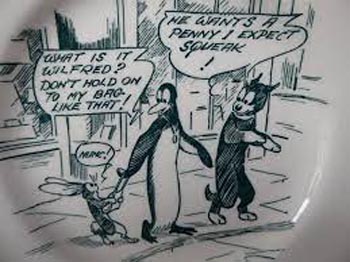 my father's membership book numbered 190560 so it must have been a very popular club. In the book it reads "Gugnuncs might form themselves into little separate clubs ..... Gugnunc choirs, jazz bands and amateur theatricals might also be easily arranged". Howard wonders whether any readers remember Gugnuncs and whether any jazz bands emerged from the club? Pip was a dog, Squeak was a penguin and Wilfred a long-eared rabbit who could only say 'Gug' and 'Nunc'. The cartoon series was discontinued in 1955
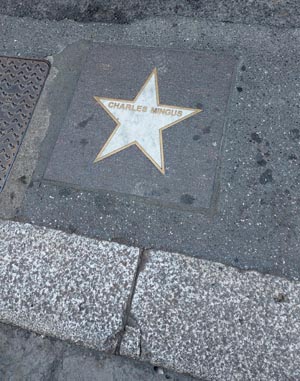
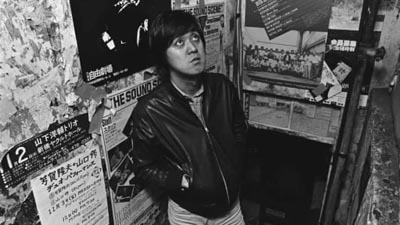
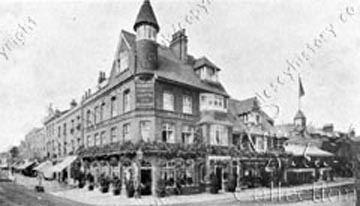

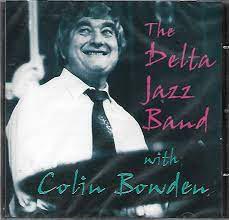 playing with the Preacher Hood's Jazz Missionaries, and in particular the period between drummers when Gerry Card left the band until Barry Martyn, back from New Orleans, joined us. During that period, we were fortunate enough to enlist the services of Colin, and boy did he give the band a lift on each and every gig. It was my responsibility to collect Colin and his drums from his home in the Carshalton area at the time. I would park up my beaten-up Ford 5cwt van, make my way to the front door and on each and every occasion music would emanate from the open windows. It was never pure New Orleans music, but Ellington, McKinney's Cotton Pickers, Fletcher Henderson, Bix, you name it. He had a wide appreciation of all jazz, and could accompany any tune you would care to name, plus The Preacher Hood band played some obscure numbers at the time, not normally heard by most of the traditional bands then. (check out "Since my best girl turned me down") Some of my favourite memories of Colin, and they will endure for the rest of the time I have left on the planet. Sad loss but great memories. Thanks for those memories Colin, you were an inspiration to us all.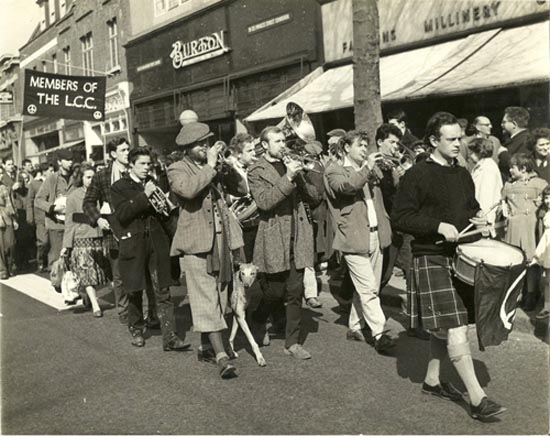

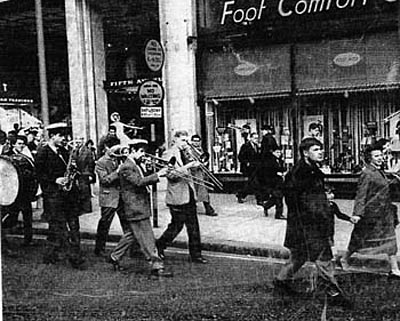
 living with my parents. Due to a terrible fog Humph and some of the other members of the band were unable to travel out. Johnny Parker and Jim Bray both came on Johnny’s motorbike as they could navigate using a motorbike in that thick fog.
 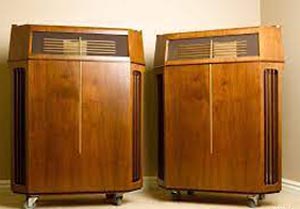 heard the sound from the Klipschorn. We played various other bands’ records, and then Johnny played on our baby grand piano some of his favourite pieces including Bad Penny Blues.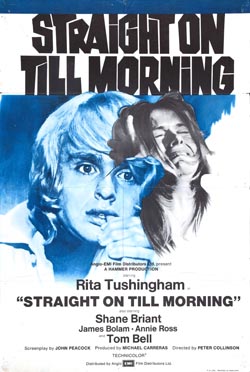
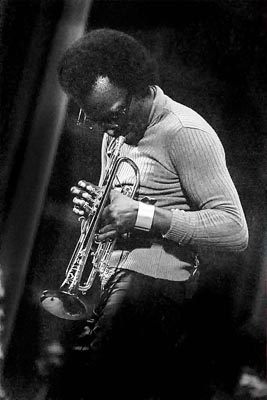
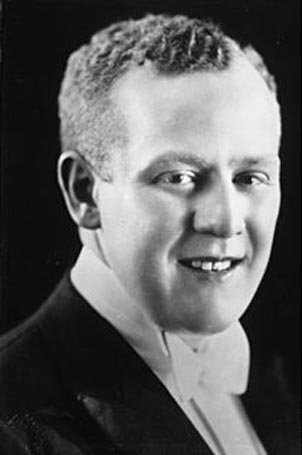
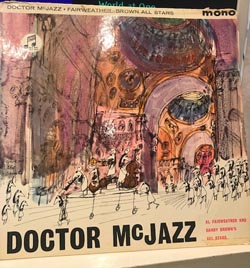
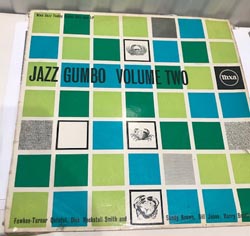
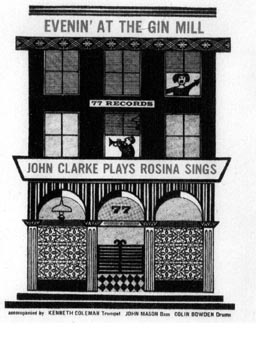
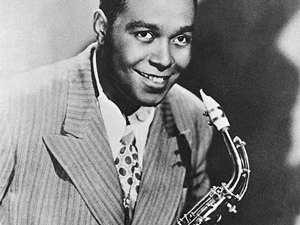
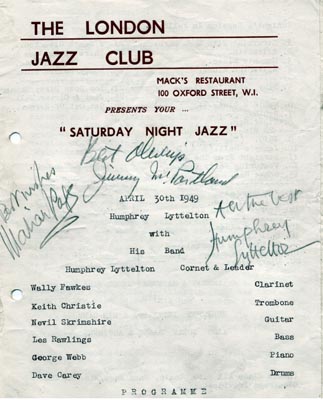
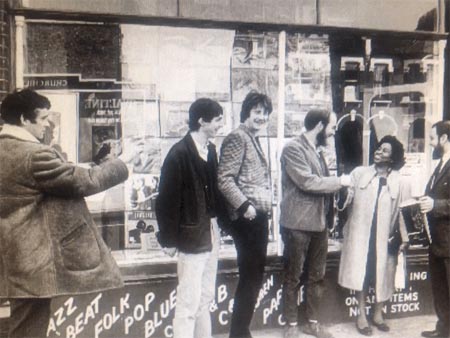
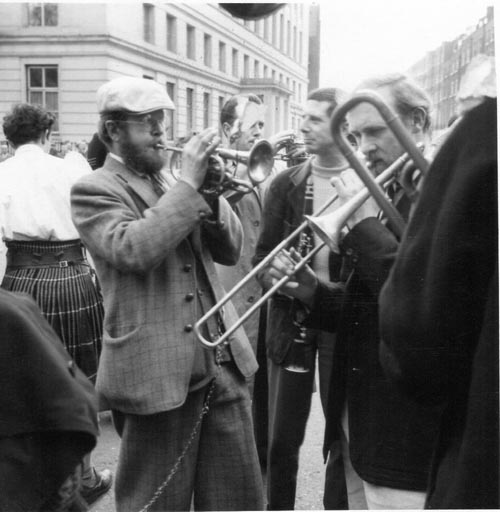
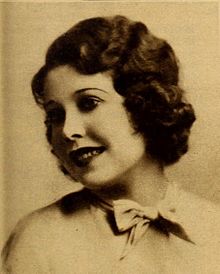 each visit Trevor would record everything he played on to a cassette tape which we would save and I have quite a few of these now transferred to CD - all good stuff. Trevor was a delightful man and he was also a regular Cranwell trained RAF fighter pilot who fought in the battle of Britain. He showed me his log books once and I was staggered to find that he had about 17,000 hours on Spitfires by the time he retired after the war. Among his collection of memorabilia was a photo of Annette Hanshaw signed by the lady herself which I would have given my eye teeth to have owned. Unusually for a singer she made very few public appearances and almost all of her work was done on records or the radio as she suffered from stage fright.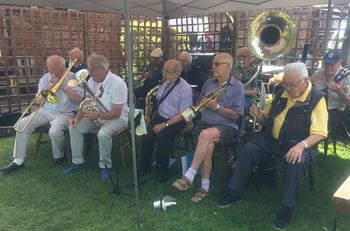
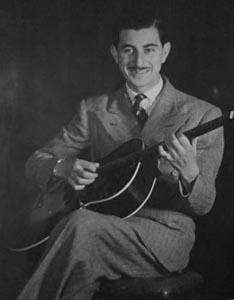 78s. Among others who were his guests were Irene Gibbons (better known of course as Eva Taylor) formerly Mrs Clarence Williams and Yank Lawson, formerly trumpet player with the Ben Pollack & Bob Crosby bands and letterly with The World's Greatest Jazz Band (always referred to by Ralph Sutton as 'the world's LOUDEST jazz band'. Vic was quite outspoken about music and referred to the world of 'pop' as 'the three chord wonders of the world'. He was the Beatles' agent for a long time and he was very complimentary about Brian Epstein as their manager and classed him as a genius. When asked why, he would reply that only a genius could turn four mediocre musicians into a multi million pound international business.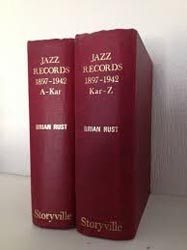
 each from selected interviews to be used. However, this involved two Archive Trustees visiting the Library, listening to the whole 6 interviews previously chosen and select the 3 minute clips. BUT the clips could only be used on the proviso we gained permission from the interviewee to do so. Of course, as the majority of those involved had passed to the Big Jazz Club in the Sky, this meant tracking down living relatives.
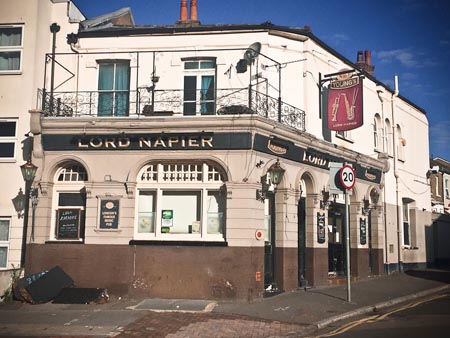 below. Progress has been slow, but demolition eventually started in April 2018.
Bill Brunskill's band were regulars at the pub for about 30 years, and Thames Television made a jazz documentary there in 1984. "Whatever Happened to Bill Brunskill" was presented by George Melly (
below. Progress has been slow, but demolition eventually started in April 2018.
Bill Brunskill's band were regulars at the pub for about 30 years, and Thames Television made a jazz documentary there in 1984. "Whatever Happened to Bill Brunskill" was presented by George Melly (
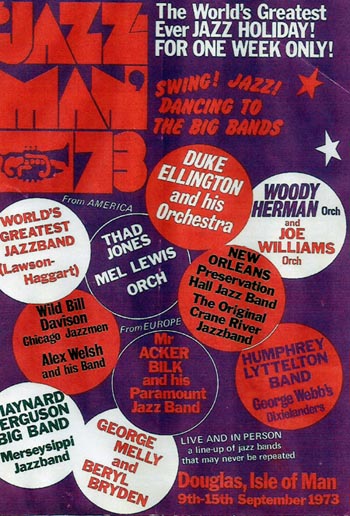
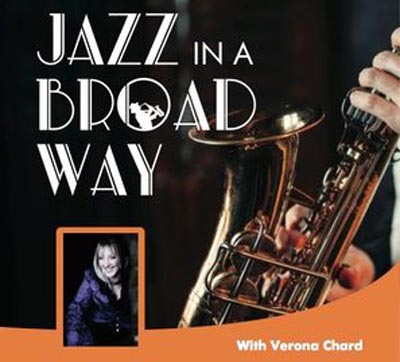
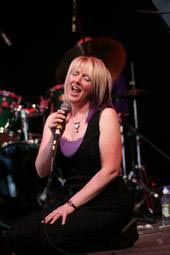 charges around £14
 Melodic Patterns in Jazz Solos.
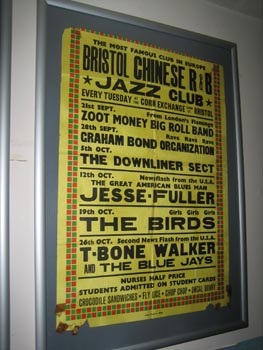
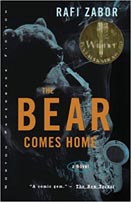


 teaching to children, or who play key roles in supporting education professionals. At least half of them teaching music'.
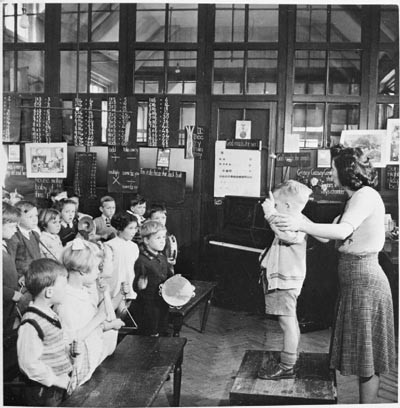 was never spoken. Every week the teacher wrote a music score on the blackboard. Then we were instructed to transpose it into another key using academic information previously drilled into us. We never actually heard the music represented so the exercise was essentially a maths lesson.
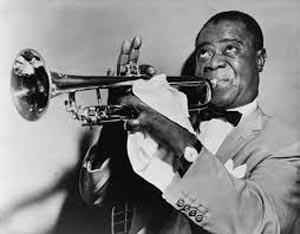 business in 3 or 5 years time? What steps and stages should you / can you take to get there? What are the challenges and opportunities? How could he, as a consultant with contacts and experience help someone achieve those steps?
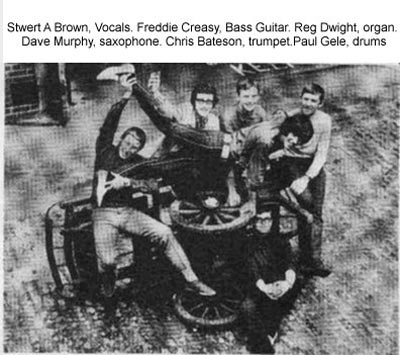 perhaps thoughtlessly told him “Chris is a trumpet player”. Roy beamed at him, and held out his horn which he had beside him. “You’re a trumpet player, man” he said “Play me some things!”
Chris froze for a moment, looked wildly round, and fled out of the door. I didn’t see him again for some weeks'.
perhaps thoughtlessly told him “Chris is a trumpet player”. Roy beamed at him, and held out his horn which he had beside him. “You’re a trumpet player, man” he said “Play me some things!”
Chris froze for a moment, looked wildly round, and fled out of the door. I didn’t see him again for some weeks'.
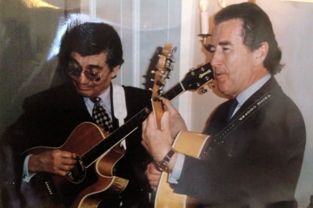
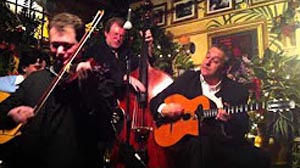
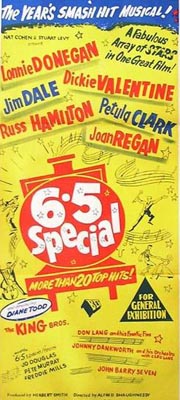
 on the basis of sound, and they all happen to be men then that’s that – there is no criticism to be made.
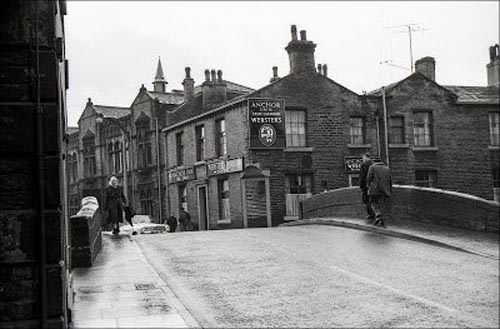
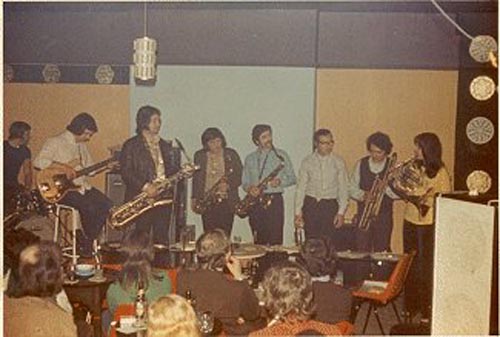
 there’s more. The man in question was Maxwell Knight (1900 – 1968), widely believed to have been MI5’s greatest spymaster.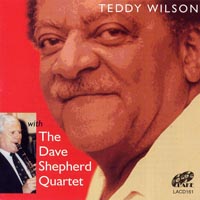
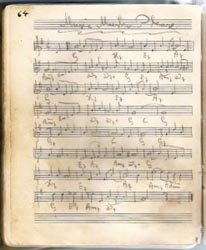 Gramophones were rare, not to speak of tape-recorders, so to keep up with popular music trends one had to listen to broadcasts from abroad.
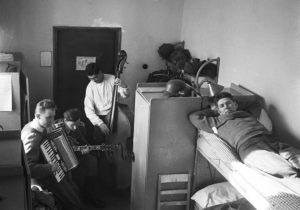 melodies I wanted were I May Be Wrong, The Continental and Music, Maestro, Please.
As a return service I was able to free him from some regular cleaning duties at the barracks and let him focus on playing with his trio for his senior officers. At present Aulis Sallinen (born 1935) is one of the best-known Finnish classical music composers and - at least to me, a real Maestro.
melodies I wanted were I May Be Wrong, The Continental and Music, Maestro, Please.
As a return service I was able to free him from some regular cleaning duties at the barracks and let him focus on playing with his trio for his senior officers. At present Aulis Sallinen (born 1935) is one of the best-known Finnish classical music composers and - at least to me, a real Maestro.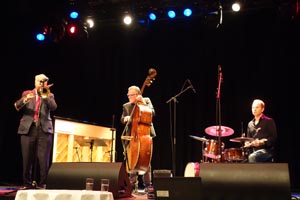 University of Science and Technology (NTNU). The Doctorate was not in music, but in science, nevertheless, Bob says: ‘I knew that the University did a good deal more than science, but I didn't know that their music department specialises in jazz. The emeritus professor is Bjorn Alterhaug, a wonderful bass player and composer and arranger. In his mid-20s he was on the Ben Webster In Norway album, and has done some excellent CDs since (e.g. Constellations and Songlines). I was invited to play with him and also with Vigleik Soraas (piano) and Håkon Mjåseth Johansen (drums). We did an hour's lunchtime gig at the splendid Rockheim building
 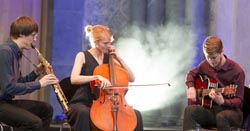 in Trondheim. This was a lovely experience for me, to play with such outstanding musicians. They even borrowed a nice trombone for me!’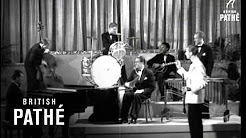


 with some negative force. She also made a second error regarding Myrna Loy and I spent a few days fuming and intending to write and read her fortune. Apathy finally got the better of me and I didn’t bother.' (Rex Reed wrote: 'The dialogue gains sparkle when he goes ecstatic about keeping the dying art of jazz alive in the style of his idols, Louis and Bird and Monk and Miles, and the instrumental passages, where he simulates playing jazz riffs with the drive and swing of Bill Evans, are downright thrilling.' Chazelle is quoted as saying: ... the two "feel like the closest thing that we have right now to an old Hollywood couple," akin to Spencer Tracy and Katharine Hepburn, Fred Astaire and Ginger Rogers, and Myrna Loy and William Powell.')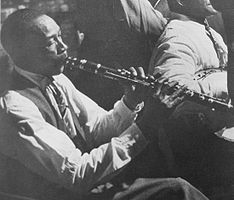
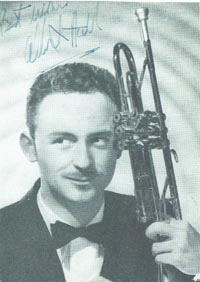

 fitting a busy schedule around golf too difficult.
He played regularly at several venues including a memorable session at the now defunct Norwich Jazz Party in a front line with Dan Barrett and Jon-Erik Kelso. Apart from playing at the said golf club many times - sometimes in a trio, other times in a quartet with Ray Simmons (trumpet and flugelhorn), Ron was in demand wherever tasteful but swinging clarinet and sax was called for.
Prior to coming to the UK Ron played clarinet with Jim Cullum's band and before that in the White House Band for many years.'
fitting a busy schedule around golf too difficult.
He played regularly at several venues including a memorable session at the now defunct Norwich Jazz Party in a front line with Dan Barrett and Jon-Erik Kelso. Apart from playing at the said golf club many times - sometimes in a trio, other times in a quartet with Ray Simmons (trumpet and flugelhorn), Ron was in demand wherever tasteful but swinging clarinet and sax was called for.
Prior to coming to the UK Ron played clarinet with Jim Cullum's band and before that in the White House Band for many years.' 

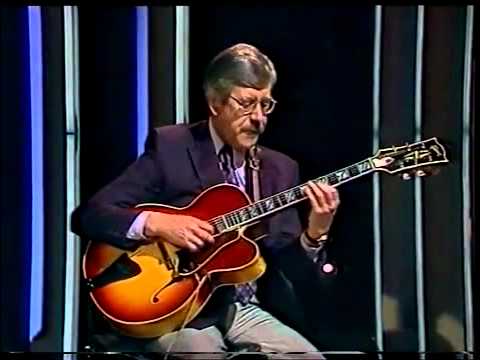 Stewart, in a theatre that is now in another use. I was only there for my liking of the guitar. I would not have gone if it were a concert of piano or brass instruments. The musicians with Louis were Jim Doherty on piano, Peter Ainscough on drums, and Dave Fleming on double-bass. I knew these musicians well from television appearances, especially from the talk/interview Late Late Show, hosted by Gay Byrne. The audience was sparse that night; a large pub would have been more suitable. I didn’t understand Louis’ music; it was a bit like hearing the same tune for the whole concert. I could only appreciate the dexterity of his finger work on the neck of his Ibanez guitar, and his plectrum dexterity.
 Germany. The Irish lead singer went back to working on the railway. Dill Katz would have gone back to England. A disheartened lead guitarist Gerry Kent remained in Ireland for a time - months to a year. A great band was decimated. In my more than five years of showbands, I regarded Gerry Kent as the finest instrumental guitarist on the Irish scene.
 on the brink of a comeback. But an attempted interview soon descends into a caper chase of drug deals, shootouts and stolen tapes, interspersed with flashbacks to Davis’s once-inspirational relationship with Frances Taylor (Emayatzy Corinealdi), amid rasping declarations that “it takes a long time to play like yourself”
 to be spent on the music and that was largely what I found missing throughout the film. I found the narrative chaotically disjointed and although Don Cheadle must have dug deep into researching Miles the man, I didn't come away feeling I had any convincing understanding of him; OK, there were few moments now and again when it felt real - e.g. the brief discussion at the piano with Junior towards the end.
  small, intimate performance space with great sound potential, an impressive lighting rig, and the willingness to put up the necessary money for jazz gigs. Obviously a marriage made in heaven – so what could possibly go wrong? Well, for fifteen years nothing much did go wrong.
 over the years. I had a fantastic team of people to help too, reliable techies who did the best job, volunteers who ran the box office, bar, coffee bar, and front of house - and generally left me free to have a lovely time! And I loved it.
 myself (circa 1973), possibly chatting after doing our regular voice/piano feature, "Crazy 'bout My Baby".
I can't speak for Pam but I very much enjoyed those duets, as I am sure did the rest of the band who always seized the opportunity to quench their thirsts at the nearest outlet.
Incidentally Pam rarely partook and the pint on the piano lid is mine not hers!
myself (circa 1973), possibly chatting after doing our regular voice/piano feature, "Crazy 'bout My Baby".
I can't speak for Pam but I very much enjoyed those duets, as I am sure did the rest of the band who always seized the opportunity to quench their thirsts at the nearest outlet.
Incidentally Pam rarely partook and the pint on the piano lid is mine not hers!  quiz, but disappointed not to find the Sarrusophone in the list.
A wonderful, rare, instrument, played by Sidney Bechet on Clarence Williams Blue Five 1924 recording of 'Mandy, Make up Your Mind.'
quiz, but disappointed not to find the Sarrusophone in the list.
A wonderful, rare, instrument, played by Sidney Bechet on Clarence Williams Blue Five 1924 recording of 'Mandy, Make up Your Mind.' musical tastes from 'Bunk to Monk' and beyond......last week we even arranged our own 'Riverboat Shuffle' on the back waters of the mighty Thames - not Mississippi!
We have just commenced our summer recess, but in the past we have had film shows, quizzes and guest speakers including Jimmy Hastings (who lives locally) and Simon Spillet, who was great!'
musical tastes from 'Bunk to Monk' and beyond......last week we even arranged our own 'Riverboat Shuffle' on the back waters of the mighty Thames - not Mississippi!
We have just commenced our summer recess, but in the past we have had film shows, quizzes and guest speakers including Jimmy Hastings (who lives locally) and Simon Spillet, who was great!'

 famous New Orleans musicians of the time, chief among whom are Louis Armstrong, Johny Dodds, King Oliver and Bunk Johnson along with a host of other familiar names (
 National Jazz Archive has been working alongside Waltham Forest to identify the residences of jazz musicians within the Borough which covers Leyton, Leytonstone, Walthamstow and Chingford. The National Jazz Archive reports on the current plan:
  Dankworth, one of the finest British jazz musicians and composers whose work is known both by jazz fans and the public at large, and of clarinettist Dave Shepherd who, in his career, has played with Billie Holiday, Gerry Mulligan, Teddy Wilson, founder of the Archive – our own Digby Fairweather, and many other renowned jazz performers. Recently, a plaque was placed on the house in Leyton where trombonist, Jackie Free, spent his first twenty five years and learnt the trombone at the local Boys Brigade. Now, following detailed research, three more jazz musicians with reputations in the UK and around the world have been identified as spending part of their lives residing in Waltham Forest and worthy of Blue Plaque recognition.
 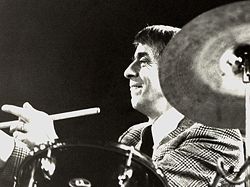 noting that it was during this tour of the UK that Leyton born trombonist, Jackie Free, played alongside Louis. In 1958 Randall retired due to ill health and, after several ‘come-backs’, died in 1999.
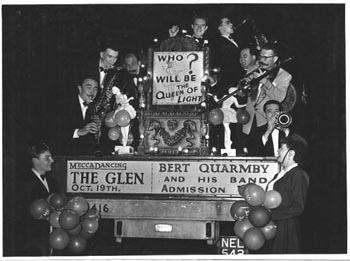 when we were in Margate in 1956 for the summer season. He always gave me 6d. The way to win any 8 year old's heart. I also remember mum and dad kept in touch with his mum and dad and remember visiting them.
Am I right in saying he also worked as Harry Miller and the Millermen?
Bert my dad died ten years ago. There is a nice picture of dad's band with Harry on drums if you go to Bert Quarmby big band.
when we were in Margate in 1956 for the summer season. He always gave me 6d. The way to win any 8 year old's heart. I also remember mum and dad kept in touch with his mum and dad and remember visiting them.
Am I right in saying he also worked as Harry Miller and the Millermen?
Bert my dad died ten years ago. There is a nice picture of dad's band with Harry on drums if you go to Bert Quarmby big band. reddy on the Tempo label in September 1949.'
 he was soon playing with the orchestra at the jitney dance hall.
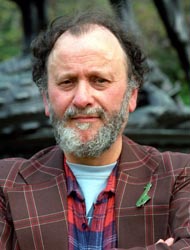 him (Dexter Gordon, Art Blakey, Count Basie, Adelaide Hall, Andre Previn....) and without exception they were amazing. It is a shame that he never quite managed to capitalise on his knowledge, writing, and recorded interviews. He had an incredible interview technique and knowledge of the subject. I have many fond memories of the way he managed to get the interviewees to talk about themselves on a musical level (not gossip).
  the mixing process.
 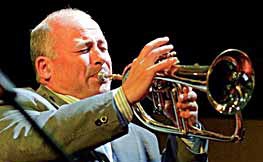 Goodmanesque. He was also a sight reader and with perfect pitch.'
 'I once did a gig with Alan Cooper. He was a fine clarinettist almost from the word go. In the early days he had a metal clarinet, a bit of a novelty at the time.'
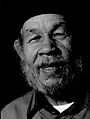 contact the Jamaican trombone player Rico Rodriguez. Please
  touch with Alex's wife Maggie: 'We started seeing each other and eventually married and have a son William. I returned to professional ranks in 1986 to join Digby Fairweather's 'Superkings' and subsequent shows such as 'Let's Do It' with Paul Jones, 'Lady Sings The Blues', Val Wiseman, and 'The Great British Jazzband'. I also toured Germany with an all-star American band led by Bob Haggard, and played the Berne Festival, etc. I was involved in quite a few recordings during this period including three CDs for a Post Office sponsored band - the 'First Class Sounds'.