
THE CLPGS CYLINDER JAZZ RECORDINGS
and
THE EFFECTS OF RECORDING ON JAZZ
In September, 2007, the CLPGS or to give the organisation its proper title The City of London Phonograph and Gramophone Society Ltd., held its Annual General Meeting at the Lord Leycester Hotel in Warwick. We hear that as usual the weekend was filled with informative talks, social gatherings and indulgent meals, but after lunch on the second day, the weekend came to a close with a novel experience.
The Society was entertained by a jazz group with Mike Durham (cornet and trumpet), Jon Penn (piano), Norman Field (clarinet and saxophones) and a special guest, Tom ‘Spats’ Langham (banjo, guitar, ukulele).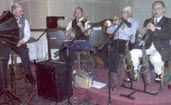
What made the experience special was that cylinder recordings were made of some of the numbers and then played back to the audience. The band captured brilliantly the feel of small band jazz from the 1920s and 1930s with some fine solos. For single, unmixed takes the band showed that recordings can still be made on vintage equipment with vintage performances.
The CLPGS Quartet
 Since then, some of the recordings have been transferred to a CD. The CD is not at present available commercially which is a pity as there are some great tracks here – we particularly enjoyed Harlem Madness and a slow tempo version of Sugar.
Tom 'Spats' Langham
The success of the session encouraged the CLPGS to make a second attempt in 2008, this time with a slightly larger band. Society Chairman, Richard Taylor, takes up the story:
"On Sunday afternoon the audience arrived to see Duncan Miller with his large black recording horn in front of six eager jazz musicians.
Dennis Armstrong (who came up from Bristol at late notice to replace Mike Durham who was unable to be with us) played trumpet. Paul Munnery was on trombone, Norman Field played clarinet and Tom ‘Spats’ Langham played banjo. Jon Penn played his electronic piano and Nick Ward was on the 1920s drum kit.
Duncan had brought plenty of blank wax cylinders to enable him to record every 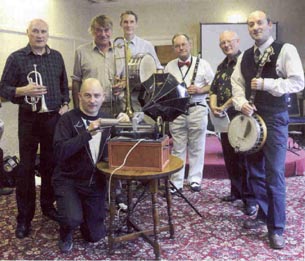 tune. At The Jazz Band Ball was performed to enable the recording head and stylus to be set for the correct levels. Although Duncan had set up the band with the brass instruments to the back, the banjo was too prominent and had to be moved back, and Nick on drums had to play a little quieter. This done all was ready to start; away went the band in good form on Tin Roof Blues. Duncan had told the audience not to applaud until he raised his hand.
The CLPGS Sextet with Duncan Miller
The room was full of tension for what seemed an age before we were able to clap and cheer. All was going well. ‘Spats’ played a banjo solo; two takes were required, the second moving him nearer the horn. The rest of the band returned and off they went, number after number being cut.
In all, fifteen waxes were recorded. The audience was not left out; at the end of Sensation Rag they were crowded forward toward the horn to applaud. They were also asked to shout ‘O play that thing’ at the appropriate time on Dippermouth Blues. All had an enjoyable time, and if Duncan can work his magic we may well have indestructible recordings to buy as a memento of the occasion."
Duncan explains the technical aspects of making the recordings:
"The machine I was using is an adapted Edison concert phonograph top works with the addition of a flywheel to give steady recording speed. The recorder is of the trunnion type used in the Edison and other studios from about 1903 onwards and the diaphragm is 33mm in diameter and of glass in this case, about 5 thousandths of an inch thick. For the session I used a 33” long flared horn. The wax and the blanks were made by me using the similar formula to the 1900s blancs and are made longer than the finished cylinder to allow for the later processing.
We cut two-minute records as they can be played back without damage to the groove; the finer groove 4min records can be cut but we would not be able to listen to them until the records had been processed.
I have just been rebuilding the electroforming equipment and plan to produce moulds from the masters."
The City of London Phonograph and Gramophone Society Ltd. Website is at:
www.clpgs.org.uk
Photographs courtesy of CLPGS/Robert Girling
Mike Durham
It would be fair to say that the invention of sound recording or, more particularly, the growth in commercial recording had, and indeed is still having, an effect on most if not all musical genres.
In 1917 the first jazz records were made. Columbia has the distinction of being the first company to record a jazz band but it didn't issue the recording. It was Victor that first issued a jazz record: a recording of the Original Dixieland Jass Band (note that it was called 'jass' at that time). This recording brought jazz to the attention of the world and it sold in hundreds of thousands. Although it came from New Orleans, the ODJB was made up of white musicains. Meanwhile, the New Orleans Rhythm Kings, who were also white musicians, tried more to emulate the authentic black style of music.
Of course, these early jazz records were made in the acoustic recording era with all of its attendant restrictions, not least of which was the requirement for musicians to produce a good volume level. The vocalists needed to be 'iron-lunged' and they developed, by necessity, a declamatory style of singing. Good examples of this early style of performance from 1926 are Thick Lip Stomp by Bennie Moten and his Kansas City Orchestra and Grandpa's Spells by Jelly Roll Morton's Red Hot Peppers.
With the arrival of the microphone and amplifiers the tyranny of the acoustic studio was gone. The musicians no longer had to crowd around a horn and instead could spread out in a more natural way.
The increased dynamic range of the recording system meant that now there was also a greater artistic freedom for composers and performers. The 'crooning' style of singing arrived as well as a more relaxed style of instrumental playing (e.g. Bix Beiderbecke's Blue River with vocalist Seeger Ellis).
In the acoustic era, bass drums were not allowed in the studios, partly because of their size and also because their low frequency sounds were beyond the range of the recording. Mutes were used in brass instruments to keep their volume down enabling a better balance with quieter instruments and voices to be achieved. The sound of Johnny Dodds' Black Bottom Stompers playing an un-muted Come On and Stomp, Stomp, Stomp is more like the actual sound of a jazz band of the period.
Those early recordings continued to have an influence on later generations of jazz musicians. The revival of the New Orleans jazz style of the 1940s and 1950s had many adherents in the UK and Europe. One such was the French clarinettist Claude Luter who was inspired by the recordings of, amongst others, King Oliver. Even jazz revivalists today use the old acoustic recordings as reference material. Maybe the constraint of the standard 10-inch, 3 minute record sometimes had a positive influence on jazz music making?!
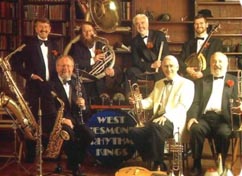
Cornettist/Trumpeter Mike Durham and the West Jesmond Rhythm Kings
Mike Durham's band is West Jesmond Rhythm Kings, he also leads Spats and his Rhythm Boys, organises the Whitley Bay International Jazz Festival and monthly concerts for Jazz @ The Exchange in North Shields.
© Sandy Brown Jazz 2008 - 2014