According to a website about London’s Sacred Sites there have been a number of locations linked to the magician Merlin. At Merlin's Caves in Kent (commonly known as Chislehurst Caves) there are, apparently, nine druid altars and the site is thought to be more than 8000 years old. There was a Merlin's Cave underneath The Penton and near a pub by the same name in Islington, and according to the website Dead Pubs, there was a Merlin's Cave pub in Rosoman Street, Clerkenwell which was also known as New Merlin's Cave in 1851.
Sadly, we have no evidence of the magician Merlin or of one of his caves beneath the pub that stood at 34, Margery Street in Clerkenwell ... but who knows?
Somewhere around 1970, pianist Johnny Parker and reed-man Wally Fawkes were playing at a pub in Cross Street, Islington. For some reason, they and trumpeter John Chilton decided to move to a nearby pub at 34 Margery Street, London, WC1 – the New Merlin’s Cave, and it was there that pianist Graham Tayar first heard them.
The pub was a short walk from King's Cross Station, down Gray's Inn Road and turn left down Calthorpe Street. The landlord, Bertram Stephens, ran the pub according to the book, as at one stage the police had closed it down for music being played too late. Johnny, Wally and John would play on Sunday lunchtimes, and many people would turn up with their children. Children in a pub! Bertram was not happy! You couldn’t have children where drinks were served, so he tried to ban them.
Jazz at New Merlin's Cave: Alan Elsdon (trumpet), Bruce Turner (saxophone) Ian Christie (clarinet) and Graham Tayar by the bar. Photograph by Dick Scott-Stewart courtesy of Graham Tayar.
‘So what did we do?’ says Graham Tayar, ‘First, I went to the local police station and spoke to the Chief Superintendent. We reached an agreement that as long as the jazz was played in a separate room, the police would not object. We then promoted the jazz sessions through the press and the radio and gradually built up a strong family audience, including a priest and a vicar. I presented a mini-feature on Radio 4’s Start The Week programme and this helped to draw in the crowds. A place where you could take your kids, have a pint and listen to jazz!’
‘It was a tatty old pub,’ recalls Graham. ‘It was probably late Victorian. There was a corridor that ran from the pub to the room where the band played. The room had a small stage at one end and a limited amount of seating. Most people stood and listened. Of course people took their drinks to the room and so we were not strictly able to separate the alcohol from where the children were. You could go to the pub at other times during the week and it seemed seedy, but come Sunday lunchtime the atmosphere changed somehow with all the people, the families and the music.’
Ron Rubin, pianist and bass player, remembers it as a 'scruffy dump' - 'If this is the New Merlin's Cave, what can the old one have been like! It was an elephant's graveyard for old pianos - they went there to die!'
The Sunday lunchtime club grew in popularity. It was originally organised by John Chilton and Duncan Hamilton, a trombone player and college lecturer, assisted by Graham. Eventually Duncan emigrated and Graham took over the reins.
‘George Melly came along most weeks,’ says Graham. He wasn’t singing regularly with the Fawkes/Chilton Feetwarmers at that stage, although John and Bruce Turner were playing at the club. Then John Chilton and George decided to go on the road and Wally left as he didn’t want to tour. Other musicians came along to take their place. More often than not Colin Smith or Alan Elsdon was on trumpet, John Barnes or Bruce Turner on reeds, Keith Ingham played piano, Harvey Weston, bass, and John Armatage was on drums. But many other musicians played there, including visiting Americans. I can remember that Billy Butterfield, Teddy Buckner, Milt Buckner, Roy Eldridge, Jonah Jones and Slim Gaillard all came along at one time or another.’
‘Sid Perelman, who attended regularly, even tried to persuade Benny Goodman to drop in for a blow, but Goodman – understandably – wanted to spend his Sunday mornings sleeping!’
Richard Greatorex send us this early picture of New Merlin's Cave.

Richard says: 'The photo dates from the First World War, and shows Margery Street (Margaret Street) from the Amwell Street (Upper Rosoman Street). The original pub and neighbouring properties were demolished to make way for Charles Rowan House (built 1928-1930), but the original New Merlin's Cave must have closed some years earlier, as its successor was built 1921-2.'
If in the picture you look to the right of the pub, you will see across the road a building site, Richard points this out as the location of the second New Merlin's Cave when the original pub and neighbouring properties were demolished to make way for Charles Rowan House (built 1928-1930). Richard goes on to say: 'Perhaps, I should correct the “original pub” as the pub in the photograph was the third so named in Clerkenwell. The pub further back, corner of Margery Street/Fernsbury Street (Ann Street) was the “King William IV”, also demolished in the 1920s. The anti-aircraft gun in the foreground (inside the wooden construction being hosed by the man on the left) was located at the New River Head site of the Metropolitan Water Board.'
Click here for maps and early details of the area.
By the 1980s, things began to tail off and audience numbers fell. The New Merlin’s Cave pub was pulled down in the 1990s.

Here once stood New Merlin's Cave
Nevertheless, during its heyday, New Merlin’s Cave hosted jazz from some of Britain’s most popular jazz musicians. In October 1975, Bruce Turner and John Barnes recorded their Jazz Masters LP live at St Pancras Town Hall with Colin Smith, Keith Ingham, Harvey Weston and John Armatage, and Graham Tayar formed his own band – The Crouch End All Stars – with John Keen (trumpet), Ken Blakemore (trombone), Graham Tayar (piano), Hilary Graham (banjo), Don Smith (bass), Ken Pring (drums) and Ian Christie on clarinet. Ian took over from Wally Fawkes who had played with the All Stars for seven years. They recorded the album Sunday Best album in 1986 with Jim Bray depping on bass.
Graham says: ‘The band is still playing after forty years with many of its original members, all in their seventies. Wally, who has rejoined the band is an octogenarian and is still playing magnificently.’
Writing in the Illustrated London News of September 1984, David Mitchell said: ‘The New Merlin’s Cave, near King’s Cross, where the pub jazz revival of the early 70s began, and where some of the musicians responsible for it still play, is a must for any serious fan. With such lively exponents of the punchy, pre-bop jump band style as saxists Bruce Turner and John Barnes, pianist Collin Bates, and trumpeter Alan Elsdon, you can guarantee a groovy lunchtime. Graham Tayar … presides as MC and takes the collection in a pint mug.’
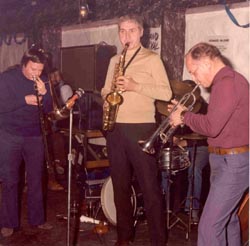
Pete Strange, Bruce Turner and Ray Crane
Photograph © Graham Tayar
David Mitchell’s article gives a very good feel for the time. He pointed out that pub pay was poor and that ‘members of a 16-piece big band would be lucky to get a fiver each.’ Entrance was usually free, although drink prices were slightly increased, or there might be a collection or a small entrance fee. David pointed to the need for people like Graham Tayar: ‘To a very great extent the future health of pub jazz depends on zealots like him. Publicans change their minds, customers fall away and there are casualties. In one short four-month period (in 1986) three long-standing dates disappeared from the calendar.’
It is over sixty years since Graham went to King Edward's School in Birmingham with pianist Ray Foxley and followed Ray to the Old Crown and other pubs to hear jazz in the 1940s and 50s. Graham taught himself to play piano and his love of jazz stayed with him through his time at Cambridge, in Ethiopia, and during his work with the BBC as a radio producer. Now retired, he still plays once or twice a week. His role in building up the New Merlin’s Cave as a key London jazz venue in the 1970s is part of Britain’s jazz history.
Dave Bowen remembers the place well:
'Pleased to read the piece about the New Merlins Cave. I was a regular visitor and sometime sitter-in there in the early 70s. Was it John Chilton who dubbed it The Pudding Club in tribute to the numbers of children with their parents? It wasn't exactly a healthy place for them to be considering the fug of smoke that hung in the air. You had the added interest of the possibility of a famous guest sitting in.'
'One such memorable occasion was a visit by trumpet player Bill Coleman and I seem to recall the clarinettist Matty Matlock having a blow on another session. Sandy Brown came down sometimes and I still recall a great extended solo he played on "I Can't Get Started". I read somewhere that the writer Laurie Lee was also a fan and regular visitor.'
A story that would be remembered only by the musicians involved (and I'm sure confirmed by my old mate Mel Henry who was also present) was a late night private birthday drink at the New Merlins Cave for Johnny Parker (late lamented) which ended with the sudden arrival, through all portals, of a what seemed like a very large contingent of local police officers who must have suspected it was the site of an illegal drinking den. What stands out in my memory is the trumpet player Alan Wickham, no shrinking violet he, who encircled a group of rather startled young coppers, berating them for victimising innocent musicians having a quiet private drink when they should be doing something useful out in the streets and dealing with "all these blanking protesting students". Happy days!'
Mike Durell writes:
'Regarding Merlins Cave, I would like to claim to having played the coldest gig of the century at this pub. I was there with Eddie Thompson on piano and Jim Hall on drums. It was in the middle of the very cold winter about 1982/83 I think. We played both sets wearing our overcoats and scarves. There was no heating on whatsoever until just as we were packing up at the end, I happened to touch a radiator at the back of the stage and it was just about warming up at one end! Happy days?. '
'Another memory is of being called in at very short notice on a Sunday morning to accompany Bob Wilber (the resident bassist Pete Chapman was indisposed or something). Bob was not the featured or advertised soloist on this gig, but had just been bought along by someone as a guest. I was working every night at the Playboy Club at the time, had stayed overnight somewhere and only had my bass guitar with me. We played a set OK, can't remember who the others were. When Bob Wilbur, who had a reputation for being outspoken, got on the stage he looked pointedly at my Fender bass and said "What the hell is that?" I had to explain to him that it was a Fender bass guitar made in America where he came from and that if he was not happy with it then get off the stand. Everything went very quiet and he picked up his soprano without another word. The gig went very well and everybody was happy. Those are my memories of Merlin's Cave!'
Jo Thorpe recalls that :
'I was one the kids tearing around the Merlin's Cave on a Sunday afternoon ... my mum Andree used to take me there religiously every Sunday with my 3 brothers!
It was a great education for me and my brothers. One of my brothers is now a professional bassoonist ....
I love music and love to sing.... and only have fond memories of being there and playing around on the stage which, if I remember correctly, had a cave- like frame on it ... and meeting many of the muso's there and being encouraged to have a go on the drum kits etc!
This would have been in the 70's, I think. Thanks for your page, this brought back many fond memories'.
We also received an enquiry about a lady named Eddi MacPherson who might have sung with the Sandy Brown band during the late 1950s / early 1960s. Jo Thorpe also wrote to say: 'I saw your request for information about a lady called Eddie Mcpherson... I knew her too she was a good friend of my mum's.. I couldn't say wether she sang in any band, I do know she used to work in clubs... because my mum used to look after her son Graham a lot.... Graham later went on to be very famous as the lead singer of Madness... He was also one of those kids running around the Merlin's Cave on a Sunday afternoon'.
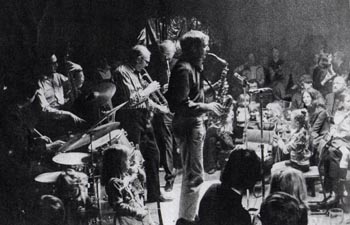
Dave Bowen sends us the this picture of a session at Merlin's Cave. He is not sure of the picture's origin, but says: 'It gives a very good impression of the atmosphere of the Merlin's Cave sessions in the 70s. With Wally Fawkes, John Chilton and Bruce Turner (at the microphone). I believe it has Geoff Kemp on bass and it looks like Eddie Taylor on drums. The pianist is clearly obscured!'
John Perkins remembers New Merlin's Cave through a haze of London's Pride: 'I remember gong to Merlin`s Cave in March 1977. We were visiting a friend of a friend who lived off Grey`s Inn Road The first time we had visited London from Herefordshire. We spent most of the Sunday afternoon in there listening to the music. As I recall a famous drummer from America did a session but I can`t remember his name – too much London`s Pride!
In the evening my friends and I went out on the town while our host went to a nearby postmen`s social club to play darts!'
Marcus Howell writes:I have just seen the website with reference to New Merlins Cave. I remember this pub with many great Sunday lunchtime gigs. George Melly would wander in carrying his helmet - he had just got off his moped. The pianist Lennie Felix would sometimes pop in, and on one occasion the dapper Bud Freeman, the Chicago Tenor player, wandered in with Lennie Felix.
Mostly The Late Great Bruce Turner would lead proceedings and in the early days Keith Ingham would sit in, eventually he emigrated to New York. Johnny Barnes, Alan Elsdon and sometimes Colin Smith would also play on various occasions. These were great days for British Jazz.
Geoff Mason adds: 'It wasn’t only jazz at the New Merlins Cave. I had a disco residency there in the early 70’s, the landlord at that time was quite poorly, heart condition I think, but in an effort to trend the place up a little he decided to make the back room look like a cave - plaster of paris over chicken wire on a timber frame and painted grey, he did the stage end and then lost interest. But it was always cold in there and it never took off as a disco, I left there and went to the Market House in Broadway Market in Hackney'. Now it looks as though the Market House has been revitalised as Geoff writes in 2013: 'I passed through Broadway Market and I was delighted to see that the Market House has been refurbed and is a going concern again, although by the time you read this it may have closed again, but at least it’s no longer in a state of dereliction. By the way the name of the landlord at New Merlins when I worked there was Steve'.
Allistair Beckett adds his memories showing that it was not just jazz there:
'Hey great to read about the old New Merlins Cave . So sad that that as well as the Hammersmith Clarendon Hotel it is now no more !!'
'I remember playing as drummer of Surfin Lungs at both venues many times in 1984,85 and 86 era. There was a great little garage scene going around that time and other great bands such as Surfadelics, Volcanoes, and Cannibals were all regulars. I remember Merlins Cave landlady having a huge Alsation dog to help persuade late revellers to leave -happy days !!!'
Michael Gilmartin writes:
'I used to go to the Merlin on Sundays. One Sunday George Melly was in the crowd and sang, The Whores Go Crazy 'bout The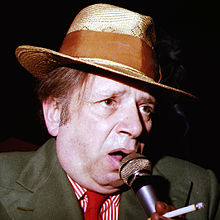 Way I Ride. Another one of my heroes,Viv Stanshall was a regular. I still miss that pub. I am a London licensed taxi driver and in the late nineties, I picked up Benny Green. I told him of my love of George Melly and he hit the roof, claiming "he wears dead men's clothes". Why he hated George I will never know as he is dead now. I've always thought that anyone who likes jazz is a bit strange - well, perhaps just different.'
All The Whores Go Crazy was written by Kid Ory and appeared on the album It's George by George Melly with John Chilton's Feetwarmers. As well as John Chilton on trumpet, Johnny Barnes was on baritone sax and Tommy Whittle on tenor sax. That album no longer appears to be available except on second-hand vinyl, but click here to sample the tune on an album by the Crane River Jazz Band. You can also click here for a video of John Petters' band playing the number in a Tribute to Ken Colyer session. The words have been changed to All The Girls Go Crazy, but the original lyrics are sung in the second verse. Before the title was sanitised, there is a much earlier 1945 version of All The Whores Go Crazy by Wooden Joe Nicholas (trumpet), Albert Burbank (clarinet), Jim Robinson (trombone), Lawrence Marrero (banjo), Austin Young (bass) and Josiah "Cie" Frazier (drums) - click here
Viv Stanshall was best known as the singer with the Bonzo Dog Doo-Dah Band. He died in 1995 - click here for the first part of a documentary programme about him introduced by John Peel.
2013.10
Robert Missen adds:
I have only just seen your website on New Merlin's Cave and would like to share some of my reminiscences of the pub. I first went there in the early 1980's with family and friends. We followed the late great pianist Eddie Thompson , and New Merlin's Cave was recommended to us as a very good jazz venue where WallyFawkes, George Melly and others had performed in the past.
It was without doubt the scruffiest pub I had ever been to. The bar always seemed awash with beer and the toilets were unmentionable! However Ina and Jacko behind the bar always made us very welcome and where else could you see week after week such marvellous musicians as Colin Smith, Alan Elsdon, Digby Fairweather, Alan Barnes, John Barnes, Roy Williams, Brian Leake and Ron Rubin to name but a few. I remember the children in front of the stage and sometimes on the stage, and how the pianists got such wonderful tunes out of such terrible pianos I will never know. Finally Graham Tayar was always a fixture rattling a pint mug containing the entrance fee. Happy Days.
2014.5
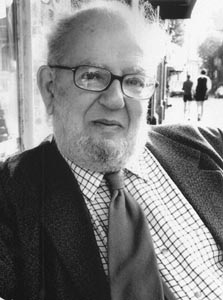
Graham Tayar - The UK pianist who led the Crouch End All Stars with with John Keen (trumpet), Ken Blakemore (trombone), Graham Tayar (piano), Hilary Graham (banjo), Don Smith (bass), Ken Pring (drums) and Ian Christie on clarinet. Ian took over from Wally Fawkes who had played with the All Stars for seven years. Graham told me about setting up the jazz club at New Merlin's Cave not far from London's Kings Cross Station for this page on New Merlin's Cave where above there is a picture of Graham at the club standing by the bar. Graham's funeral was on Friday 6th May midday at Golders Green Crematorium, followed by a celebration in the Bull & Gate pub in Kentish Town.
Graham Tayar b. 5.8.1933 - d. 22.4.2016
Martin Guy wrote: Sorry to hear this. Many memories of Sunday lunchtimes at New Merlin's Cave with John Chilton and George Melly and also of being an occasional Crouch End Allstar. RIP Graham
Mike Reynolds looks back at the legendary jazz venue: 'I was walking along Margery Street recently and thought about the pub where I used to go on a Sunday.
I worked in High Holborn and would zoom off to the Cave in my lunch break to get at least a half hour fix of the wonderful sounds and images not to mention smells of this rough old place.
One Sunday I persuaded my wife to come along and we also took our 2½ year old son as I knew children were allowed. We lived in Tilbury then so it was a long day out. The date was 9th September 1973. I took along a cassette player/recorder from Dixons and a sixty minute tape. We arrived a bit late but I sat with this little machine on my lap and recorded about 50 minutes of music. The sound is definitely not great hifi but still listenable and extremely nostalgic. The line up that day was John Chilton, Bruce Turner, Colin Bates, Steve Fagg and Chuck Smith. Last but not least George Melly. In a couple of places I can hear myself and my young son and when he dropped his dummy George announced "Oh dear, he's dropped his placater"! Lovely to hear it still after 46 years. I must admit my son doesn't get excited about jazz in any format. I blame myself and George Melly.
Great piano too.
On another day there was this wonderful singer fresh in from the U.S. who just had an amazing voice. Susannah McCorkle. I remember that session well. I have a vinyl with her singing with Keith Ingham who sometimes played at the Cave. It was a tragedy she died too young.'
2019.12
Tris Murray writes: 'My mum used to bring me and my brother to New Merlin's Cave in the '70s to catch George Melly and John Chiltern's Feetwarmers. We kids would run around outside, occasionally plunging into the smokey fug for crisps and lemonade. I now run a gallery in Queens Park, Kilburn. I want to do a photographic exhibition celebrating the Jazz scene at NMC in the early mid '70s. There was always a photographer who sat by the door. I believe that was Dick Scott-Stewart. Can you help with his archive, or any other photographers that took pics there?'
[Our page on New Merlin's Cave was started some time ago and the one picture we have by Dick Scott-Stewart is not good enough for an exhibition. If any readers do have pictures and can help Tris, please contact us and it would also give us an opportunity to update the page - Ed]
2020.4
John Rivaldi says: 'I used to live in Rosebery Avenue so I could walk to Merlin's Cave in about five minutes, I went regularly and listened to bands - I would have been about 18 years old. I remember one time seeing Champion Jack Dupree there, Johnny Parker then had a go. Johnny Parker had some kind of medical problem and had trouble climbing the steps to get to the stage, Champion Jack remarked “That’s what you get when you go with strong women”. I was also very close to Cross Street, off of Essex Rd and Upper Street, a pub there called the White Horse (?) something like that, very, very good, and in Upper Street itself was the Kings Head. As a little side thing, the Kings Head refused to go metric - drinks were in pounds, shillings and pence. Living in Rosebery Avenue I was a regular at the 100 Club. When I first joined it was called “Jazzshows“ (I think), there was no bar; when you went in, on the right where the bar is now, were rows of cinema type tip-up seats; then they introduced beer and Chinese food. Ken Colyer was the band for me, also others such as Dick Charlesworth and The City Gents, Acker was also good in those days. My Dad introduced me to jazz - in the 1930’s and followed Armstrong, Kid Ory, Fats Waller, etc.'
2020.7
Peter Rowlands says: 'I have read the various comments on this pub, which I went to regularly to hear jazz in 1973/4. However, the comments only refer to the Sunday sessions, which I went to sometimes, but I more often went to a mid week evening session, which featured the same players as the Sunday session, (Turner, Chilton etc) although I can't recall George Melly ever singing at these sessions. It was always a good night, partly because it featured one of the great British jazz musicians of the time, Bruce Turner, who was always a joy to listen to. That is not to belittle John Chilton, who was a very good musician.'
2020.8
Tim Whiteley writes: 'I’d just like to share some reminiscences of Merlins Cave.
When my two daughters were 5 and 6 (roughly) respectively and becoming more demanding at the weekend we started the Sunday habit of slogging from Hertfordshire down to Merlin’s Cave for a liquid lunch and the sounds of the best jazz in Britain.
There was indeed at this time a semblance of the requirement to keep the younger children apart from the dense cigarette smoke and beer-driven Bachanalia which pervaded but all that was required was to establish a dry and less-smelly table where the kids could have fun with their crayons and colouring books. Our children are now in their 50s with part-remembered memories of some of George’s more ‘dodgy’ numbers and a well-founded interest In jazz. What more could we ask for? Perhaps the re-building of the old dump which was our home on Sundays ? Perhaps to hear the once more the horn of Ruby Braff who spellbound us one Sunday morning as he passed through London. You don’t forget these things do you ?'
2022.9
If you can add to these memories of New Merlin's Cave, Clerkenwell, we should really like to hear from you: please contact us.
If you found this page interesting, you might also like our pages on:
Wood Green Jazz Club: Fishmongers Arms
The Cy Laurie Club
The Dancing Slipper, Nottingham
Cooks Ferry Inn
The Six Bells, Chelsea
The Prince Of Wales,
Buckhurst Hill
Eel Pie Island
Click HERE to join our mailing list
© Sandy Brown Jazz 2010 - 2020