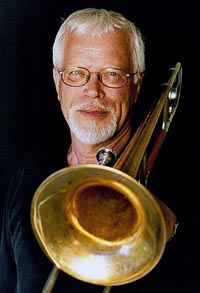
For 35 years, trombonist and bandleader Ole ‘Fessor’ Lindgreen had led ‘Fessor’s Big City Band’. Their music might have been rooted in New Orleans, but this was one of the most unprejudiced bands in Denmark. When the band broke up in 2003, Fessor went on to guest with many other bands as well as playing with the Grand Danois Quintet.
In 2005, he had just returned from Portugal where he met up with free jazz trombonist Roswell Rudd - someone Fessor had been in touch with for a number of years and was was faced with a decision about how to use a grant from the Association of Danish Jazz-Rock and Folk Music Authors (DJBFA) to make a record that reflected the story of the Blues.
“I was thinking about how to handle the project,” says Fessor, “so one night I was sitting in this small Copenhagen venue, talking to tuba player Jacob Munck, and he got very enthusiastic about it, telling me about this ‘artists’ house’ in Mali. And I thought, ‘wow, Mali’, ‘cause I got Roswell’s record ‘Malicool’, and he had described everything about it.”
Fessor Lindgreen
“Next thing was that Jacob mentioned it to guitar player Niclas Knudsen, who I hardly knew. I had never played with him until then, but he turned out to be a great guy, and he wrote some great tunes … and then alto player Søren Siegumfeldt heard it through the grapevine and asked if he could come along. I told him he was most welcome, I’ve played with him on a few occasions and he’s also familiar with many kinds of ethnic music.”
“So we split for the town of Koulikoro, Mali and stayed for a month at this house that actually belongs to bass player Moussa Diallo. Before we left I’d been fiddling around with some of Niclas’s tunes … a bit tricky, but I like them. Søren also brought a few tunes along, plus some old Danish songs, so we had some sketchy things in the back of our heads when we started working together.”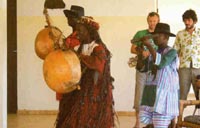
“As we were staying for a month, the best thing to do was to hire a small bus and a driver. That turned out to be great as our driver, Ibrahim Nienta, knew just about everybody around. He connected us to several musicians, so we got to meet Toumani Diabaté and some of his musicians, and one night Ibrahim took us to a big wedding party and of course there were musicians there. I mean, music is such an integral part of their life.”
“There wer e several similar situations where we met some great musicians, more or less by accident, who were interested in playing and recording with us. One night, at another wedding party we met one man playing a small wooden piano and another playing a talking drum. Niclas had brought his computer equipment along for recordings, but sometimes, without a word of warning, electricity broke down … that’s the way it is in the countryside ... talk about field recording….”
“During our stay we really felt that we were respected by the musicians, and it was obvious that they felt it was fun to join in – very open-minded, and the youngsters were incredibly nice to me when it came to teaching me their stuff. With me being the oldest and grey-haired, they always brought me a chair – sort of protecting the old man.”
“Let’s face it: the money was not entirely unimportant, of course, as they are really poor. And when I 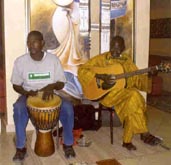 say poor, I mean that they have to live on an average of one dollar a day, so what we paid them for doing the sessions with us was considered very good money.”
“Toumani and the musicians around him seem to be pretty well off, economically. They play the big venues in Europe and the US, but they are a tiny minority. And even two of his percussionists who played a session with us were impressed with the pay, but we were just happy to give them a fair share. But then, I have to add, we never felt that we were being taken advantage of, they are also very proud people.”
“As for the music, Niclas and Søren particularly knew a lot about how to handle the little sketches that we had brought along. They knew about the African conception of harmonies and they knew how much they could supply, so to say, so that the other guys could add whatever they felt would enhance the music. But they don’t read music the way we do, so often Niclas had to play little bits for them so they could get in the groove. No problems about that.”
Some of our ideas and sketches turned out to go in different directions when they started treating them their way … at some points I got scared by their rhythms … seems like they consider a straight four-four boring … helps a little if you start shufflin’, but in a little while it becomes primitive to them too, so they start to subdivide like … Søren’s got a song that sounds like it’s running away a little bit, a Dollar Brand-like tune … but they felt that this was the right way to handle it.”
“To these cats it’s not a quality per se to keep the tempo steady … Swedish musician Peps Persson really nailed it when he said that ‘your heart beats differently from one hour to the next, depending o the circumstances’. The tempo is not the same all the time. With the Big City Band I was used to counting off the tempo, and it was supposed to stay where it was put, but here music was like an extension of their breathing, a very organic thing.”
“Two weeks into our stay Moussa arrived, incredibly helpful and concerned about us, taking us way out into the bush, taking us to dinners with his family, lovely people, and highly respected, all of them. The trip was pure delight. We enjoyed each other’s company, becoming close friends. One of the nicest experiences I’ve had for years…”
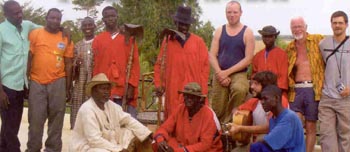
Mali is a region that has produced, in spite of extreme poverty, some of the greatest stars of modern African music: kori players Toumani Diabaté and Mory Kanté; charismatic singers Salif Keita, Oumou Sangaré and Kasse Mady, or bluesman Ali Farka Touré. These artists have brought Malian music to the attention of a global audience, but there are still many who have never been outside their village, and who play their music and sing their songs simply because they have to - because it has for centuries been part of their lives, for weddings and for funerals, in joy and sorrow.
Some families have been musicians or great singers through many generations, and some are said to treat their craft with some secrecy, not being interested in sharing their knowledge. What Fessor and his friends encountered in Mali, however, told a different story.
The result of the trip is an album ‘Fessor In Africa’ recorded at Moussa Diallo’s residence in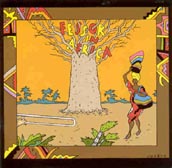 Koulikoro, Mali in December 2005. The Danish musicians play with Diawoyue Kouyaté (tamambar), Boulacor Kouyaté (ngoni), Vieux Kouyaté (dun dun), Fousseni Kouyaté (yimbe), Bakary Kouyaté (tamani), Mallamine Kouyaté (tamani), Yoro Sidibe (doso ngoni), Abdoulaye Traore (doso ngoni), Vieux Dao (dege), Idrissa Sangare (kusuba), Cheich Oumar Diakite (doso ngoni), Mouktar Koulbale (ballofon) and Badia Diabate (tamani).
In the album’s sleeve notes, Thorbjørn Sjøgren says: “Is it jazz, the? Frankly I couldn’t care less. Some years back I was talking to Irish piper Paddy Moloney about a project of his involving traditional as well as rock musicians, including the Rolling Stones. Molony said: ‘Some of the songs, it wasn’t too easy to put an end to them. The lads were doing all sorts of twists, and when we finished, Keith Richards turned to me, laughing, and said: “Well, you know, Paddy, in the end music is music …”
In 2009, Fessor continues to move on to new projects. He has just finished a recording session with ‘Fessor and His New Generation Band’. He says: “Most of the musicians could be my grandchildren, but WOW how they can play, and they have big respect for older jazz too, nice.”
You will find Fessor’s website at www.fessor.com with the option to translate it.
© Courtesy of Fessor Lindgreen and Thorbjorn Sjogren 2009.
© Photographs: Hanne Nyboe and Marcia Coleman. Album cover design by John Ovesen