
[Your computer might ask you to allow the music to play on this page]
Tony Milliner |
Anthony George Milliner was born in Paddington, London on 28th December 1929. His parents were both musical, his mother was an exceptional pianist and his father was a drummer and tap dancer. Tony’s mother was only able to read from music, but that didn’t stop her being able to interpret a range of different musical styles very effectively. It is not surprising that Tony learnt to play the family piano by ear at a very early age. Tony’s parents played regularly in the London musical theatre orchestras for musical theatre productions that included ‘Me And My Girl’ and ‘No, No Nanette’.
 Tony’s father was a despatch rider for the National Fire Service, and when he died in a road accident, his mother also gave up her professional music career. But, music remained important to Tony, and it was when his mother eventually remarried and the family moved to Oxford that he started to listen to Jazz and was knocked out by the playing of trombonist Jack Teagarden.
In time, the family moved back to London where Tony’s stepfather opened three bakery shops in the Wood Green area.
© Photograph courtesy of Tony Milliner
By the time Tony was 25, he had begun learn the trombone. He joined up with a band called the High Curley Stompers who played in the Staines area, and started to make regular trips to London to sit in with the musicians and the bands that frequented Mac’s rehearsal Rooms opposite the Windmill Theatre in Great Windmill Street.
It was there one Saturday evening where he was invited to join Dave Carey’s band at a time when the band’s music was beginning to move away from Dixieland. Tony spent an enjoyable period with Dave Carey until one day in 1957, agent Jim Godbolt told him that Jeremy French had left the Fairweather-Brown band and that they were looking for a trombone player. Tony had long admired clarinettist Sandy and trumpeter Al’s music and so he approached them and became their trombonist for the next six years. This was a time when the Fairweather-Brown band was thriving and several albums came out including Al and Sandy (1959), Doctor McJazz (1960) and The Incredible McJazz (1962)
In 1957, Tony also recorded with trumpeter Al Fairweather on six tracks of a collection called Fairweather Friends that was released in 1958. The recording engineer was Joe Meek and the supervisor, Denis Preston. The line-up was Al Fairweather (trumpet), Red Price (tenor), Tony Coe (alto), Tony Milliner (trombone, bass trumpet), Al McPake (guitar), Stan Grieg (piano) Tim Mahn (bass) and Graham Burbidge (drums).
Here is Al Fairweather's composition Coe-Pilot from the album:
In 1963, Rock and Roll took its toll on the jazz scene and regular gigs became harder to find. Tony was struggling to make ends meet with a young family to support and a mortgage to pay, and in the end he had no choice but to look for steady employment elsewhere. Initially he took over the management of his stepfather’s bakery shops, but soon found that it was not for him, so he followed up an advertisement for a job with Grey’s Advertising Agency, a substantial American agency working in the advertising industry.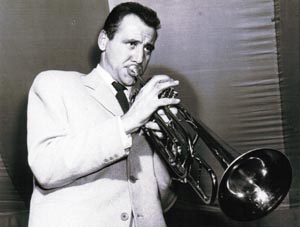
Tony was still able to play valve trombone and bass trumpet as a semi-professional, first with Tubby Hayes’ Rehearsal Band, and then sharing the leadership of a band with Alan Littlejohn at the Tally Ho pub in London. The two became good friends.
The Tony Milliner – Alan Littlejohn Sextet supported a number of visiting musicians including Dave Brubeck and Count Basie players.
Tony with his bass trumpet
© Photograph courtesy of Tony Milliner

L-R
Tony Milliner, Alan Littlejohn, Dave Brubeck, Earl Warren, Paul Desmond.
© Photograph courtesy of Tony Milliner
In 1975, Tony became a founder member of Stan Greig’s London Jazz Big Band. The London Jazz Big Band came together intermittently to play at the 100 Club in London’s Oxford Street, and played occasional gigs around the country until about 1982.
Tony was part of the backing bands for Earle Warren (Count Basie’s lead alto saxophone player), Peanuts Hucko and Bill Coleman on their visits to England. He remembered them as three great players, and particularly enjoyed working with Peanuts Hucko.

Top Row: L-R
Tony Milliner, Alan Littlejohn, Earl Warren, Paul Desmond, Lou Hooper
Bottom Row: L-R
Matt Mathewson, Pete Chapman, Mal Cutlan
© Photograph courtesy of Tony Milliner
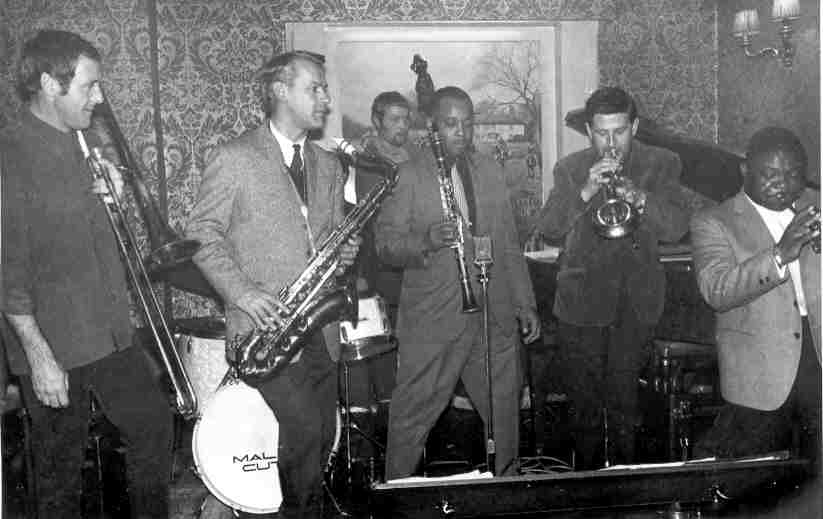
L-R:
Tony Milliner, Mal Cutlan (hidden), Lou Hooper, Dave Holland, Jimmy Hamilton, Matt Mattewson, Alan Littlejohn, Cat Anderson.
© Photograph courtesy of Tony Milliner
In the 1980’s, Tony went on to work with Alvin Roy’s band and with Alan Stuart’s Octet. Tenor sax player Alan Stuart had originally played as part of Tommy Steele’s Steelmen, and then took over Dennis Ogden’s Octet when Dennis left. The Octet included Alan West (piano), Phil Day (saxophone), Martin Drew (drums – Martin also played for Oscar Peterson), Alan and Tony.
Tony was also busy leading his own Mingus Music band, playing his arrangements of compositions by bassist Charles Mingus. The personnel of the band changed, but included Phil Day and Willie Garnett (saxophones), Henry Lowther (trumpet), Martin Guy (drums), Spike 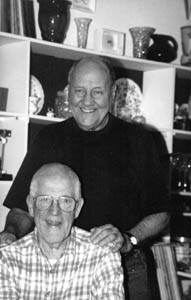 Healey (bass) and Tony on trombone.
At the end of the 1990’s - beginning of the 2000’s, Tony played with Willie Garnett’s Big Band, until he finally stopped playing, handing his Mingus compositions to Willie so that the band could keep them as part of their repertoire.
As the 2000s passed, Tony began to have trouble with his knees and legs that stopped him getting out as much as he used to, but he still enjoyed sharing jazz music and recollections from his formidable album collection. By 2015, he was more or less housebound and experiencing some confusion. His health deteriorated and in March 2015 he was admitted to hospital, eventually being discharged to a nursing home.
Tony passed away on the 3rd August 2015, his funeral was held on 19th August at 3.30 pm at Enfield Crematorium.
Tony with Stan Greig in 2001.
© Photograph courtesy of Ian Maund
Tony Milliner admires many of the classic trombone players in jazz history - J.J. Johnson, Kai Winding, Frank Rosolino, Bob Brookmeyer - but his favourite has always been Jack Teagarden.
Tony's own abilities should never be underestimated. Listen to his superb tone and fine and sensitive playing on:
‘Wednesday Night Prayer Meeting’ on The Incredible McJazz album (Lake Records CD LACD 229);‘Monsoon’ from the Dr McJazz album, or his backing to Belle Gonzalez’s vocal on ‘Monday’ from the same album (Lake Records CD LACD 211);
‘September In The Rain’ from the Al Fairweather album Fairweather Friends (Not currently available - although previously released as a compilation CD Fairweather Friends - Made To Measure by Lake Records) with Al, Red Price, Tony Coe, Stan Greig, Tim Mahn and Graham Burbidge is also a joy.
As visitors to this website will know, until Tony became unwell he spent many hours with me sharing his favourite jazz tracks, many of which appeared on the site under the heading 'Tony Milliner's Favourites'. I shall miss the time I spent with him, his humour and his vast knowledge of the music. If you would like to share your memories of Tony on this page, please contact me.
Ian Maund
Martin Guy: Sad news. Played many gigs with his sextet and elsewhere. The first pro to give me encouragement when I watched him at the Fishmongers Arms in Wood Green with the Al Fairweather & Sandy Brown band.
Pete Neighbour: How sad. I worked with Tony a few times over the years. Nice guy. RIP Tony.
Terry Cox: He and I were the tea-brigade in Sandy & Al's band which was almost impossible. We became life-long friends so I'm really gutted. He was a great human being and will be sadly missed.
Harry Davison: Sorry to hear the sad news. R.I.P Tony.
Louis Lince: R.I.P. Tony Milliner.
Rolf Junker: Very sad. R.I.P. Tony
Alan Rushton: Sad news. RIP Tony Milliner a nice guy with a lovely sound.
Rainer Strässle: I am sorry for! I wish you much strength and many friends!
John Codd: I was very upset to hear of Tony Milliner’s passing. I really enjoyed knowing him, and being in the Dave Carey band with him. The band made two CD’s with him on trombone so I have something to remember him by. My memories of Tony are that he was a very nice person to know, always helpful, and an excellent musician, I have only just found out how good he was, playing with some of the finest musicians in the world, he never spoke about this. Tony was a great person to have in The Dave Carey Band, and he helped the band, and myself. I have changed from trumpet to Trombone and Flugelhorn so I will be listening to Tony’s recorded solos.
Alvin Roy, a good friend of Tony's sent this composition by Alvin originally called Blues For Jimmy G and then renamed Blues For Sandy in memory of Sandy Brown. Alvin and Tony are the front line with George Oag (guitar), Danny Padmore (bass), Roger Marsden (piano) and Alan Rushton (drums).
Blues For Sandy
(From Colin Widdison, Washington, U.S.A., May 2009)
"From time to time I try to convince my American friends that there is jazz outside the USA. I really got a kick from your site - the chart of musicians who have played with Sandy is amazing and will prove most convincing. One name gave me a real dose of nostalgia: Tony Milliner. He was the inspiration that made me take up trombone playing. I played in a big band while at university in London and in various big bands, orchestras and concert bands since moving to the USA in the mid 60s. I'm still playing dances and occasional band concerts.
I was a fan of the High Curley Stompers during my teenage years when Tony was playing with them. The band played at the White Hart in Hartley Whitney, near Camberley, Surrey and later at a church hall in Frimley, near another White Hart. The leader of the Stompers was Alan Roe (or Rowe), trumpet, who went on to play mainstream jazz at the Camberley Working men's Club. Has anyone heard of him? - I can find no mention of him anywhere on the internet."
(From Geoff Gullon)
'A gent called Colin Widdison living in Washington DC put (the above) footnote to a 2009 article about Tony Milliner regarding The High Curley Stompers and Alan Roe. The Stompers were the favourite band of my dad, who gave me an enduring love of Trad as well as his name, and who claimed that they had once sacked as a member Chas McDevitt of Nancy Whiskey and “Freight Train” skiffle fame. In any event, Alan was still blowing in the mid - 70’s. I went to several gigs of the Alan Roe Jazz 6 in this era - my mate Steve Barton’s dad Dave was the drummer and an ex High Curley Stomper, John Shoebridge, played trombone. Lost connection after that, I’m afraid.'
2013.4
Frank Daniels writes:
My memories of when the Al Fairweather/Sandy Brown Band were touring the jazz clubs of Britain in general, and Nottingham and Derby in particular, is really delving back into the dim and distant. I was only a young teen-ager at the time - about 17, as I recall.
I first met Tony Milliner in, I think, 1958 when I went to a concert at the Regent’s Hall (now long gone) in Nottingham and I was waiting in the foyer for a friend of mine to join me. I was quite early, and as I waited a man came into the foyer and waited alongside me. As there were only the two of us there we started to chat together and it turned out that I was waiting to become a member of the audience, but he was a member of the band and was waiting for the other band members to turn up. They had gone to the pub (I think), but he was a non-imbiber. I was quite excited to be talking to one of the members of the band which I had come to hear.
At that time there were two jazz organisations in Nottingham – the Jazz Club, and The Rhythm Club. I had been introduced to jazz at school by my music master, who had told me about the various jazz concerts at the Regent’s Hall, which were a Jazz Club production, and I and my friend had gone along to see the concert by Sandy Brown’s Jazz Band, as they were called in those days. Some weeks later, the band was playing in Nottingham again, this time at The Trent Bridge Inn, near the cricket ground, courtesy of the Rhythm Club. I went along that evening, where I once again spoke to Tony Milliner, who remembered me from the previous occasion.
As well as the concerts (which were gradually wound down), the Jazz Club also operated at a dance hall called The Dancing Slipper where The Fairweather/Brown All-Stars (as they were now known) were a very frequent and popular attraction. I saw them many times there, and it was there one evening that Tony asked me where the nearest telephone box was (no mobiles in those days). I told him, and said I’d walk there with him at the interval. As we went to the phone-box he said he had to phone a hotel, as the booking had been overlooked, so I said to him just book for the other five band members, as I could put one (him) up for the night. This we did and as I was still a teenager living at home with my parents, they were most surprised the next morning to find a stranger in the spare room. This happened on a few more occasions.
On one of the band’s visits to Nottingham, they were playing at The Dancing Slipper on the Saturday night, and on the Friday night previous they were playing in Derby, at the Trocodero, I think it was. Now that week, my parents were on holiday and had gone away. I went to Derby, about 16 miles from Nottingham, but only about 11 miles from where I lived between Nottingham and Derby. When I saw the band, I asked where were they staying that night, as they were playing in Nottingham the next night? I was told they had booked a hotel for the night, so I said if you can cancel it I  can put you all up at home, as my parents and brother are all away for a few days. That night, we all went back to my (parents’) house and spent the night there. Lots of records played into the very early hours!
The site of the Dancing Slipper
The P.A. at the Jazz Club was done by a man who lived not far from me called Alan Gilmour, who also recorded every session on to reel-to-reel tape. He was a very friendly man, who would sometimes let people borrow some of his tapes. I borrowed most of the ones I was interested in and I well remember a tape of one Dancing Slipper session with a terrific version of Splanky with a tremendous solo from Tony. As you may know, Alan Gilmour passed away a few years ago, and his widow, Ivy, passed his tapes on to Paul Adams at Lake Records who has issued some of them on CD, but so far none of the Fairweather/Brown tapes. Perhaps they had already been played to death. (Click here for a version of Splanky by the Sandy Brown Quintet in 1966).
At about the same time as Tony left the Fairweather/Brown band, I left England to live for a time in Norway, and so lost touch with the jazz scene. On my return, as a married man, the scene had changed considerably, and I, obviously had different priorities, but I do try to collect records (CDs) to remind me of the old days.
I well remember when Radio 2 was the Light Programme and on a Saturday afternoon Sports Report was broadcast, the signature tune of which was Out Of The Blue by Alan Littlejohn’s Jazz Band.
I also remember when Peter Clayton used to introduce Jazz Record Requests on Radio 3. One time he had a request for Out Of The Blue and I am sure he said it was by The Tony Milliner – Alan Littlejohn Sextet. I have searched diligently but I cannot find such a record anywhere. It may be that my memory is faulty, it may be that Peter Clayton got the bands mixed up, but does anyone out there know of such a record?
2015.12
Patricia Adams writes from Ontario, Canada:
Thank you so much for the lovely article you wrote on my cousin Tony Milliner. Tony was nephew to my late father, Charles Milliner, and although we kept in touch over the years I never had the fortune to meet him in person on too many occasions as we lived in Bristol, followed by Bridgwater, Somerset. Then, in 1972, my husband and I and our two children emigrated to Canada where we have lived since then with my parents joining us in 1979, so meeting up with each other was even more difficult, and letters had to suffice.
My father was a great jazz fan and taught me to appreciate the music so I followed suit, although we both had a tendency to enjoy Traditional Jazz and perhaps some Mainstream far more than Modern, but we always loved to hear Tony play and well remember the time he came to Bristol to play at the Colston Hall. I still have my EP of the Fairweather – Brown All Stars EP record with my favourite track of “September in the Rain”, although have nothing to play it on, these days, unfortunately! (The tune is on the album Fairweather Friends new copies of which are not currently available but it is on a 3 x CD box set with September In The Rain amongst many other tracks here - Ed)
I remember times prior to Tony’s successful career, when Uncle Sid (Tony’s father) had a Bakery in Oxford and my parents, my brother and I went to spend Christmas with them – I was 9 years old - 3 years before the birth of my youngest brother. I was fascinated by the music and was sorely upset when I had to go to bed. There were so many people there who were family members and friends that many people had to sleep on the bread racks in the bakery! Something I have never forgotten. There was another houseful on another time when we went up to Lordship Lane, Wood Green for another Christmas. Lots of music and fun. Then, when Tony made a name for himself, we did not see so much of him as he was so busy, plus Mum and Dad had a Grocery Store in Whitehall, Bristol, to run, so time-outs for us were usually down to Weston, Weymouth or Lyme Regis, etc., and so the years rolled away.
This photograph is of Tony (left) with my Mum and Dad at Heathrow airport. As you can see there is a distinct family likeness! Dad was almost 11 years older than his nephew. This was taken in 1992.
We tried to get over to see Tony when in England, but he wasn’t well and so we only got to talk to him on the phone, as we did from here, although not as often as I would have liked.
Again, thank you, it was great to read about just how good he was – we always thought so, but of course, we were biased!
© Sandy Brown Jazz 2009 - 2016