Aotearoa Jazz by Howard Lawes |
The first recorded inhabitants of Aotearoa (New Zealand), the Māori, were people who arrived around 700 years ago from Hawaiki, a place that exists in culture and tradition but without a defined, physical location. Hawaiki is of great significance to the Māori, associated with the birth of children, the home of their ancestors and it is frequently commemorated in poems and song but they also believe that there were earlier inhabitants of Aotearoa (The Land of the Long White Cloud) who were created in nature, and that in turn instills in them a great reverence for the natural environment. The Māori have an extensive repertoire of poetry, song and dance, they 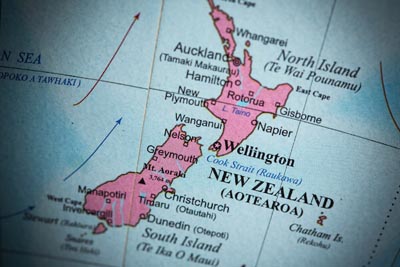 use waiata (song) in many contexts, waiata aroha are songs of love while waiata tangi are songs of mourning. As in many other languages, folk song is used to recall ancestors and battles; nursery rhymes are used to educate children and the Māori language (reo Māori) is no different.
The first recorded sighting of Aotearoa by Europeans was by the Dutch explorer Abel Tasman in 1642 but fierce skirmishes with the Māori were enough to discourage Tasman from further exploration, however, the discovery was recorded on nautical charts as 'Nieuwe Zeeland'. Over 100 years later in 1769, the British under James Cook came ashore at Poverty Bay and once again the Māori proved unfriendly but in time hostility subsided. The British, French and Russians all had designs on the new lands and in the first part of the 19th century colonisation began in earnest. Deals made with the Māori included trade in weapons leading to increased hostility both against settlers and between Māori tribes and resulting in a considerable decline in population due both to warfare and also introduced disease.
In 1840 the British reached a deal with representatives of the Māori and with the signing of the Treaty of Waitangi claimed sovereignty over the whole of New Zealand. The treaty was designed to protect both the colonists and the Māori, their landholdings, tradition and culture while giving ultimate control to the British. The interpretation and implementation of the Treaty has often been criticised; the Māori themselves, their language, traditions and culture have been marginalised and even today the treaty is not enshrined in New Zealand law, although in more recent times (The Treaty of Waitangi Act, 1975) there have been renewed efforts to enhance the lives of the Māori population through a tribunal process.
During the 20th century the number of Māori speakers steadily declined, but concern about the very existence of what remained of Māori culture became ever more forceful. In the 1960s and '70s courses were introduced at universities in Aukland and Wellington, organisations such as Nga Tamatoa (The Warriors) were formed to protect Māori rights, Ngā Puna Waihanga to protect Māori arts and Te Reo Māori Society (The Māori Language Society) sought to protect the language. In 1972 a petition was presented to the government calling for the re-introduction of Māori language teaching in schools and finally in 1987 Te Reo Māori was recognised as an official language of New Zealand. 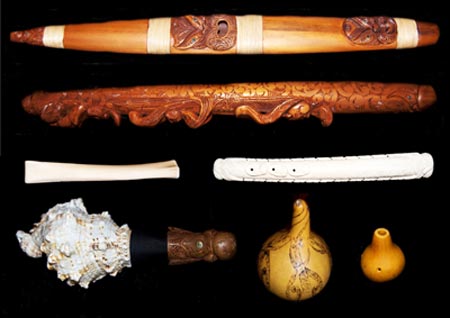 The Waitangi Tribunal (set up after the 1975 act) agreed that Te Reo Māori was a taonga (treasure) that should be preserved under the treaty. With language comes song and in 2022 the Waiata Anthems Week commemorates the 50th anniversary of the presentation of the petition.
taonga pūoro
As well as Māori song there is an impressive range of traditional Māori instruments which together are called taonga pūoro. Many of the instruments are wind instruments, intricately carved from wood or fashioned from shells but there are also stringed and percussion instruments. Some of those that sought to preserve this element of Māori heritage were Hirini Melbourne, Richard Nunns and Brian Flintoff. While Melbourne is of Māori descent both Nunns and Flintoff are 'pākehā', meaning of European descent. Hirini Melbourne was pivotal in the revival of the Mäori cultural inheritance, learning to play the instruments and teaching others about the culture and history of his people. Richard Nunns, of Scandinavian heritage, was born in New Zealand. He came from a brass, jazz, and improvised music background but his fascination with the taonga pūoro led to him become one of the foremost ethno-musicologists of his time. As a musician Nunns has released albums of Mäori music such as Te Ku Te Whe (1994) with Hirini Melbourne, and free improvisation (Rangirua, 2001) with British free jazz icon Evan Parker. Brian Flintoff is an acclaimed artist and sculptor who has helped revive the art of Mäori instrument making and has produced a book with CD called Taonga Puoro - Singing Treasures: The Musical Instruments Of The Maori.
Interesting and important as musical traditions are, Mäori musicians have not stood still. The annual Aotearoa Music Awards has a prize specifically for music of Mäori origin with the first award in 1994 going to Moana & The Moahunters with a song called AEIOU which might be categorised as 'Mäori funk' - here is a short video sample.
In 2004 Ruia won the prize with a reggae-style song called Hawaiki, while in 2008, Richard Nunns and Hirini Melbourne triumphed with Te Whaiao: Te Ku Te Whe Remixed which is a far more traditional waiata including sounds of the natural world.
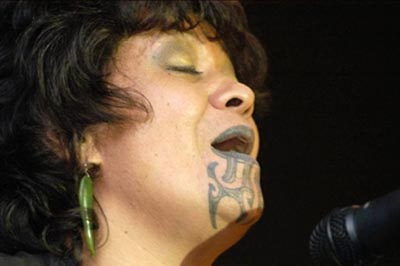
In 2008 the jazz award went to the Mäori jazz singer Whirimako Black for her album Sings (2007) which features eleven classic songs such as E Taku Tauaro (My Funny Valentine).
Whirimako Black
Here's a video of Whirimako Black singing E Taku Tauaro (My Funny Valentine)
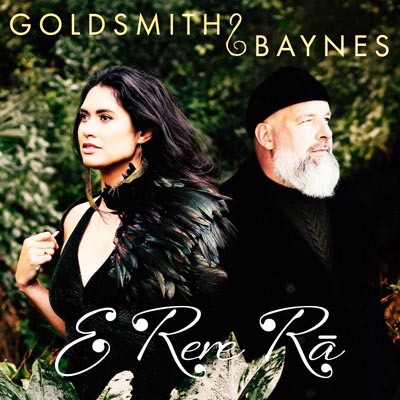
Whirimako Black has earned the accolade "New Zealand's first lady of jazz" and has been the inspiration for another Māori, a young, contemporary jazz artist from the Tairawhiti region, East Coast of the North Island of Aotearoa/NZ, called Allana Goldsmith, whose iwi (Māori tribes) are Ngati Porou and Ngai Tai. Allana has teamed up with British pianist Mark Baynes (calling themselves Goldsmith Baynes) to produce an album called E Rere Rā released via the Meow Jazz label. Also featured on the album are Hikurangi Schaverien-Kaa (drums), Alex Griffith (electric bass), Tom Dennison (bass), Riki Bennett (Taonga Puoro), Cameron Allen (saxophones), Jono Tan (trombone), Mike Booth (trumpet and horn arrangement) and Kim Paterson (flugelhorn and trumpet). Of the eleven tracks on the album, three have already been released as singles, one of which, Tipuna, was performed at Waiata Anthems 2021.
Listen to Kore Rawa from the album.
A further performance at the Aotearoa Music Awards resulted in funding from Te Mangai Paho (Māori Broadcsting Organisation) for a second track, and then Creative NZ provided funding for the rest of the album. The songs on the album are all original and sung in te reo, some of the titles hark back to Māori tradition such as Tipuna (Ancestors) and Te Aranga O Matariki (The Restoration of Matariki); Matariki is the Māori new year's day which has just been recognised with a public holiday; some tracks are just piano and vocals while others feature a larger jazz ensemble.
Listen to Te Aranga O Matariki (The Restoration of Matariki).
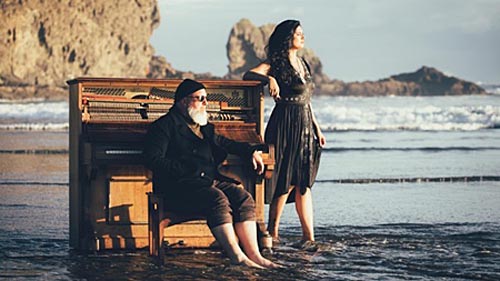
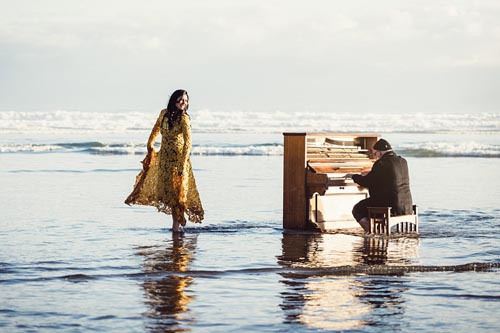
Neither Allana Goldsmith or Mark Baynes are well known in the UK and one might ask why, in their publicity photos, they have placed their piano in the sea or why sing songs in a language understood by only about 200,000 people?
But this is clearly a project from the heart, celebrating the fact that a race of people are gradually re-establishing their identity in their adopted land and that their language is something worth preserving. Modern Māoris are embracing other cultures as well as preserving their own, the songs on E Rere Rā may be waiata but the music is modern jazz with just a touch of taonga puoro.
Here is a video for Tō Ihu
Allana Goldsmith sings jazz beautifully and her recent concert at the Tauranga National Jazz Festival singing the songs of Ella Fitzgerald and Sarah Vaughan was sold out, Mark Baynes is an experienced pianist and arranger working in New Zealand. Goldsmith Baynes are a duo well worth a listen and certainly deserve a wider audience.
To finish, here is a short snatch from a video of Allana and Mark playing Lullaby Of Birdland from 2109 (not on the E Rere Rā album)
Click here for details and samples of the album E Rere Rā
Click here for Allana and Mark's website.
Other pages you might find of interest :
© Sandy Brown Jazz 2022
Click HERE to join our mailing list