[Some computers might ask you to allow the music to play on this page]
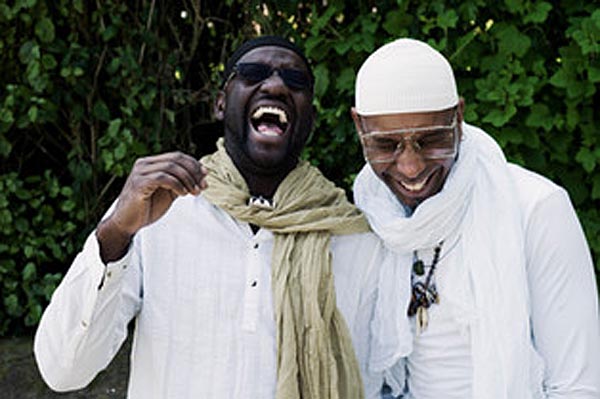
Omar Sosa and Seckou Keita by Robin Kidson
|
The rich blend of Europe and Africa which is Cuban music received a huge boost with the increasing popularity of “world” music from the 1980s onward. Now, Cuban musicians are internationally known. One of the most prolific is seven times Grammy nominated jazz pianist, Omar Sosa. Despite living in many different parts of the world, he has stayed close to his Cuban roots. He has had a particular interest in exploring the African origins of both Cuban music and Cuban culture more generally. “I’m Cuban”, he says, “born in Cuba, but for me, Cuba is another province of Africa. And the backbone to all my music over all these years, and I’ve released over 30 records, is Africa”.
Omar Sosa’s absorption in Africa extends to matters spiritual – he is, for example, a practitioner of the Afro-Cuban religion known as Santería which has a pantheon of saints known as orishas. Sosa wears white in his performances in honour of his own particular patron orisha known as Obatala.
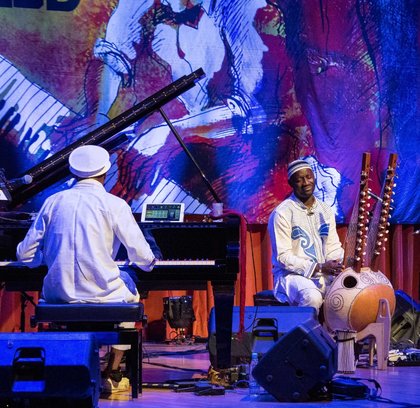
In 2012, Sosa was invited to perform in London with the Senegalese kora player, Seckou Keita. “Seckou arrived just before the gig, took out his kora and started playing”, Sosa recalls, “and I clicked with him like we had been playing together all our lives”. The two musicians began collaborating and in 2017, released an acclaimed album together, Transparent Water. They also toured all over the 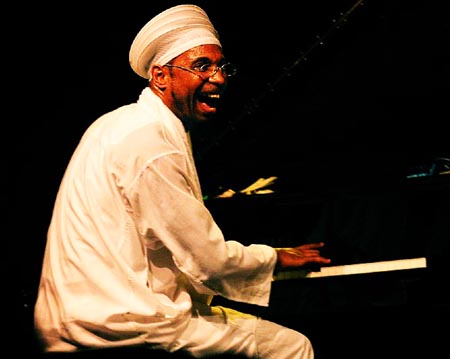 world, chalking up some 85 gigs since 2017. In 2020, during the enforced worldwide Covid lockdown, they wrote and recorded their second album. It’s called Suba and is due to be released on the bendigedig label on 22nd October 2021.
Omar Sosa
“The project”, says Sosa, “is Africa done our way”. His own sense of Africa comes via Cuba but Seckou Keita’s experience is much more direct. He was born in Senegal, heir to a dynasty of bards and kora players. The kora is a 21 string lute with a harp like sound and Keita started learning the instrument at the age of seven taught by his grandfather and kora maestro, Jali Kemo Cissohko. African music may have been the basis of the world’s popular music through its influence on jazz, blues, rock etc, but the actual music played in Africa was largely unknown outside the continent until the 1980s. Since then, African music has become hugely popular and musicians like Seckou Keita play all over the world. Keita came to live in the UK in 1999, aged 21. He has built an enviable reputation since, culminating in him becoming BBC Radio 2 Folk Musician of the Year in 2019. As well as his collaborations with Omar Sosa, he has also worked with artists from many other different traditions including Welsh harpist, Catrin Finch.
The new album, Suba, has eleven tracks all written by Sosa and Keita working together. The title means “sunrise” in Mandinka, Seckou Keita’s native language. Sunrise is his favourite time of the day: “even if you’re facing certain difficulties”, he says, “you reset your brain back to normal. You see that sunrise as a new day, a new peace, a new something, good or bad. An exciting something. That was the feeling I had when I was writing”. For Omar Sosa, “the concept of the record is peace, hope and unity. In this moment we’re living, when everything’s falling apart little by little, the last thing we have inside ourselves is a scared connection with our inner voice, with our spirit and light and with our ancestors. We try to give hope through music and tell people that we can be together”.
Omar Sosa plays piano, synths and percussion on the record as well as providing backing vocals. Seckou Keita plays kora, percussion and takes the lead vocal. They are joined by Venezuelan percussionist Gustavo Ovalles. This basic trio is augmented by three other musicians on some of the tracks: Brazilian cellist Jaques Morelenbaum, Dramane Dembélé from Burkina Faso on flute, and British percussionist Steve Argüelles who also contributes “modular effects”.
Much of the album was written in the summer of 2020 on the island of Menorca and then recorded at a studio in Germany. A short film has been made about how the album came into being:
There are some common themes running through the album. One of them is friendship and the joys of collaboration. The first track of the album, for example, is called Kharit which means “friend” in Wolof. “I was inspired to write the song”, says Seckou Keita, “by the many facets of friendship I have in my life….Actually, the real meaning of kharit is ‘my other half’ or ‘the half cut from me’. Khar means something you’ve cut, or that has been cut from you. You can’t buy that. It can only happen naturally”.
Kharit establishes some of the notable features of Suba: Keita’s warm, expressive voice; the way in which piano and kora meld beautifully together; the rhythms, sometimes very subtle but always compelling; and the memorable tunes. Kharit begins as a gentle lilt then changes into something slightly more foot-tappingly jazzy driven by Keita’s talking drum. Here is a studio performance of Kharit.
In line with its title, another thread running through the album is the sun and its meaning. Drops of Sunrise exemplifies this theme – “In this song”, explains Keita, “I’m evoking, generally or particularly, a hope sunrise, because Suba is a hope album. The album started like that, imagining a sunrise. I’m a morning person. You wake up and whatever you have dreamt, you see the sunrise and 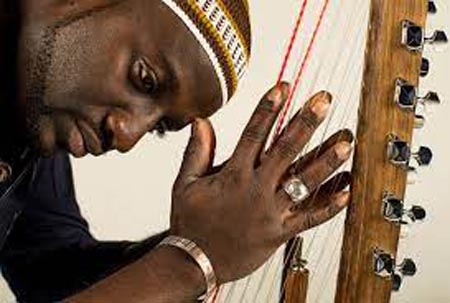 hope that the day is going to carry a bright future. Suba also means tomorrow, what it’s going to give us after this strange 18 month period of pandemic life is over”. Although the song is sung in Wolof and Mandinka, it feels more like a piece of sophisticated latin jazz with a strong latin, almost pop song, beat. It is, none the less, a satisfying and memorable piece of music, successfully blending together its constituent parts.
Seckou Keita
A third motif which features strongly in Suba is water, particularly the sea. Voices On The Sea, for example, is a marvellous evocation of the element. It begins with an attractive repeating pattern with the sound of voices (children?) in the distant background. Various percussion effects mimic the actions of the sea – waves washing against the shore, water lapping against boats and rocks. Steve Argüelles contributes some strikingly imaginative “water percussion”. Dramane Dembélé’s flute captures the reflective mood and also some of the voices associated with the sea including slaves being shipped from Africa as well as migrants setting off to a new life.
Migration, whether forced or voluntary, also underlies Floating Boat which is a wistful piece full of longing with, again, percussion by Argüelles and Ovalles strongly suggesting boats bobbing on the sea. The cello of Jaques Morelenbaum adds another melancholic 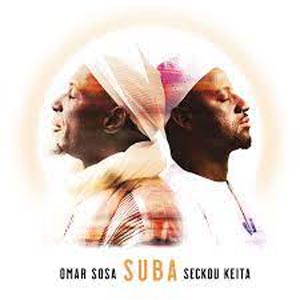 dimension. “Looking at the movement of the water”, says Keita, “there’s sadness but it’s relaxing, the beautiful mind of it”. Sosa adds “In a way, this is what we live today: it’s a sadness but with optimism and hope”.
That note of melancholy and nostalgia also comes through on other tracks, particularly those with Morelenbaum’s richly lyrical cello. On Korason, for example, and No One Knows, the cello perfectly captures a deep mood of wistful longing. These sadder pieces may seem strange for a “hope album” but moods of melancholy and nostalgia can be cathartic, releasing positive feelings of joy in the present and, yes, hope for the future – “sadness but with optimism and hope”. That sentiment comes through on Rei’s Ray which Omar Sosa wrote in memory of Cuban flute player, Reynaldo Perez Cruz. It is slow and sombre but is played against a compelling, even joyful, beat. Dramane Dembélé’s flute work here is heartfelt and passionate, sounding like birds crying out. The piece is “like a cry without a cry”, says Sosa, “not a cry for sadness, but a cry for how the spirit is gonna be elevated”.
Perhaps Suba’s most dominant mood, however, is its strong sense of spirituality. “The one thing that Africa can teach us”, says Omar Sosa, “is the spirituality in every living thing. We need to listen to the ancestors. We need to be clean enough inside of ourselves to listen to their voices. But we are often slaves to our crazy and humiliating society, where everyone needs to be ‘successful’”. On Allah Léno, Sekou Keita sings: “So in case you don’t see me again, know that it’s God’s will. And if you do see me, that’s God’s will too”. The God in question can be Allah or the Supreme God of the Santería pantheon. The tune is, once again, memorable with a head--nodding latin beat. Omar Sosa’s piano is particularly distinctive here with some complex, asymmetric playing which jaggedly but effectively fits itself neatly into the rhythm. Sosa and Keita first played Allah Léno back in 2017 and it quickly became a crowd favourite. Here is a live studio performance.
The most jazz oriented track on the album also has a religious significance. 2020 Visions is an upbeat number which Seckou Keita wrote during lockdown in the UK. When he first heard it played through, Sosa said, “Oh man! You’re going jazz!”. Keita’s response was, “the world is jazzy at the minute, so I’m following the world”. The piece is driven forward by the batá drum which is much used in the rites of the Santería religion. The number 2020 also has an arcane significance to Santería followers.
Religious ritual from a more directly African tradition underlies another upbeat number, Gniri Balma. Gniri means “dance” in the language of the Balanta people of Senegal, and Balma means “balaphon”. The piece is about an odd one-legged dance performed in the circumcision rituals of the Balanta. “The man-dance has come”, sings Keita, “If you can’t move your leg, you can use your hands; if you can’t use your hands, your heart can dance”.
Sun, sea, migration, religion, circumcision rituals….there’s a lot going on with Suba with a rich tapestry of underlying meaning. In the end, though, what matters to the listener is what’s heard, not what’s read. And what you hear on Suba is superb music, absorbing and wonderfully satisfying, yet accessible to most if not all musical tastes. The music also stirs images in the brain: people dancing, boats at anchor, sunrise in warm climes…. Omar Sosa and Seckou Keita are brilliant at giving musical expression to mood, place and image. Suba is a convincing argument for the proposition that the most interesting music around at the minute arises from collaborations between different musical traditions.
For a taste of what Omar Sosa and Seckou Keita are like playing live together, here is a video of them performing Dary, a track from Transparent Water, in Japan in 2017.
You can see and hear them in the flesh as they are touring the UK this November. Dates include:
17 November: Howard Assembly Rooms, Leeds
18 November: SJE Arts, Oxford
19 November: EFG London Jazz Festival, Queen Elizabeth Hall
20 November: Galeri, Caernarfon
21 November: Stoller Hall, Manchester
22 November: Liverpool Philharmonic Music Room, Liverpool
23 November: The Apex, Bury St Edmunds
24 November: Lakeside Arts, Nottingham
25 November: St. Georges, Bristol
26 November: Theatr Mwldan, Cardigan
27 November: Taliesin, Swansea
For further details of Omar Sosa and Seckou Keita, go to their websites at: https://omarsosa.com/ and https://www.seckoukeita.com/
Finally, for information on how to get hold of Suba, click here.
Other pages you might find of interest :
© Sandy Brown Jazz 2021
Click HERE to join our mailing list