
© Picture courtesy of Alvin Roy
Alvin Roy was born in Jerusalem in 1940, the son of Albert and Annette Roy. His father had emigrated from England to join the Palestine police and during the war became chief fire officer of Jerusalem. Alvin went to a Catholic convent kindergarden, which probably accounts for his atheist leanings today. In 1948, when the state of Israel came into being, the family, which included his brother Robin, settled in Wood Green, north London.
Alvin attended Glendale Grammar School and in 1958 clarinet lessons were introduced as an after school activity. This happened around the time he listened to his first jazz record, fell in love with sound of the clarinet and pestered his mother to buy him one. However, after three lessons he was thrown out of class for playing a blues, which in those days was considered taboo in a classical lesson. Six months later he joined a Trad band that rehearsed every week in a church hall in the Balls Pond Road. They never appeared in public, which, because of the appalling low standard, was probably no bad thing.
Leaving school in 1959, Alvin joined Rank Records as jazz repertoire planner and worked alongside Dick Rowe (who later on, famously turned down the Beatles when he was with Decca records) and Tony Hatch the songwriter.
By 1960, Alvin was leading his own Traditional Jazz band in London and it was when they won the Soho Jazz Contest that year, that Alvin decided to play professionally.
His Saratoga Jazz band, recorded for the Ember, Decca and Riverside labe ls and began to be booked at many of the jazz venues up and down the country during the 1960’s Trad boom. These included the Marquee, the Cavern Club, the Dancing Slipper, Wood Green jazz club and numerous dancehalls, including a season at the Mecca Royal Ballroom in Tottenham. Appearing in front of royalty at the Victoria Palace theatre, trips to the German jazz clubs followed and it was during this time that the band’s single, ‘True Blue’, reached the Japanese top 20. In 1963 the band did a season at Butlin’s followed by a trip to Spain and on returning to the UK they found that the Trad jazz boom bubble had burst.
Of ‘True Blue’, the Melody Maker magazine’s review said:
'The Alvin Roy Band’s single True Blue, which has reached the Top Twenty in Japan, should ensure that they have a long career in the music business. The infectious sound created by the band had my feet tapping and I couldn’t get the tune out of my head for hours after hearing the record.’
Disillusioned with the scene, Alvin broke up the band, stopped playing and joined EMI in their Artistes Promotion division. However, in 1968 he was asked to join a semi-pro band which rekindled his interest in playing. He reformed his band with some of the original members and in 1971 started an 8 yea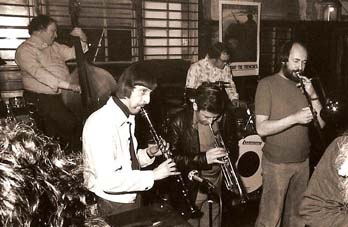 r residency at the Prospect of Whitby in Wapping, London.
The Alvin Roy Band at the Prospect of Whitby.
Nobby Williams (double bass), Alvin Roy (clarinet), Alan Littlejohn (trumpet),
Martin Guy (drums), Boots Baker (trombone)
© Picture courtesy of Nick Littlejohns
During this period, the style of the band changed as banjo was replaced by guitar and a piano was added. Several personnel changes saw Alan Littlejohn, Ray Crane and Tony Milliner playing with the band and in 1980 Alvin made the first of many broadcasts on the BBC Radio 2 ‘Jazz Club’ series. His last broadcast featured Acker Bilk as a guest with the band before the programme was taken off the air.
One reviewer wrote for Crescendo magazine:
‘Radio 2’s Jazz Club featured the first appearance of the Alvin Roy Band who proceeded to play a mixture of blues and standards during their set. Their accomplished line-up of Trumpet, Trombone, Clarinet, Piano, Bass and drums would lend one to think that the outfit would be the usual standard Dixieland set-up, playing the same old tunes in the same old way. However this preconception was soon dispelled when they launched into Miles Davis’s ‘So What’ as their opening number. They continued with a mixture of standards like ‘Summertime’ and ‘Green Dolphin Street’ and over the period of the broadcast showed that the standard of British jazz was not lacking in flair and inventiveness …’.
In the year 2000, Alvin moved away from London to Carterton in Oxfordshire, and continues to play regularly with his band ‘Reeds Unlimited’. In 2007 they played at the Witney Jazz Festival with visiting American jazz legend Scott Hamilton and in 2008, with Bob Wilbur. In addition to ‘Reeds Unlimited’, Alvin leads a variety of combos playing a range of music from New Orleans/Dixieland jazz to a more modern swing/mainstream style featuring standards from the great American song book and composers such as Berlin, Porter, Ellington and Gershwin.
One newspaper review said: ‘It was refreshing to encounter Alvin Roy’s clarinet-featured combo who played a mixture of mainstream, middle of the road type jazz with a few modern selections thrown in for good measure. His clarinet solos, smooth, dark and often liquid, were devoid of the excess of vibrato so often heard in more trad-type settings’.

In January 2007, Alvin released his latest album ‘Hedonism’, and you can hear a sample track by clicking here . The album features Alvin on clarinet, Roger Barnes (piano), Pete Billington (bass) and Mark Doffman (drums) playing ten tracks that include Autumn Leaves, Come Sunday, Moonglow, Just Friends, Like Someone In Love and Alvin’s composition Blues For Sandy a tribute to Sandy Brown..
Alvin was impressed by Sandy Brown’s clarinet playing: ‘Sandy was a great influence on me – I remember seeing the Sandy Brown / Al Fairweather band at Wood Green Jazz Club, not realising that years later I’d play with Sandy and have Tony Milliner in my band’.
There are also a number of Alvin’s own compositions on the album including 'Isis Blues' and 'Hedonism'.
John Martin wrote in Jazz Rag: ‘Roy … is a passionate player with a full and resonate tone with ideas that are fluent and often quirky. This is honest straightahead jazz by musicians who have no other agenda’.
Reviewing the album, Tony Augarde said:
As the former leader of a trad band, you might expect Alvin to play Dixieland numbers like ‘The Saints’ or ‘Bill Bailey’ but his repertoire is more modern and varied, embracing jazz standards, Ellingtonia, show tunes and original compositions … ‘Isis Blues’ is an easygoing swinger, and ‘Hedonism’ is a bouncy bossa nova with an attractive melody.
Alvin Roy has a pleasant clarinet sound, staying mainly in the middle register … At his mellowest, as in the sensitive performance of Duke Ellington’s ‘Come Sunday’, he may remind the listener of Acker Bilk’s liquid tone…
The rather lurid album cover may create the wrong impression with its phallic overtones, as this is actually a CD of accessible, swinging jazz’.
(Click here for the full review).
There are several video clips of Alvin’s band recorded at the 100 Club in 1985, when he celebrated 25 years as a bandleader and among the guests shown are Digby Fairweather, Alan Littlejohn and Mick Hutton. From 1986 at the 100 Club you can watch 'Beale Street Blues', and 'Stomping At the Savoy' with Digby Fairweather on trumpet.
You can view a number of Alvin's other performances with musicians such as Alan Littlejohn, George Oag, Matt Matthewson, and including 'Blues For Sandy' by clicking here
There is a nice video of Autumn Leaves played by Alvin Rpy's Reeds Unlimited on YouTube (click here). This was recorded on 28th April at the Ampleforth Arms, Oxford with Alvin on clarinet, Mike Wills (saxophones), Geoff Barwell (piano) and Stuart Holbrook (bass).
Alvin's Quartet played at the Oxford Jazz Festival in 2010. Click here for a video of Mood Indigo with Alvin on clarinet, Martin Pickett (piano), Steve Smith (bass) and Frank Hockney (drums).
You can also visit Alvin's own website at www.alvinroyjazz.co.uk
2010 - Alvin writes on hearing of the death of Monty Sunshine:
'I was sad to hear about the passing of Monty, who, unknown to him, was the
inspiration of me taking up the clarinet. I heard my first jazz record while
I was at 6th form college and it happened to be a Chris Barber recording of Creole Love Call and I fell in love with the sound of the clarinet and
pestered my mother to buy me one. Monty's tone on the instrument fascinated
me, with its pure, almost cloying sound and I wanted, in vain, to reproduce
that in my own playing.'
fell in love with the sound of the clarinet and
pestered my mother to buy me one. Monty's tone on the instrument fascinated
me, with its pure, almost cloying sound and I wanted, in vain, to reproduce
that in my own playing.'
'As the years went by I listened to many different players and many different instruments and like most musicians, tried to absorb the sounds and styles of the greats but Monty was the first player to inspire me and for that I'm grateful to him.'
'The photo was taken at the Marquee Club, Oxford Street in about 1960 when I sat in with the Chris Barber band.'

2015 - Alvin writes: 'In the Forum section, Gary Capon was asking about the drummer Colin Seymour. Here is a link to a video from the100 club with Colin on drums. The late Alan Littlejohn (trumpet), Matt Mathewson (piano) and George Oag (guitar) are in the line up together with Digby Fairweather (trumpet) and Mick Hutton (bass) (click here). I would point out that Digby, myself, Mick Hutton and hopefully Colin Seymour are still around......in body, if not in spirit....it's the others who, sadly, are no longer with us.'
In July 2016, Alvin released an album with the Bullingdon Jazz Quartet. We reviewed it in our August issue of What's New:
Alvin Roy (clarinet), Alexander Hawkins (piano), Jez Cook (bass guitar on tracks 1,2 and 7), Roger Davis (bass on tracks 3,4,5,6 and 8), Charlie Stratford (drums).
These musicians play regularly with various bands at 'The Bully', the Bullingdon Arms in Oxford. For this album they got together at the SAE Studios in Littlemore, Oxford for a one-take session recording 8 tracks of 'Standards'. The SAE Institute was founded in 1976 and has since grown to become the world’s largest, industry-focussed creative media educator with 54 campuses in 26 countries. The studios are a 'state-of-the-art' education facility and the recording was undertaken by students at the Institute. There are occasional problems with the mixing, but overall, this is a relaxed, straight ahead album.
It feels like the band is warming up as Van Heusen's It Could Happen To You opens the set and they are more settled as they move into an enjoyable take on the traditional C.C. Rider with a nice opening from Alexander Hawkins before Alvin Roy states the tune. Alvin has a lovely clarinet tone, honed over years of playing with his various bands through which have passed many UK musicians including Alan Littlejohn, Ray Crane and Tony Milliner. His playing is imaginative, across the register with trills and flourishes and the occasional reference to other tunes.
Alvin Roy
Stella By Starlight follows and then a slow version of I Got It Bad (And That Ain't Good) with a nice solo from Alexander Hawkins who in 2016 was awarded 'Jazz Instrumentalist Of The Year' at the Parliamentary Jazz Awards. I hadn't realised before how similar the opening  of the latin flavoured Sombrero Sam is to The Beatles' Can't Buy Me Love. Alexander Hawkins has mainly played to the setting of the session but here he gets low down and dirty in a steady, driving solo. Click here to listen to Sombrero Sam.
Alexander Hawkins
The music slows again for Jerome Kern's Yesterdays before moving into I Cover The Waterfront (on the liner notes it says 'I Covered The Waterfront' but then I guess Alvin Roy has played it a few times!). The album closes as the band comes out with Alexander Hawkins leading them into a swinging version of Oscar Pettiford's Blues In The Closet.
The liner note says that the band 'got together to record these tracks just for the fun of it ... I hope you will enjoy listening (to the numbers) as much as the musicians enjoyed recording them.' This is a recording that doesn't set out to be a Top Ten 'dazzler', but if you like your jazz laid back and uncomplicated, this could suit you. It will probably suit the customers at The Bully in between bands.
Click here for details.
© Sandy Brown Jazz